(Or: How to Walk in the Footsteps of Hannibal, Wander Through 1,000 Years of History, and Sip Mint Tea in a Village That Looks Like a Painting)
Tunis in One Day (Quick Plan)
Best order: Carthage → Medina → Sidi Bou Said
Time: 8–10 hours (full day, but a good one)
Getting around: TGM train + short taxis
Budget (rough): €25–€60 per person (transport, entry tickets, food)
Small things that save your mood: download offline maps + carry cash for snacks/tickets
Carthage: The Rise and Fall of Africa’s Greatest Ancient City
Why Carthage Matters
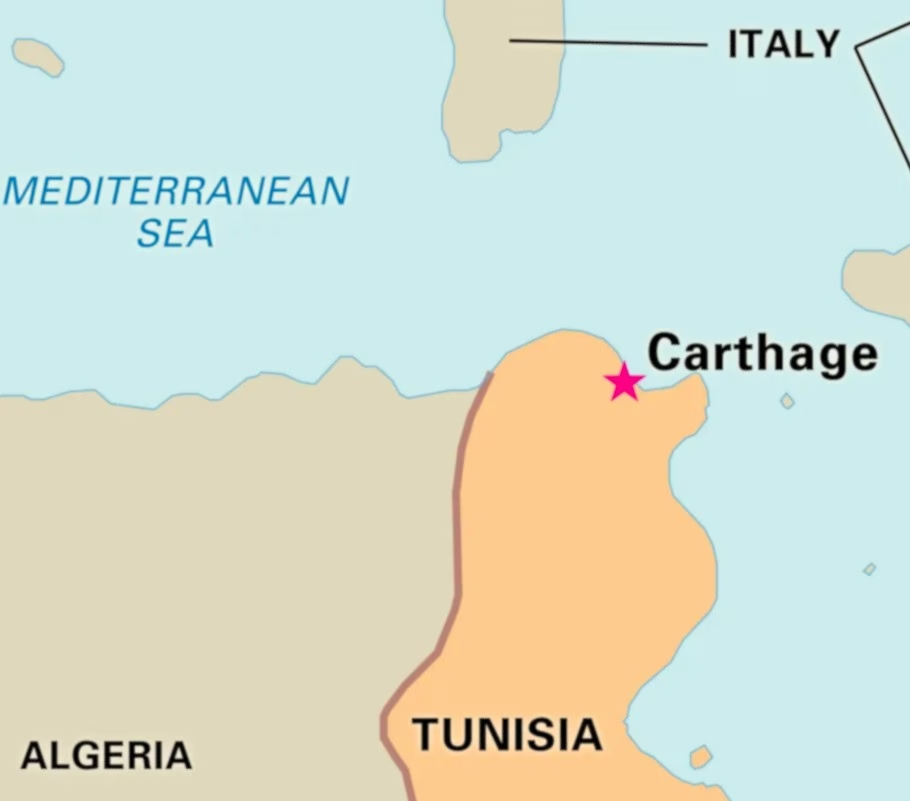
Phoenician settlers founded Carthage in the 9th century BCE. It grew into the wealthiest and most powerful city in the ancient Mediterranean, until Rome destroyed it in the Punic Wars. Today the ruins are a UNESCO World Heritage Site. A place that was once glorious, then gone.
One thing worth knowing: Carthage’s general Hannibal crossed the Alps with elephants to attack Rome. It did not end well for him.
How to Get to Carthage
Location: 15 km northeast of Tunis, about 20 minutes by car.
Taxi: Around €10 from Tunis.
Train (TGM): From Tunis Marine to Carthage-Hannibal station. 15 minutes, ~ €0.50.
Tour: Half-day tours from Tunis run around €30.
What to See in Carthage
1. Byrsa Hill
This was the heart of ancient Carthage. Climb it and you get panoramic views over the ruins and the Gulf of Tunis. While you’re up there, visit the Carthage Museum (~ €5). It holds Punic masks, Roman mosaics and enough context to make the ruins actually make sense.
2. The Punic Ports
These harbors made Carthage a superpower. The circular one was for warships. Hannibal’s fleet sailed from here. The commercial port handled traders from across the Mediterranean. After Rome destroyed Carthage, they copied the port design. That tells you everything.
3. The Roman Ruins
Rome razed Carthage in 146 BCE, then rebuilt it as a Roman city. The Antonine Baths are massive, second only to the Baths of Caracalla in Rome. Walk through the Roman Villas too. The mosaics are still intact.
4. The Tophet
A sacred site often linked to the most contested part of Carthaginian history. Some sources claim children were sacrificed here to Ba’al Hammon; others argue the remains point to a cemetery and symbolic burials. Either way, it’s a heavy place, worth visiting if you’re up for it, and easy to skip if you’re not. Reading up on the debate beforehand changes what you notice once you’re there.
Where to Eat Near Carthage
Restaurant Le Golfe: Seafood with views of the Gulf of Tunis. Order the grilled octopus.
Café des Délices: Casual, good Tunisian salads and fresh juice.
Carthage and Sidi Bou Said are close to each other. Combine them in one day and you will not regret it. Carthage is quieter than people expect, which is exactly why it works.
The Medina of Tunis: A Walking Tour Through 1,000 Years of History
Why the Medina Matters
The Medina of Tunis is a UNESCO-listed maze of narrow streets, mosques and souks that date back to the 8th century. Arabs, Berbers, Andalusians and Ottomans all left their mark here. You can feel it in the architecture, the smells, the way the light falls through the alleyways. At one point this was a center of Islamic intellectual life. Scholars and poets came from across the world. That history is still in the walls.
How to Get to the Medina
Metro: Place de Barcelone station, Line 4.
Taxi: Around ~ €3 from anywhere in Tunis.
Hire a guide for around €15 or download Google Maps offline. The alleys are genuinely confusing and that is part of the charm, but a guide saves time.
What to See in the Medina
1. The Zitouna Mosque
Built in 732 AD, this is the second largest mosque in Tunisia. The courtyard has marble columns and geometric tiles. If the minaret is open to non-Muslims, climb it. The view over the medina is worth it. Dress modestly, cover shoulders and knees. This should actually be a no-brainer.
2. The Souks
This is where Tunis comes alive. Spices, textiles, copper… everywhere you look. Go in the morning when it is less crowded.
Souk El Attarine: Perfumes and essences. Stop and smell the amber and oud.
Souk des Chéchias: Traditional red felt hats. They have been made here for centuries.
Souk des Orfèvres: Gold and silver jewelry. Haggle. Start at half the asking price.
3. Dar Ben Abdallah
An 18th-century palace turned museum. It shows you how Tunisian elites actually lived, mosaics, fountains, lavish tiles in the harem quarters. Entry is ~ €3 and worth every cent.
4. The Al-Zaytuna Madrasa
A 17th-century Islamic school that still functions as a center of learning. The library holds ancient manuscripts on science and philosophy. Ask to see the roof. The view over the medina is one of the better ones you will find.
5. The Hidden Courtyards
Behind unmarked doors, tucked away from the crowds, you find these quiet courtyards. Dar Lasram is a restored 19th-century house turned cultural center. Dar El Jeld has a stunning Andalusian courtyard you can visit for free. And sometimes, if you knock on a wooden door, a homeowner will let you peek inside (proceed with caution, especially when traveling alone).
Where to Eat in the Medina
Café des Nattes: A hidden café. Mint tea and pastries.
Dar El Jeld Restaurant: Fine dining in a palace. Order the lamb couscous.
Fondouk El Attarine: Rooftop views of the medina. Good for lunch.
Try lablabi while you are here. It is a chickpea soup and it is Tunis’s best street food. Simple, filling, and nothing like what you expect. It’s magical, but it can be a lot. Give yourself permission to take breaks.
Sidi Bou Said: Tunisia’s Blue and White Village by the Sea
Why Sidi Bou Said Looks Like a Painting
Perched on a cliff over the Mediterranean, Sidi Bou Said is all cobalt-blue doors, whitewashed walls, and bougainvillea. It looks like a Greek island dropped into North Africa. The village was shaped by Andalusian refugees in the 12th century, and the blue and white color scheme was introduced by a Baron in the 1920s. It is now protected by law.
How to Get to Sidi Bou Said
Location: 20 km north of Tunis.
Taxi: Around €15 from Tunis.
Train (TGM): From Tunis Marine to Sidi Bou Said station. 25 minutes, €0.50.
Tour: Half-day tours from Tunis run around €25.
Go in the late afternoon. The light at that hour is something else for photos.
What to See in Sidi Bou Said
1. The Streets
Every door, window and alley is painted cobalt and white. Get lost on purpose. Each door is different. Look for the Street of the Cats, there are cats everywhere and they do not care about your schedule.
2. Café des Nattes
The best spot for mint tea with a view of the Mediterranean. Order the mint tea with pine nuts and a brik à l’œuf, a Tunisian pastry with egg inside, crispy and good. Sit on the terrace. Take your time.
3. Dar El Annabi
A 19th-century palace that shows traditional Tunisian life. The courtyard has mosaics and fountains. The rooftop gives you panoramic views of the village and the sea. Entry is ~ €3.
4. The Cliffside Walk
A path along the cliff with views of the Mediterranean and Tunis below. Walk to the lighthouse. That is the best spot for sunset. The sky turns pink and the sea goes quiet. It is one of those moments you do not plan for but remember for a long time.
5. The Artisan Shops
Pottery, textiles, jewelry. Blue and white ceramics and handwoven rugs. Bargain politely and start at half the asking price. Most sellers expect it.
Where to Eat in Sidi Bou Said
Restaurant Le Café des Délices: Seafood with views of the village.
Au Bon Vieux Temps: Traditional Tunisian dishes in a historic house.
Pâtisserie des Nattes: Best pastries in town. Try the makroudh, a date-filled pastry.
Order a fricassé too, a Tunisian sandwich, spicy and crunchy. It is the kind of thing you eat standing up and then immediately want another one. Yes, it’s photogenic. No, you’re not the first person to think so, go late and you’ll still love it.
Practical Tips Before You Go
You can do all three in one day. Carthage in the morning, the Medina in the afternoon, Sidi Bou Said at sunset. It is a full day but a good one.
Hire a guide in the Medina. Worth around €15 to €20. The alleys are a maze and a good guide shows you things you would never find alone.
Wear comfortable shoes. Cobblestones and hills everywhere. Not the day for flip-flops.
Eat the street food. Brik, lablabi, makroudh. Do not skip this.
Dress modestly in the Medina. Cover shoulders and knees. It is a sign of respect and locals notice.
Quick Answers to Common Questions
Can I visit all three in one day? Yes. Carthage in the morning, the Medina in the afternoon, Sidi Bou Said at sunset. That is the order that works best.
Is the Medina safe? Yes. Stick to the main streets and avoid empty alleys after dark.
When is the best time to visit? Spring (March to May) or fall (September to November). The weather is mild and the crowds are manageable.
Can I take photos in the Medina? Yes, but ask before photographing people or the inside of mosques.
How do I get from Carthage to Sidi Bou Said? Taxi for around €10 or the TGM train for around €1.
Why This Trip Stays With You
Tunisia is a country of layers. Ancient ruins, medieval medinas and a cliffside village that looks like it was painted by hand. In Carthage you walk where Hannibal walked. In the Medina you get lost in a thousand years of history. In Sidi Bou Said you sit in a blue doorway and watch the sun go down over the Mediterranean. As a Latin student and history nerd this was by far my highlight of my Tunisia travel.
Pack your camera, wear good shoes and go. You will figure out the rest when you get there.
P.S. Want more Tunisia tips? Sign up for my newsletter The Long Game. I’ll send you my calm, no-drama Tunisia notes: a one-day Tunis route you can copy, what’s worth paying for, what’s not and the small logistics that save you from spending your trip negotiating with Google Maps.
P.P.S. Got a favorite spot in Tunisia or a memory from a trip? Share it in the comments. I am always adding to my list.
Germany’s White Cliffs of Rügen (Kreidefelsen) are stunning: chalk cliffs soaring 118 meters above the Baltic Sea, wild beaches, and hiking trails with beautiful viewpoints. This is Jasmund National Park, Germany’s smallest but most spectacular national park. Think Dover meets Jurassic Coast, but with fewer crowds and more fairy-tale vibes.
Fun fact: The cliffs are made of chalk. The same stuff as school chalk! But don’t try to write on them. In fact, you probably don’t want to get too close because of breakoff risks. Chalk is a soft stone.
🗺️ How to Get to the White Cliffs of Rügen
By Car:
From Berlin:3.5-hour drive via the A20 and A205.
From Hamburg:4-hour drive via the A1 and A20.
Parking:P1 Königsstuhl (€5/day) or P2 Nationalpark-Zentrum (€3/day). Pro tip: During travel season (from May to September) arrive before 9 AM to beat the crowds.
Make a whole Rügen vacation out of your trip and drive from Binz, Sellin or Sassnitz
By Train + Bus:
*Take the ICE train from Berlin or Hamburg to Binz (3–4 hours).
*Transfer to Bus 241 to Sassnitz (30 mins, €3).
*Walk or take the shuttle bus (€2) to Königsstuhl.
By Bike:
Rügen is bike-friendly if you don’t mind hilld, rent a bike in Binz or Sassnitz (€15/day) and cycle to the cliffs (~1 hour). Pro tip:Follow the Rügen Coastal Cycle Path, scenic and flat.
🏞️ What to See and Do: The Ultimate Guide
1. Königsstuhl (The King’s Chair)
Why it’s iconic: The most famous cliff, a chalk monolith that juts into the Baltic. The views are unreal. And there are quite the interesting legends on how it earned its name.
What to do:
*Hike to the Viktoria viewpoint (10 mins from the bus lot).
*Visit the Nationalpark-Zentrum Königsstuhl (15), interactive exhibits on the cliffs and park.
2. The Wissower Klinken
Why it’s special: A series of chalk pinnacles that look like giant teeth. Photographers love this spot.
What to do:
*Hike the Wissower Klinken Trail (1.5 hours, moderate).
*Climb the wooden stairs for views of the cliffs.
3. The Victoria Viewpoint (Viktoriasicht)
Why it’s special: The bestphoto spot, panoramic views of the cliffs and sea.
What to do:
*Hike from Königsstuhl (30 mins) or from the parking lot.
*Bring waiting time, that platform is small.
4. The Stubbenkammer Cliff
Why it’s special: The tallest cliff on Rügen (118m), dramatic and less crowded than Königsstuhl.
What to do:
*Hike the Stubbenkammer Trail (2 hours, challenging). Pro tip: Wear sturdy shoes, the trail is steep.
🥾 Hiking Trails: The Best Routes for Every Level
Trail
Difficulty
Time
Highlights
Königsstuhl Loop
Easy
1 hour
Cliff views
Wissower Klinken
Moderate
1.5 hours
Chalk pinnacles
Stubbenkammer
Hard
2 hours
Panoramic views
Victoria Viewpoint
Moderate
1 hour
Sunset views, photo spots
Pro tip: Download the Komoot app for offline maps and trail details.
📸 Best Photo Spots (And How to Get the Shot)
Spot
Best Time
Tip
Königsstuhl
Sunrise/Sunset
Less crowds
Victoria Viewpoint
Golden hour
Bring a tripod
Stubbenkammer
Midday
Contrast of white cliffs and blue sea
Boat Cruise
Mornings
The only way to view the cliffs in all of their glory
Pro tip: Use a polarizing filter, enhances the blue of the sea and white of the cliffs.
🍽️ Where to Eat Near the Cliffs
1. Nationalpark-Gaststätte Königsstuhl
Why go? Right next to the cliffs, local seafood and German dishes. Order this:Rügen herring with potatoes, fresh and delicious. Pro tip: Sit on the terrace for views of the Baltic.
Why go? Luxury with sea views, perfect for a post-hike meal. Order this: Their fish and desserts are to die for Pro tip: Reserve a table, popular in summer.
💡 Pro Tips for the Ultimate Rügen Experience
Visit in Shoulder Season:
May–June or September, fewer crowds, milder weather.
Wear Layers:
The wind off the Baltic is chilly, even in summer.
Bring Water and Snacks:
Limited food options near the cliffs, pack a picnic.
Respect the Cliffs:
Stay on marked trails, chalk is fragile and dangerous if you wander too close to the edge. I cannot mention this enough. People have died by being at the cliffs edge or below them at the wrong time.
❓ FAQ: Because You’ve Got Questions
Q: Are the cliffs safe for kids? A: Yes, but supervise them closely and stay on marked trails.
Q: What’s the best time of year to visit? A: May–September, best weather and access to trails. I honestly loved visiting at the very end of April, because dogs are still allowed on the beaches. Winter is dramatic but some trails and even restaurants and shops on the island close.
Q: Can I find amber on the beach? A: Yes! Look after storms, best spots are Stubbenkammer and Prorer Wiek. But be careful, some of it might be yellow phosphor from the mines of WWII that is washed ashore now that the mines are all rusty.
Q: Is there a fee to enter the park? A: No, Jasmund National Park is free. Only the Nationalpark-Zentrum has an entry fee and the busshuttle to the Königsstuhl isn’t free either.
🎉 Final Thought: Why Rügen’s Cliffs Are Germany’s Hidden Gem
Rügen’s White Cliffs are more than just a scenic spot, they’re a feeling. Standing on the edge of the cliffs, watching the Baltic crash against the chalk, you’ll understand why this place inspires artists, writers, and dreamers. It’s wild, beautiful and unforgettable. Germany’s answer to the Cliffs of Moher, but with fewer crowds and more charm.
So pack your hiking shoes, grab your camera and dive into Rügen’s magic. And when you’re standing on the cliffs, wind in your hair and sea spray on your face, you’ll know why this is Germany’s most dramatic coastline. Want more travel destinations? Here are some of my favourites. And I even offer full itineraries, so you don’t have to lift a finger to plan your trip. You just need to book.
P.S. Want more Rügen secrets? Sign up for my newsletter The Long Game and get exclusive guides, local tips and zero tourist traps.
P.P.S. Got a favorite Rügen spot or hidden gem? Share in the comments. I’m always adding to my list! 🏞️✨
I still remember the first time I wandered into Osnabrück. It wasn’t part of any grand Euro tour or famous “must-see” list, but it was the city I chose to study law in and yet a place I knew little about. But by the end of my university time, Osnabrück had etched itself onto my heart as one of those underrated German cities that surprises you at every turn, a true hidden gem in Germany’s travel scene. If you’re a busy professional craving an off-the-beaten-path Germany escape that mixes unique experiences with comfort or a student trying to chose a cozy city to study in or spent a semester abroad, follow along. This Osnabrück travel guide will show you how to savor history, culture and coziness in one long weekend. I promise, afterwards you’ll want to stay.
Day 1: First Impressions : Old Town Charms and Cozy Welcomes
Stepping off the train in Osnabrück (after an easy ride from Hamburg or Frankurt (Main)), I felt an immediate sense of calm. The city’s pace is unhurried, and everything seems within arm’s reach, ideal when you’ve only got a weekend or a poor student biking everywhere. After checking into a boutique hotel in the Altstadt (Old Town), I chose a lovely spot right near the market square, ensuring all the sights were walkable, I set out to explore on foot.
My first stop was the Historic Market Square, the storybook heart of Osnabrück’s Old Town. Framed by rows of colorful, gabled merchant houses, the square exudes Hanseatic medieval charm. At its center stands the Gothic City Hall of the Peace of Westphalia, where a golden dove-shaped door handle welcomes you into history. Inside the wood-paneled Peace Hall, I sat on the same benches where, in 1648, delegates negotiated the end of the 30 Years’ War, you can literally feel the breath of history in the air. Outside, the Bürgerbrunnen (Citizens’ Fountain) tells 1200 years of city stories through intricate bronze figures. As a history buff, I was in heaven. As a traveler, I was simply in awe, it’s not every day you casually stroll through the birthplace of European peace treaties. The historic Osnabrück City Hall on the Market Square, where the Peace of Westphalia was signed in 1648.
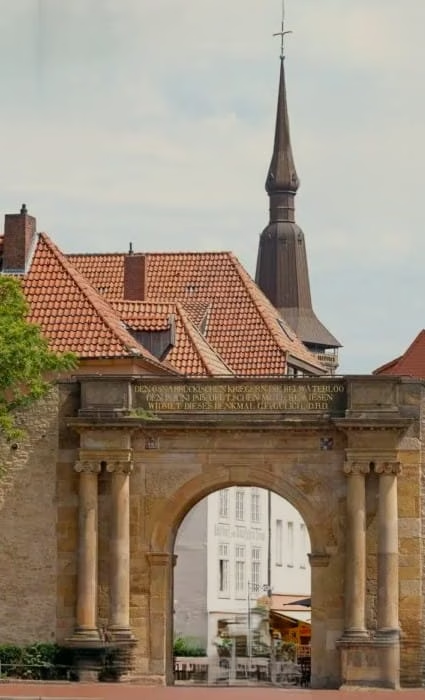
From the square, I wandered past St. Mary’s Church and into Heger Tor, a grand neoclassical gate that once guarded the city. Locals call it the Waterloo Gate, a memorial to soldiers who fell at Waterloo. Passing through, I entered the Heger Tor Viertel, a district of cobbled lanes lined with half-timbered houses, quirky boutiques, and inviting taverns. It’s incredibly walkable, you won’t need anything more than comfy shoes to explore Osnabrück’s Old Town alleys. Around each corner, I found something photo-worthy: a hidden courtyard here, a whimsical street sculpture there and always the mix of medieval and modern life blending effortlessly.
Heger Tor
By mid-afternoon I craved a caffeine fix. I ducked into Café Kommode, a cozy little café beloved by locals. True to its name (“kommode” means dresser in German), it’s adorably furnished with vintage cabinets and armchairs, as if you’re having coffee in a stylish grandmother’s living room. I ordered their house specialty cappuccino and a slice of hazelnut cake. Legend has it a priest once called their homemade chocolate pralines “heavenly,” and after tasting one, I couldn’t agree more. Sinking into an antique sofa, sipping my coffee, I felt the stress of office emails melt away.
Travel tip: Osnabrück’s café scene is fantastic, take the time to slow down and people-watch. You’ll notice everyone from university students to friendly grandpas enjoying the afternoon “Kaffee und Kuchen” ritual. In this city, relaxation is practically a cultural heritage.
Refreshed, I continued my stroll. Just a few blocks away stands Osnabrück Cathedral (St. Peter’s) with its twin towers and peaceful cloister. I fondly remember it as the church where my best friend got married. Outside on the square, people are strolling in every direction or having a coffee or pizza under the statue of Justus Möser (a famous jurist born here), giving the square a friendly buzz. It was the perfect teaser for the next day’s plans. As dusk fell, Osnabrück’s Old Town took on a warm glow. Many buildings lit up and lively murmurs drifted from restaurants. For dinner, I craved something hearty and local. I found it at the Hausbrauerei Rampendahl, a historic brewery tavern on Hasestraße. The atmosphere was just what I needed: rustic wood interiors, the clink of beer glasses, and the smell of home-brewed beer and hearty food wafting from the kitchen. I devoured an order of cheese “Spätzle” paired with their house pilsner, of course. The portions were generous (I later learned you can order half-portions that still fill you up), prices reasonable, perfect as a student and the convivial vibe made a solo traveler like me feel right at home. If you prefer vegetarian or lighter fare, no worries: Osnabrück’s city center offers everything from organic Italian and tasty soups, to vegan street food, all within a few minutes’ walk. This city truly has culinary fulfillment for every taste and budget.
After dinner, I wasn’t quite ready to call it a night. Instead, I followed the sound of laughter and clinking glasses to Sonderbar, a tucked-away local bar known for its impressivly quirky decor. . By midnight, I realized I’d experienced exactly what I came for: authentic connection in an underrated city that doesn’t feel touristy at all. I walked back to my hotel under the gentle glow of old street lamps, already excited for what the next day would bring.
Day 2: Culture and Discovery: Markets, Masterpieces and a Dash of Quirk
I woke to church bells and sunlight filtering through medieval-paned windows, a glorious Saturday in Osnabrück. Today was all about diving deeper into the city’s culture. First up: breakfast at the Weekly Market. This market, held in the square by the cathedral, is a Saturday tradition. By 9 AM, it was in full swing. I joined locals browsing stalls piled high with fresh produce, artisan bread, and flowers. Hungry, I made a beeline for a bakery stand and treated myself to a “Franzbrötchen” (a cinnamon-sugar pastry native to northern Germany) and a cup of local roast coffee. I enjoyed them right there in the square, perched on a bench near the statue of Justus Möser, watching Osnabrück come to life. There’s something heartwarming about being part of a city’s morning routine. I felt less like a visitor and more like I belonged. After fueling up, I headed to the nearby Museum Quarter, specifically to the Felix Nussbaum Haus. This museum was a highlight I’d been anticipating, blending art, history, and striking architecture. Designed by renowned architect Daniel Libeskind (who also created the Jewish Museum in Berlin), the Felix Nussbaum House is a modern architectural marvel nestled amid old city walls. Its design is all sharp angles and tilted lines, Libeskind intended it to feel a bit disorienting, reflecting the tragic story of the artist inside. Felix Nussbaum was an Osnabrück-born painter whose life was darkly interrupted by the Nazi regime; he was murdered at Auschwitz in 1944. Walking through the museum’s corridors, I felt his story in every painting: from the bright, hopeful early works to later pieces filled with fear and anguish. It’s rare that a museum moves me emotionally, but one self-portrait of Nussbaum hiding in an attic, painting himself with haunted eyes was incredibly poignant. Yet the experience wasn’t depressing; it was inspiring. The very existence of this museum, with over 200 of Nussbaum’s works on display, felt like a triumph of art over darkness. I left with a deeper appreciation for Osnabrück’s commitment to remembering its history while embracing creativity.
Emerging back into the sunshine, I decided a lighthearted pick-me-up was in order. Fortunately, Osnabrück has just the thing for a sweet tooth. I strolled over to Leysieffer, a famous local chocolate shop and café that’s been delighting residents for over a century. Fun fact: Osnabrück is the original home of Leysieffer, founded in 1909, so you know they’ve perfected their craft. I sat in their pretty café and savored one of Leysieffer’s signature Himmelspralinen (“heavenly pralines”). Let’s just say I now fully understand why their chocolates are legendary. It was the perfect palate cleanser after the heavy emotions of the museum. Next, I decided to experience a bit of Osnabrück’s modern local culture. Just a short walk from the Old Town is the L&T shopping center, an upscale department store that hides a very unexpected attraction: in its sports department basement, there’s an indoor surfing wave called the Hasewelle! Yes, you read that right, surfing in the middle of a German city. I couldn’t resist checking it out. Inside L&T, stylish shoppers mingled with curious onlookers like me, all gathered around a large glass pool where wetsuit-clad surfers were riding a never-ending wave. The energy was contagious. I didn’t try it myself, but watching locals catch a wave in a store was a delightfully quirky reminder that Osnabrück isn’t afraid to mix old and new. If shopping is more your thing, L&T also offers 22,000 square meters of retail therapy, from high fashion to outdoor gear, but I was content with the free surfing show.
For the afternoon, I had two options: delve into nature or visit another museum. Osnabrück tempts you with both. Ultimately, the sunny weather lured me outdoors. Did you know Osnabrück is the only major city situated inside a nature park? The UNESCO GeoPark TERRA.vita surrounds the city with rolling hills, forest, and even geological wonders. On a whim, I hopped on a local bus (public transit is efficient here) to the edge of town for a short hike at the Piesberg, a former quarry that’s been transformed into a scenic park. The trail was easy and the views from the top, rugged sandstone cliffs and green countryside, were worth the mild climb. I found it pretty cool that I could be immersed in nature just 20 minutes after being in a bustling market. If hiking isn’t your style, another popular option is the Osnabrück Zoo, uniquely set in a forest and even featuring an underground zoo exhibit (yep, there are animals that live below ground, talk about offbeat!). Families especially love it, but as an adult I can attest it’s quite fun to explore for a few hours. Whether you choose a nature walk or the zoo, it’s a relaxing change of pace that shows off Osnabrück’s softer side.
As evening approached, I returned to the city center for one more cultural treat: a classical opera at the theatre. I lucked into a ticket for Mozarts Zauberflöte. Sitting among local music lovers, letting the orchestra’s melodies wash over me, I felt an uplifting sense of belonging and inspiration. It’s experiences like this, blending with the community, enjoying a shared love of art, that make small-city travel so rewarding. For my final dinner in Osnabrück, I opted for a lighter meal. I found the Zinnober, a wine specialist with an amazing restaurant. Over a glass of Riesling and a plate of seasonal veggie risotto, I reflected on how fulfilling yet unhurried the day had been. In big cities I often feel pressure to race from sight to sight, but here I was genuinely relaxed, having seen so much without ever feeling rushed. Osnabrück had quietly worked its magic.
To cap off the night, I followed the sound of live jazz to a tiny bar near the Heger Tor. Inside, a trio was playing upbeat swing while a friendly bartender recommended local craft beers. I recognized a couple of faces, the city is just the right size that you might bump into the people you saw at the market or the concert hall. We exchanged smiles and cheers. Traveling solo in Osnabrück never once felt lonely; it felt like being among old friends.
Day 3: A Fond Farewell: Relaxation and Inspiration
All too soon, Sunday morning arrived, my last day in this lovely city. I allowed myself a lazy start (one of those cozy hotel mornings where you linger over coffee and a German breakfast spread of breads, cheeses, and fruits). Checkout wasn’t until late morning, so I decided to squeeze in one more uniquely Osnabrück experience before catching my afternoon train home.I took a leisurely walk to the Osnabrück Castle, a Baroque palace that now houses the university. The gardens behind the castle practically begged for a stroll. I meandered through the manicured lawns and fountains of the Schlossgarten, watching students study under trees and elderly couples feed the ducks. The castle’s exterior, painted a cheery yellow, made for a great photo-op and the atmosphere was incredibly peaceful. It struck me that Osnabrück seamlessly blends youthful energy (thanks to the university) with a tranquil, almost meditative vibe. Not many cities can be vibrant and chill at the same time, but this one nails it.
With just an hour or two left, I returned to the Old Town for a final dose of its charm. Many shops were closed (note: in Germany, most stores shut on Sundays), which actually made the stroll even more enjoyable, the streets were quiet, almost all mine. I popped into Café am Markt, which was open and busy serving brunch. Snagging a seat by the window, I indulged in one more coffee and a waffle topped with fresh berries. Outside, the bells of nearby St. Mary’s tolled noon. I could see a few tourists gathering by the Town Hall, taking photos of the Peace of Westphalia plaque, but mostly it was locals out for Sunday walks with their dogs or grabbing ice cream with their kids.
Is Osnabrück worth visiting? Absolutely! Precisely because it isn’t overrun with tour buses and selfie sticks. It felt like a secret I was in on, a place where you can deeply engage rather than just “see and tick off” sights. Before heading to the station, I walked one last loop around the Market Square, now calm and sun-drenched. I found myself already feeling nostalgic about this city I hadn’t even left yet. In just three days, Osnabrück had given me exactly what I needed: a mix of inspiration, humor, history, and heart. From the emotional impact of the Felix Nussbaum Museum to the silly delight of indoor surfing, from rich historical lessons at the Peace Hall to laughing with locals over beers, this trip was the perfect reminder of why I love travel. It recharged my batteries and broadened my perspective, all without straying from that mid-budget comfort zone. I didn’t have to sacrifice good food or a nice bed to have an adventure here. Osnabrück proves that sometimes the best getaways are hiding in plain sight, away from the tourist traps.
Did I return? Absolutely! I spent the next seven years in this city, achieving my law degree and still think about this city with nostalgia. Which is why I ever so often return to my alma mater.
Travel Q&A: Planning Your Osnabrück Escape
Q: How do I get to Osnabrück?
A: Osnabrück is well-connected and easy to reach. By train: Direct trains run frequently, roughly 2.5 hours from Berlin (via Hanover) and about 30 minutes from Münster. It’s also on the international rail line between Amsterdam and Hamburg. I took a train from Hamburg and arrived in ~2 hours, relaxed and ready. By air: The nearest airport is Münster/Osnabrück (FMO), about 30 km away, with car rentals and shuttle buses available. Alternatively, fly into Düsseldorf or Hamburg and take a train. By car: Osnabrück lies at the intersection of major Autobahnen (A1 and A30), so driving is straightforward (about 1 hour from Bremen, 1.5 from Dortmund). Once in the city, you won’t really need a car, the center is compact.
Q: Can I do this trip over a long weekend?
A: Definitely! Osnabrück is perfect for a 3-day long weekend. I arrived on a Friday and left Sunday and felt I experienced a lot without rushing. It’s even doable in 2 days if you skip a few things, but three days lets you soak in the atmosphere, include a mix of history, culture and relaxation (as this itinerary shows). Many corporate professionals (myself included) use a Friday off to turn Osnabrück into an easy weekend getaway. It’s also a great add-on city if you’re traveling between bigger German destinations, a worthy stop that won’t eat up too much time but gives you ample memories. I even know some people that visit Osnabrück on daytrips from Bremen or even Cologne.
Q: When is the best time to visit Osnabrück?
A: I’d recommend late spring to early autumn for the best weather. April-June brings mild temperatures, blooming parks and the city’s famous May Week festival (if you enjoy street food and music, time your visit for that!). Summer is lovely and not overly crowded (students generally leave by Juli after graduation or for the semester break and return in September), you can dine outdoors on the market square terraces comfortably. Early fall (September) is also gorgeous, with autumn colors in the surrounding nature park. I visited in August for the first time after my admission letter and had sunny days around 23°C (73°F). Winter is chilly and quiet, but Osnabrück does host a magical Christmas Market worth seeing if you’re in the region during the holidays. Just bundle up and enjoy the lights and Glühwein in the historic square. Overall, there’s no bad time for this hidden gem, but fair weather lets you enjoy all the outdoor cafés and walking tours to the fullest.
Schloss Osnabrück
Q: Is Osnabrück solo-travel friendly?
A: Absolutely. I traveled solo and felt completely safe and welcomed. The city is medium-sized (~165,000 residents) with a laid-back, friendly vibe. Many locals speak English (and are eager to help if you need directions or recommendations). There are many international students in the city and overall it has a very relaxed campus feeling. As a solo traveler, I loved the ease of striking up conversations, whether at Café Kommode, in a brewery or during the night watchman tour (which I highly recommend for solo folks; you’ll inevitably chat with others carrying lanterns alongside you!). The city is well-lit and populated in the evenings, especially around the Old Town, so I was comfortable walking back to my hotel at night. For women traveling alone, Osnabrück feels as safe as it gets. Just watch yourself around the main station at night (that’s also where the red light district is located) and keep an overall watchfulness. In all of my seven years in the city I had one unsafe situation and luckily that was right around the corner from the district attorney and the police station. You’ll also find plenty of spots to enjoy your own company: quiet museum mornings, cozy reading nooks in cafés and benches in the Schlossgarten for journaling (or bring a blanket and join the students grilling there). It’s an ideal place to slow down and enjoy some “me time.”
Q: Where should I stay for comfort and convenience? Aim to stay in or near the Altstadt (Old Town) so you can walk everywhere. There are a few great mid-range hotels that balance comfort, style and location. I stayed at the Romantik Hotel Walhalla, a beautiful half-timbered inn right by the Market Square, it had modern amenities and a historic ambiance (and a fantastic breakfast!). Another solid choice is the Dom Hotel near the Cathedral, which is contemporary, comfortable and literally steps from the weekly market. If you prefer boutique design, look up Hotel Fraser (just an example; Osnabrück has several chic small hotels). All these options keep you central, meaning you can drop off your shopping bags or take an afternoon rest easily. Prices are moderate (I paid far less here than I would in bigger German cities for equivalent quality). For budget travelers, there are a couple of hostels and pensions, and for luxury seekers, a few upscale options with spa facilities on the outskirts. But truthfully, mid-range in the center hits the sweet spot, you’ll have the Old Town charm at your doorstep without sacrificing comfort.
Q: How do I get around the city?
A: On foot, mostly! Osnabrück’s main attractions are clustered in the city center and the Old Town is very walkable. I never once needed a taxi within the Altstadt. The cobblestone lanes are pedestrian-friendly (and you’ll keep stumbling on hidden gems by walking). For farther spots like the zoo or Piesberg, the city bus network is reliable, frequent and safe. A single ticket costs just a few euros. I used the bus to reach the Piesberg trailhead and it was a smooth 20-minute ride. If you enjoy cycling, the city also offers bike rentals and has decent bike lanes (Osnabrück is aiming to become a certified biking city) plus, biking is a fun way to explore the parks or along the Hase River that runs through town. Driving in the center isn’t necessary (and parking in those ancient streets can be tricky and pricey), so I’d suggest parking the car if you brought one and enjoying Osnabrück at a human pace.
Conclusion: Don’t Wait, Osnabrück Awaits You!
Leaving Osnabrück after finishing uni, I felt a mix of contentment and nostalgia. Content from the wonderful experiences I’d collected and nostalgia because I’d found a home in this city that I am going to miss, but also happy I can share it with others. This city proved that a place doesn’t have to be famous to be extraordinary. In fact, its very under-the-radar status is part of the charm. Osnabrück let me slow down, learn, laugh and rejuvenate, all in one short trip and by living here. If you’re dreaming of a getaway that balances inspiring history, friendly vibes, a touch of humor and plenty of comfort, Osnabrück is calling your name. So, what are you waiting for? Life is busy and the “right time” to travel might never announce itself, make the time. Plan that long weekend, go experience this hidden gem of Germany and create your own story in the City of Peace. I promise you’ll come back not only with beautiful photos, but with a refreshed spirit and maybe a few new friends (and definitely a box of Leysieffer chocolates!).
Don’t miss out on more offbeat travel inspiration! Subscribe to my newsletter for practical guides and heartfelt tales that fit into a real working person’s schedule. And before your next adventure, check out our related articles on other hidden gems in Germany and Europe, your perfect trip might be closer than you think. Travel well, travel often and remember: sometimes the lesser-known path leads to the most unforgettable destinations.
Cheers to your next journey, perhaps it’ll be Osnabrück! 🌟
Only have a day in Athens? Don’t worry, this compact city packs ancient grandeur, artistic soul and Mediterranean charm into a walkable experience. Whether it’s a layover, cruise stop, or your first taste of Greece, this 24-hour itinerary blends iconic sights with hidden gems and authentic moments.
Here’s how to see the best of Athens in one incredible day, without feeling rushed:
🌅 7:30 AM – Sunrise at the Areopagus Hill (Mars Hill)
Why start here: Skip the Acropolis crowd and greet the day with a golden view of the Parthenon and the city waking up. This free hilltop spot is just below the Acropolis entrance and perfect for peaceful photos. Bring coffee and breakfast pastry from a nearby bakery. Wear shoes with grip – marble rocks get slippery.
🏛️ 8:30 AM – Explore the Acropolis
Arrive early to beat the tour groups and the heat. The Acropolis opens at 8:00 AM and it’s magical in the morning light. Must-sees: The Parthenon (iconic temple of Athena), the Erechtheion with its graceful Caryatids, panoramic city views. 🧠 Tip: Buy a combo ticket online (€30) that also includes the Ancient Agora, Roman Agora and more, valid for 5 days. 📸 Don’t linger too long here, you have a lot more to see!
🏛️ 10:00 AM – Acropolis Museum
Just a few minutes’ walk from the ruins, this award-winning modern museum adds context and beauty to what you just saw. Budget: ~1–1.5 hours. Great bathrooms, AC and a peaceful rooftop café. Don’t miss the glass floor over ancient ruins. 🎟️ Entry: €15 in high season / €10 in low season.
☕ 11:30 AM – Coffee Break in Koukaki
Head to the leafy neighborhood of Koukaki, just south of the Acropolis but far quieter than Plaka. Try a freddo espresso or traditional Greek coffee. Café picks: Little Tree Books & Coffee or Lotte Café-Bistro for cozy vibes 🧠 Bonus: Pick up a handmade notebook or Greek poetry book while you sip.
🏘️ 12:30 PM – Wander Anafiotika & Plaka
This is Old Athens at its dreamiest, whitewashed houses, blue shutters, winding alleys, and flowering vines. You’ll feel like you’ve left the city and entered a Cycladic island. Start at Anafiotika, hidden behind the Acropolis slopes. Meander down into Plaka for neoclassical buildings, artisan shops and postcard-perfect streets 🎁 Souvenir tip: Look for handmade leather sandals or small-batch olive oil.
🥙 1:30 PM – Light Lunch at a Garden Courtyard
While we’re avoiding food content in-depth, aim for something quick, fresh and in a shady spot to refuel. Neighborhood suggestion: Psyrri for local character and fewer tourists. Eat light so you stay energized for the afternoon.
🏛️ 2:30 PM – Ancient Agora
Often overlooked, this was the true heart of Ancient Athens, a lively space where Socrates once debated and citizens voted. Highlights: Stoa of Attalos (now a museum), Temple of Hephaestus (incredible preservation), shady olive trees and wildflowers in spring 🎟️ Combo ticket from the Acropolis covers entry.
Temple of Hephaestus from above
🛍️ 4:00 PM – Flea Market + Local Finds in Monastiraki
Browse vintage books, quirky souvenirs and antiques in the buzzing Monastiraki Flea Market. You’ll find everything from orthodox icons to vinyl records. Visit Hadrian’s Library ruins next door. Grab a snack or drink from a street vendor (local fruit or koulouri ring). It’s a great place to people-watch and soak up energy.
Hadrian’s library
🌇 6:00 PM – Sunset Viewpoint: Lycabettus Hill or Philopappos Hill
You have two dreamy sunset options: 1. Lycabettus Hill (highest point in Athens). Take the funicular or hike (~20–30 min). Epic city views, especially of the Parthenon lit up. 2. Philopappos Hill (near the Acropolis). Quieter, romantic ruins, easier walk. Ideal if you’re short on time or energy. Bring a small bottle of wine or just sit and reflect as Athens glows golden and the city lights begin to flicker.
🌙 8:00 PM – Stroll Through Lit-Up Plaka
Even if you don’t dine here, Plaka by night is magical. Bougainvillea climbs the walls, soft music floats from cafés and the Parthenon glows above you. Snap a photo from Lysikratous Street. Enjoy a final walk or pop into a quiet bookshop or boutique.
✈️ Leaving or Staying? If you’re catching a night flight, book a cab via Beat or take Metro Line 3 to the airport (last train departs ~11:30 PM). If you’re staying another night, wind down with a drink at a rooftop bar like A for Athens or Couleur Locale.
🧭 Final tips for 24 Hours in Athens. Wear grippy shoes (you’ll thank yourself). Stay hydrated (bring a refillable water bottle). Avoid overplanning, give yourself space to wander and feel the city
The Day My “Perfect” Routine Exploded (And Why I’m Glad It Did)
A few years ago I decided to become a superhuman. I set my alarm for 5 a.m., planned a 90-minute gym session, blocked my calendar for “deep work” sprints, and even scheduled “mindfulness breaks” (because, you know, balance). And throughout the whole Covid lockdown it worked. But then I had to discover: it only works as long as that is my only focus.
I had to learn: You don’t need more discipline. You need softer discipline.
WTF is soft discipline? It’s not about white-knuckling your way through life. It’s about building consistency that actually sticks, especially when Q2 hits and your calendar looks like a Tetris game on steroids.
If you’re a busy professional who’s tired of starting strong and fizzling out by April, this is your lovely, no-BS guide to making habits that last. No brutal routines. No guilt. Just amazing, sustainable progress.
What the Hell Is Soft Discipline? (And Why It Beats “Hustle Culture” Every Time)
The Problem with “Hard” Discipline
We’ve been sold a lie: That success requires grinding, forcing and suffering. But here’s the truth:
Burnout is real. 76% of professionals report burnout symptoms by Q2 (source: American Psychological Association).
Willpower is limited. Studies show we only have about 3-4 hours of high-quality focus per day (source: Harvard Business Review).
Life happens. Meetings overrun. Kids get sick. Your boss drops a “quick project” at 4:59 p.m.
As I had to learn: Hard discipline fails because it doesn’t account for reality.
Soft Discipline: The Gentle Art of Actually Getting Sh*t Done
Soft discipline is about designing your environment, systems and mindset so that consistency feels easy, natural and even enjoyable. It’s not about being perfect, it’s about being smart and kind to yourself.
Key principles:
✅ Start stupid small (so small it’s impossible to fail).
✅ Stack habits (attach new habits to existing ones).
✅ Design for frictionless action (remove barriers before they stop you).
✅ Embrace the “two-day rule” (never skip twice in a row).
How to Build Soft Discipline This Spring (Without Losing Your Mind)
1. Start Stupid Small (Seriously, Like Ridiculously Small)
WTFact: The most successful habit-builders don’t start with “work out 5x a week.” They start with “put on gym clothes.”
Why? Because momentum beats motivation. If you can do 2 minutes, you’ll often do 20.
Examples:
Fitness: “Do 1 push-up” → Often turns into a full workout.
Reading: “Read 1 page” → Often turns into a chapter.
Meditation: “Breathe for 60 seconds” → Often turns into 10 minutes.
Action Step: Pick one habit. Make it so easy you’d feel silly not doing it. Do it for 7 days. Then, and only then, consider scaling up.
2. Stack Your Habits (Like a Pro)
Habit stacking is the art of attaching a new habit to an existing one. Your brain loves routines, so piggybacking makes new habits stick faster.
Examples:
After I pour my morning coffee, I will write 1 sentence in my journal.
After I brush my teeth, I will do 10 squats.
After I sit down at my desk, I will drink a glass of water.
Here’s what I do: After putting on my toner, I will do a little back stretch (PM) or a little hopping (AM). Before I do my skincare routine, I will prep my tea. After my skincare, I do half an hour of reading before bed. After walking the god, I will ha´ve dinner.
Action Step: Identify 1-2 existing habits. Stack a tiny new habit onto them. Use this formula:
After [current habit], I will [new habit].
3. Design for Frictionless Action (Remove the Barriers Before They Stop You)
WTFact: You’re 3x more likely to follow through if you prepare the night before (source: British Journal of Health Psychology).
How to remove friction:
Fitness: Lay out your workout clothes the night before. Keep your sneakers by the door.
Healthy eating: Pre-cut veggies on Sunday. Keep a water bottle on your desk.
Productivity: Close all tabs except the one you need. Use apps like Freedom to block distractions.
Action Step: Spend 5 minutes tonight preparing for tomorrow’s habit. What’s one thing you can do to make it easier?
4. Embrace the Two-Day Rule (The Secret to Never Quitting)
Rule: Never skip your habit two days in a row.
Why? Missing one day is normal. Missing two starts a slide into “I’ll start next Monday” hell.
What to do if you skip a day:
Day 1: “Oops, life happened. No big deal.”
Day 2: “Non-negotiable. I’m doing this, even if it’s just 1 minute.”
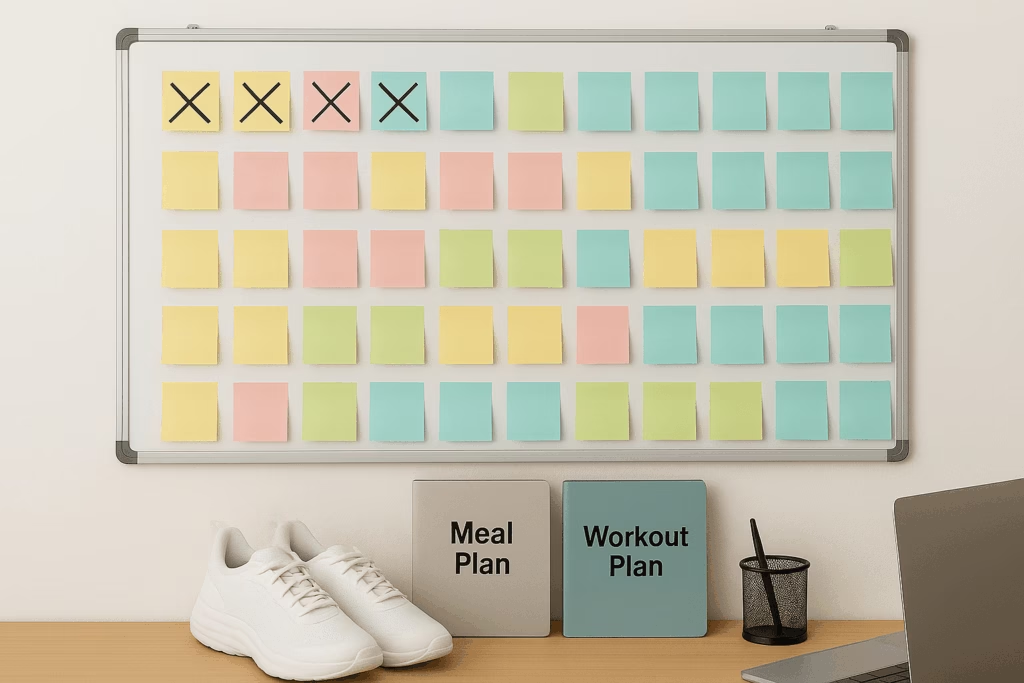
Action Step: Track your habit with a simple checklist. If you miss a day, reset immediately.
5. Use “Temptation Bundling” (Make Habits Fun, Not Punishment)
WTFact: People who bundle habits with guilty pleasures are 51% more likely to stick with them (source: University of Pennsylvania).
Examples:
Only watch Netflix while on the treadmill.
Only listen to your favorite podcast during your commute (if you walk/bike or connect your phone to the car).
Only eat chocolate after you’ve written 500 words. (I did this while studying for my law exam.)
Action Step: What’s a guilty pleasure you can bundle with a habit you want to build?
Soft Discipline for Busy Professionals: Real-Life Examples
Here’s your proof that it works:
Case Study 1: The Corporate Warrior Who Hated Mornings
Problem: Sarah, a marketing director, wanted to meditate but “never had time.” Solution: She stacked “1 minute of breathing” onto her existing habit of waiting for her coffee to brew. Result: 6 months later, she meditates for 10 minutes daily, without “finding time.”
Case Study 2: The Traveling Consultant Who Wanted to Work Out
Problem: Mark’s job had him in hotels 3 weeks a month. Gyms were inconsistent. Solution: He committed to “10 bodyweight exercises” in his hotel room, using an app like Nike Training Club. Result: He worked out 4x a week, even on the road.
Case Study 3: The Parent Who Wanted to Read More
Problem: Lisa, a mom of two, hadn’t read a book in years. Solution: She kept a book on her nightstand and read one page before bed. Result: She finished 12 books last year, without “finding time.”
Q&A: Your Burning Questions About Soft Discipline
Q1: “I’m already overwhelmed. How do I add one more thing?”
A: You’re not adding, you’re replacing. Swap 5 minutes of doomscrolling for a tiny habit. Example: Instead of checking Instagram first thing, breathe for 60 seconds.
Q2: “What if I fail?”
A:Failure is data. Miss a day? Ask: What made it hard? Adjust. Example: If you skipped your workout because you were tired, try a 5-minute stretch instead. I also recommend to plan your routine for the baddest of days, like a minimal viable routine. Stick to it even then and it will feel so easy to add more on the best days.
Q3: “How do I stay consistent when traveling?”
A: Pack your habits. Bring resistance bands, download meditation apps or use the “two-day rule” religiously. Example: Even if you’re jet-lagged, do one push-up to keep the streak. I am famous for doing a little yoga flow on the hotel room floor in the morning.
Q4: “I’m not a morning person. Can soft discipline work for me?”
A: Absolutely. Soft discipline isn’t about when, it’s about how. Attach habits to your natural rhythms. Night owl? Stack habits onto your evening routine. Not everyone is suited to the influencer 5 AM morning routine, who fit a whole day into the time before 9 AM. You could even use your lunch break to start a new routine.
Q5: “How long until this feels automatic?”
A: Research says 18-254 days (average: 66). But with soft discipline, it feels easier immediately because you’re not fighting yourself. I would suggest trying something out for 60-90 days. Still a fight? Not the right routine.
Conclusion: Your Spring Reset Starts Now (No Brutality Required)
Here’s the lovely truth: You don’t need more willpower. You need smarter systems.
Recap:
Start stupid small.
Stack habits onto existing ones.
Remove friction before it stops you.
Never skip twice.
Make it fun with temptation bundling.
Your action step: Pick one habit. Make it tiny. Start tomorrow.
Remember: Consistency isn’t about being perfect. It’s about showing up, even when it’s messy.
Now, go build a life that feels super, amazing, and cool, without the burnout.
What’s the one tiny habit you’ll start with? Hit me up on Instagram and tell me. I’d love to cheer you on! 🌱
I remember waking up on my 30th birthday with a strange mix of gratitude and restlessness. By all accounts, I had a “successful” life, a solid corporate job, a comfortable routine. And yet, a quiet voice in me wondered: Is this it? Hitting thirty felt like a crossroads where one path was staying the course and the other was an unknown adventure. I feared that pursuing change meant blowing up my whole life: quitting my job, moving to a new city, starting entirely from zero. But an emotional insight dawned on me: change doesn’t have to be a destructive fire; it can be a controlled burn, clearing space for new growth without turning everything to ash. In other words, you don’t need to run away to a monastery or resign on a whim to reinvent yourself. There’s a middle way, an evolution that builds on who you are. Turning thirty can actually be the beginning of becoming more of yourself, not throwing the past away.
A friend of mine , a high-performing marketing manager, shared how at 34 she felt utterly burnt out and bored at the same time. She dreaded Monday mornings, yet the thought of abandoning her hard-earned career was terrifying. Instead of making a rash decision, she started with a small change: taking a night class in UX design, something that had always intrigued her. That single step was a revelation. Within a year, she transitioned into a new hybrid role at her company, reinvigorated and reinvented without ever having to nuke her résumé. Her story taught me that turning the big 3-0 isn’t an alarm bell to upend everything, but an invitation to recalibrate. Change can be gentle. Reinvention can mean adding new layers to your life, not erasing the canvas.
The Mindset Shift: Evolve, Don’t Scrap Your Life
Before diving into strategies, let’s talk mindset. The biggest hurdle to reinventing yourself is often the belief that you must discard your past to create a new future. In reality, your past is your power source. Reinvention is about evolution, not deletion. As career expert Caren Merrick wisely writes, “Reinventing doesn’t mean devaluing or eliminating all that came before you.” All your decisions, struggles, and triumphs have made you the valuable person you are – they actually qualify you for the next step in your journey. In other words, a career or life reset is not a zero-sum game where a new path cancels out your old one. Think of it more like a relay race: you carry the baton of experience forward. Each phase of your life has been training for your next adventure. “Career change is not a gaping chasm ready to swallow you; it’s simply new space in an already thriving garden,” as one coach puts it. This shift in perspective is crucial: you’re not starting from scratch, you’re starting from experience. But in one thing everyone that tells you to discard your past self is right: you will leave that past self behind and evolve.
Equally important is embracing the idea that reinvention is a process, not an overnight flip of a switch. You don’t have to have everything figured out on day one. In fact, “reinventing doesn’t happen in a day. It happens one day at a time”. Give yourself permission to take small steps and experiment. We often pressure ourselves to make grand, dramatic moves for change (cue the urge to quit and move to Bali), but sustainable reinvention usually comes through incremental shifts. High-achieving women sometimes struggle here. We’re used to excelling quickly. But becoming a beginner again in some area of your life can be a profound act of growth. It requires humility and curiosity, traits that are part of emotional intelligence. Remind yourself that it’s okay to not have all the answers. Approach your reinvention with a learner’s mindset. The same openness that got you where you are can carry you into what’s next.
Another key mindset tweak is recognizing that it’s never “too late” to change. Society may subtly suggest that by 30 or 35 you’re supposed to stick to what you’ve been doing. That’s outdated thinking. We live in a time where switching careers or evolving your life at 30, 40, even 50 is not only common but often celebrated. According to Harvard Business Review, career pivots have become more common than ever, and there’s no perfect age or timeline for making a change. Many people actually find their stride in their thirties precisely because they bring a decade of experience and self-knowledge to the table. In your twenties your brain, more precisely the prefrontal cortex that is responsible for planning, impulse control and decisionmaking is finally developed. That’s what makes you’re thirties the first decade you can confidentially decide your life for yourself. Holding onto an old identity out of fear can stunt your growth. Your self-worth is not tied to one job title or one company. You are allowed to redefine what success looks like for you at 30+, and you can do it without self-destructing what you’ve built so far.
Finally, cultivate an emotionally intelligent approach to this journey. That means acknowledging your feelings (the fear, the excitement, the doubt) and approaching them with compassion rather than judgment. It’s normal to feel fear when stepping into the unknown. That fear has kept you safe in the past. But now it’s about discerning which fears are protecting you from real danger versus which are just protecting you from growth. High performers often wrestle with perfectionism and the fear of failure. Reinvention requires a bit of letting go of perfection. It’s okay to be a beginner at something new, to ask for help, or to take a step down in prestige while you pivot. Your long-term empowerment is worth it. Remember, we are happier when we’re making progress, learning, and growing. Give yourself permission to pursue progress over perfection. With this mindset: valuing your past, being patient with the process, believing it’s possible at any age, and practicing self-compassion. You’ve already won half the battle.
Subtle but Powerful Strategies to Reinvent Yourself
You might be thinking, “Alright, I’m working on my mindset. But what concrete steps can I take to reinvent myself without detonating my current life?” Here are several practical strategies for a life reinvention or career reset that won’t require you to hand in your resignation tomorrow. Each of these approaches lets you explore and grow while keeping the stability you’ve earned. Think of them as small pivots, mini experiments, to refresh your direction:
1. Pivot Your Skills (Not Just Your Job): Look for ways to evolve within or adjacent to your current career by leveraging the skills you already have. Sometimes the fresh start you crave is available in a different department, project, or role at your existing company or industry. Can you volunteer for cross-functional projects at work? Take on a slightly different role that uses your expertise in a new way? The goal is to double-down on your strengths in a new context. Career strategist Jenny Blake, in her book Pivot, emphasizes that a successful pivot starts from a “strong foundation” of what you already do well. You use your existing strengths and interests as a launchpad into a new direction. For example, if you’re a finance manager who craves creativity, you might pivot by joining a strategic planning task force (using your financial savvy in a more creative, big-picture way) or consulting for a non-profit on budgeting (applying your skills to a mission you care about). By doing this, you’re reinventing your career without abandoning your hard-won expertise. Each skill you’ve honed is a transferable asset. One woman’s mid-30s pivot from a hedge fund to journalism was successful partly because she leveraged the analytical and research skills from finance to excel in reporting. The takeaway: don’t throw out your toolkit. Use it to build something new. Identify your core skills (leadership, analysis, storytelling, whatever they may be) and seek new outlets for them. This might mean upskilling (taking a course to apply your skills in a different field) or simply reframing how and where you use them. You’ll find it much less intimidating to step into a new arena when you realize you’re not a newbie after all. You’re bringing a wealth of knowledge with you.
2. Start a Passion Project or “Side Hustle”: If your day job isn’t lighting you up, channel that energy into a side project. This could be anything: launching a small Etsy shop, starting a blog (like me), volunteering on weekends, freelancing in a skill you want to grow, or testing out a business idea in miniature. A side hustle is a powerful, low-risk way to explore a new identity or career path without quitting your primary income source. In fact, more than half of millennials (52%) report having at least one side hustle today. Not just for money, but to explore passions and diversify their skills. One inspiring example is Nicole Gibbons, who remained in her full-time PR job for years while growing a lifestyle blog and design business on the side. Her story shows that you can reinvent gradually: evenings and weekends can become the incubation period for your next chapter. Treat your passion project as a sandbox where you get to play, learn, and even fail safely. Whether it’s writing the first chapters of a novel, taking on one consulting client or selling your handmade crafts on Instagram, a side hustle can give you new purpose and excitement. It also creates an optional off-ramp: if one day your project gains momentum (or your soul just says “it’s time”), you can choose to turn it into your main gig. But even if it stays a side gig, it can provide the creative fulfillment or sense of ownership your main job lacks. Bonus: skills and confidence from your side hustle often spill over and boost your performance in your day job too. The key is to start small and stay consistent. Schedule a few hours each week for your project and treat that commitment like you would an important meeting, because it is. It’s a meeting with Future You. And even if you decide not to side hustle. There are many ways to channel your energy differently. You can pursue knowledge ( I know I am doing that. Here’s my blueprint.) or start a new hobby that fulfills you. The options are truly endless.
3. Take a Travel Sabbatical or Solo Retreat: Sometimes you need to step away from the noise of daily life to hear your own voice again. This doesn’t mean you must quit and backpack for a year (though if you can, more power to you!). It could be as accessible as taking a 2-week sabbatical or using a chunk of saved vacation time for a purposeful break. High-performing women often neglect vacations or fill them with obligations. Instead, consider planning a trip that’s just for you. Perhaps a solo travel adventure or a dedicated retreat focused on reflection and growth. Travel has a way of jolting us out of autopilot. Exploring a new environment, whether it’s a foreign country or a quiet cabin a few hours away, can bring fresh perspective and inspiration. Many companies offer unpaid sabbatical programs or career breaks after a certain tenure; it’s worth looking into yours. Even a brief hiatus can have profound effects. One corporate professional-turned-creator, Joy Ofodu, credits a short break for helping her pivot. In that time, she reclaimed her sense of wonder and hatched a concrete strategy for her new direction. If a month is too long, try a long weekend retreat. You might attend a guided retreat (for meditation, yoga, writing, etc.) or simply design your own DIY retreat. Perhaps renting an Airbnb by the coast to journal and brainstorm. Solo time is the key: being away from roles where you’re an employee, a boss, a partner or a mom, even briefly, lets you reconnect with you. Bring a journal (we’ll talk more about journaling later) and ask yourself big questions: What do I really want? What parts of myself have I left unexplored? Often, the answers become clearer when you’re outside your routine environment. Upon returning, you’ll likely find you haven’t blown up your life at all, but you have renewed clarity and energy to gently steer it in a new direction. Travel and retreats are like pressing the “reset” button on your mindset, helping you envision possibilities you couldn’t see when you were knee-deep in emails and meetings.
4. Stack New Habits for Personal Growth: Reinvention doesn’t only happen through big external changes; it can start right in your daily routine. Enter the concept of habit stacking. This is a strategy where you attach a small new habit to an existing one, so that change fits seamlessly into your life. It’s perfect for high-achievers who say, “I’m already so busy. How can I add anything else?” With habit stacking, you’re not carving out huge chunks of time; you’re piggybacking on things you already do. For example, if you want to start learning a new skill (say, coding or a new language), you could commit to doing a 15-minute lesson right after you brew your morning coffee or during your lunch break. “When I do [current habit], I will do [new habit].” This formula works wonders. Some examples: “When I get in my car for the commute, I will play a podcast about industry trends,” or “After I brush my teeth at night, I’ll spend 5 minutes planning tomorrow or journaling.” By tying the new habit to an established routine, you’re more likely to stick with it because it doesn’t feel like a huge additional burden. Over time, these micro-habits lead to macro changes. Want to pivot careers? Start habit-stacking learning into your day: read a few pages of a relevant book every night or complete one online course lesson after each workout. Want to improve your wellness and mindset? Add a short meditation when you first sit at your desk in the morning or end the day with a gratitude list. Habit stacking leverages our brain’s existing neural pathways and cues to make new behaviors almost automatic. This is how you build new muscles for your reinvention gradually. Each small habit is a vote for the person you want to become. Over months, you might be surprised at how much you’ve transformed, maybe you’ve written 50 blog posts, read 10 books, learned to code or built a meditation practice 10 minutes at a time. These incremental changes bolster your confidence and skills for bigger shifts. And crucially, they fit into your life without blowing up your schedule. Even with a packed calendar, you can always find tiny pockets of time to invest in Future You. Habit stacking is the epitome of evolving in place. Proof that you don’t need a dramatic overhaul to start seeing yourself in a new light. To learn more I recommend reading Atomic Habits*- the book about building habits.
5. Embrace a Minimalist Mindset Reset: When you’re feeling stuck or craving reinvention, one powerful (yet subtle) tactic is to simplify. Over the years, we accumulate not just possessions, but commitments, habits and mental clutter that weigh us down. Adopting a more minimalist mindset, essentially, consciously decluttering your life, can create the mental and emotional space you need for a fresh start. This can start in your physical environment: clean out that chaotic closet, simplify your living space, make your home office a place that inspires you. Clearing physical clutter often has a profound effect on mental clarity. Remember, “Clutter overwhelms because it constantly asks for attention…every piece of ‘stuff’ tells you there’s more to do. It pulls your focus, scattering your calm.” If you’ve been too busy to organize, tackling it is surprisingly therapeutic, a cleared desk or an orderly room can quiet anxious thoughts and give your mind room to think. But minimalist mindset goes beyond tossing old clothes. It’s also about streamlining your commitments and mental load. What can you let go of in your schedule that isn’t serving you? Maybe it’s a couple of social obligations that leave you drained, or saying “no” at work to extra projects that don’t align with your goals. Consider doing a “life audit” of all your current commitments and ask: which of these truly add value or joy and which am I doing out of habit or obligation? By trimming the excess, you free up time and energy that can now go into new pursuits or simply into resting (which high-achievers often need!). You might also try a digital declutter, unsubscribe from those emails that no longer interest you, reduce mindless social media use, and curate your information diet to what genuinely inspires you. Minimalism is fundamentally about being intentional: keeping only what matters and releasing the rest. This reset can be incredibly empowering. It reinforces that you are in control of designing your life. As you simplify, you’ll likely experience a mindset shift: you start focusing on what truly matters to you (your core values, passions, important relationships) instead of being buried under things and tasks that are just “there.” One outcome of this process is that you rediscover parts of yourself that were overshadowed. Maybe decluttering your old hobby supplies reminds you how much you used to love painting, prompting you to pick it up again. Or clearing your schedule a bit allows you to finally enroll in that course you’ve been meaning to. Think of minimalist living as hitting the reset button: it creates a calm, clear space in which you can imagine and build your next chapter. As the saying goes, “a clear space, a clear mind.” Sometimes, you don’t need to add more to your life to reinvent, you need to subtract the unimportant to make room for the essential new directions waiting for you.
Tools & Resources for a Fresh Start in Your 30s
Reinventing yourself is a courageous journey, but you don’t have to go it alone. There are some fantastic tools, books and communities that can inspire and support you along the way. Here are 5 recommended resources (think of them as friendly guides) to help with your life reinvention and career reset. These are also picks that many women have found useful in their thirties (journals, planners, books, and courses galore):
Book : Designing Your Life by Bill Burnett & Dave Evans*: An inspiring and practical book that applies design thinking to crafting your life and career. It’s perfect for when you’re unsure what exactly you want to do next. The authors (Stanford design professors) guide you through exercises to “prototype” different life paths, so you realize there are multiple exciting futures you could live. From creating Odyssey Plans (different 5-year life scenarios) to conducting small experiments (like trying a class or interviewing someone in a field), this book will help you get unstuck. The big lesson is that there’s no one “right” answer for your life. You can design and iterate until it fits. If you’re feeling lost or in need of a structured approach to reinvention, Designing Your Life is like having a career coach between two covers.
Book: Atomic Habits* by James Clear: Since we talked about habit stacking and small changes, this best-selling book is a must-read playbook on how tiny habits can lead to remarkable results. Clear breaks down the science of habit formation and offers a ton of practical tips for building good habits and breaking bad ones. Importantly, he shows how to make changes so small and easy that you can’t say no, which is exactly what a busy woman with a packed schedule needs. Atomic Habits will teach you how to redesign your environment for success (e.g. lay out your workout clothes to cue exercise), how to find an extra 1% improvement every day, and how these minuscule gains compound into a new you. If part of your reinvention involves being more productive, healthier, or learning new things, this book gives you the toolkit to actually follow through. It’s extremely actionable, you’ll likely start implementing tips before you even finish reading it. Plus, it’s motivating to see case studies of how others transformed their careers and lives through consistent tiny steps. This aligns perfectly with our theme: big change through small moves.
Journaling: The Five Minute Journal* (or Any Guided Journal): Never underestimate the power of journaling for self-discovery and mindset shifts. If you feel too busy (or intimidated) to journal, the Five Minute Journal is a beautifully simple entry point. As the name suggests, it literally takes just a few minutes each morning and night. It provides prompts for gratitude, prioritizing your day, and reflecting on what went well. This kind of guided journal is an excellent tool to cultivate positivity, self-awareness, and clarity. How does this help reinvention? By writing regularly, you start to notice patterns in what makes you happy or unhappy. Journaling can surface those nagging desires or ideas that get drowned out in everyday busyness. For example, you might notice you consistently feel energized on days you work on a certain type of task, that’s a clue to lean more into that area. Or perhaps writing out your frustrations reveals it’s not your job you hate, but a specific type of project or the lack of flexibility. Such insights are gold when planning a pivot. Other journals or exercises to consider: the classic “Morning Pages” (three pages of free-writing each morning, from The Artist’s Way by Julia Cameron) which many swear by for creative rejuvenation, or specific prompt journals (search for “career clarity journaling prompts”. You’ll find questions like “What did I love doing as a child?” or “What does my ideal day look like?”). The act of writing your thoughts is emotionally intelligent practice, it engages your reflective brain and helps regulate the swirl of emotions. Think of a journal as a safe space to dream, vent, plan and eventually recognize what you really want. Tip: To get started, you might write a prompt at the top of a page like “In five years, I want to be…” and let yourself answer without overthinking. You’ll be surprised what pours out when you give yourself permission. Want to know what I do? I write a Future me log. Basically I write in present tense about me in 2031. Writing as if I already accomplished my goals, helps my brain open itself to the suggestion – kind of like a manifestation – and it helps me determine if that is truly my goal. If I am bored of something by day 5, it’s not truly a goal of mine and I can stop trying to follow up on it.
Planner or Productivity System: The Passion Planner*(Weekly Planner & Goal-Setter): The Passion Planner is a popular planner designed to help you define and break down your goals while managing your daily schedule. It’s great for translating big aspirations (like “reinvent myself”) into actionable steps on your calendar. Each Passion Planner includes sections for creating a “Passion Roadmap”, you map out your wish list for 3 months, 1 year, 3 years and lifetime. Then it guides you to pick one and break it into smaller goals and tasks, which you can schedule monthly and weekly. For a high-performing woman juggling a lot, this planner can be a game-changer because it integrates your personal goals with your daily to-dos. It encourages reflection too: each month you’re prompted to review what you learned and how you’ll improve. If you prefer digital tools, consider Trello or Notion to do similar goal-setting and task tracking. The specific tool matters less than the practice: effectively, plan your reinvention like a project. Create milestones (e.g., “Complete XYZ certification by June” or “Attend 3 networking events this quarter”) and use a planner system to keep yourself accountable. The satisfaction of checking off these steps will build momentum. Plus, writing down goals makes you far more likely to achieve them. The Passion Planner’s community also shares inspiring stories on their site of people using the planner to pivot careers, start businesses, or overcome adversity, a nice reminder that you’re not alone and that structure + passion is a powerful combo. I personally use Notion, but I was a fan of manual planners for a long time. Choose what fits you best.
Courses & Communities: Coursera (Online Courses) and Lean In Circles (Peer Community): Reinvention often requires learning new things and meeting new people who get what you’re trying to do. For learning, platforms like Coursera, edX, and LinkedIn Learning put a world of courses at your fingertips. You can take a course in data analytics, digital marketing, graphic design, leadership or even happiness psychology. Many for free or a low cost, all on your own schedule. Gaining a new certification or skill not only boosts your confidence, it makes your pivot tangible (and resume-friendly) without quitting your job. For example, if you’re curious about coding, you could complete a Python or UX Design specialization on Coursera in a few months of evenings and suddenly you have a foothold to transition roles. It’s a practical way to test your interest in a field before making a bigger leap. On the community side, don’t underestimate the power of a support network. Look for groups of like-minded women or professionals. Lean In Circles, inspired by Sheryl Sandberg’s initiative, are small groups that meet regularly to support each other’s goals, many cities or companies have them or you can join a virtual one. There are also professional networks like Ellevate Network (a global network for women in business), Ladies Get Paid (for career support), or field-specific groups (Women in Tech, Women in Finance, etc.). If you’re pivoting into a new industry, join its professional association or find a Meetup group in that space. Surrounding yourself with people who are also driven to grow can make a huge difference. They’ll celebrate your small wins, share advice (like a great course or job lead), and keep you accountable. Some communities even have mentoring programs. Remember, reinvention is an ongoing journey, having educational resources and a tribe of supporters can sustain you when challenges arise. Plus, every new person you meet expands your perspective and opportunities. As the saying goes, your network is your net worth and it’s especially true when you’re venturing into something new. So enroll in that class, join that forum, say yes to that workshop , you never know which one could become the catalyst for your next chapter.
(These tools and resources are starting points. Pick one or two that resonate and give them a try. A book might spark an idea that changes your outlook, or a course might connect you to your next mentor. Equip yourself for success, you deserve all the support as you create your fresh start. Want to learn more? I have a whole blog post about getting things done without burning out. Here.)
Q&A: Reinventing Yourself – Common Questions Answered
You likely have some burning questions about what reinventing yourself in your thirties really entails. Here, we’ll tackle a few of the most common questions high-performing women ask when considering a career reset or fresh start for women in this stage of life. These answers are honest and actionable, with a dash of tough love and reassurance. Let’s dive in:
Q: Do I have to quit my job to start over? A: No, you don’t have to quit your job to kickstart a reinvention. In fact, many women find it wiser (and less stressful) to pivot gradually rather than make a sudden leap. Quitting can indeed free up time, but it also adds pressure (hello, bills!). Instead, think of ways to experiment on the side of your current role. Can you start a side hustle or take on freelance projects in the field you’re interested in? Can you negotiate a four-day workweek or a sabbatical to test something new? The goal is to validate your new direction before you sacrifice your steady income. We’ve seen examples in the real world. The principle stands: build a bridge to your new path. Also consider internal opportunities at your current company, perhaps a different department or a special project that aligns with your desired change. It’s possible your next chapter is one conversation with HR away. I know we can help you pivot or decide on company internal courses. Finally, check if your company offers any career development benefits, like tuition reimbursement for courses or the option to rotate roles. Use those! In short, treat quitting as a last resort or a well-timed move once you have momentum elsewhere. Reinvention doesn’t require dramatic martyrdom. You can start creating your fresh start now, under the safety net of your present job, until you’re truly ready to make a smooth transition.
Q: How do I find time for myself when I’m already overloaded with work and life? A: Finding “me time” in a packed schedule is challenging, but it’s also non-negotiable if you want to reinvent yourself (or simply stay sane). Start by reframing it as priority time, not a luxury. Even if you can only carve out 15-30 minutes a day, make that your sacred self-investment window. Here are a few tactics: Schedule it. Literally block time on your calendar for yourself like it’s an important meeting. Maybe it’s waking up 20 minutes earlier for a quiet coffee and journaling or a half-hour walk at lunch or 10 minutes of meditation in your car before driving home. These small pockets can recharge you more than you expect. Also, practice the art of boundary-setting. High-performers often feel they must be everything for everyone, but remember that saying yes to everyone else all the time means saying no to yourself. Look at your week and see if there’s anything you can delegate or let go. Maybe it’s hiring a babysitter for two hours on the weekend so you can go to a yoga class or politely declining a meeting that isn’t essential. When you do have free time, try to occasionally spend it alone or doing something purely for you, rather than always social or family obligations. Even micro-breaks during the day help: spend 5 minutes breathing deeply at your desk with eyes closed or take a short walk around the block to clear your head instead of scrolling your phone. It’s about quality, not quantity, a focused 15-minute personal break can be more restorative than an unfocused hour. Lastly, communicate with your partner or support system about needing some time for yourself. Often they’ll understand and help if you voice it. Remember, taking time for yourself isn’t selfish; it’s like refilling your cup so you can pour into everything else from a place of strength. As a mentor once told me, “You can’t pour from an empty cup.” Treat your personal time as the indispensable fuel for all your other roles. Start small, be consistent, and over time you’ll find you actually become more efficient and present in work and life because you’re not constantly running on empty.
Q: Is it too late to pivot my career at 35 (or 37, or 40)? A:Absolutely not. It is never too late to reinvent your career or life, and your mid-thirties are actually a fantastic time to do it. By 35, you likely have a much stronger sense of self than you did at 22, as well as a robust set of skills and experiences to leverage. Those are huge advantages. There’s a growing body of evidence and examples showing that success is not tied to youth. According to Harvard Business Review, career pivots are more common than ever now, and there’s no magical age when the window closes. Many women make significant career changes well into their 30s and 40s. For instance, Vera Wang famously entered the fashion industry at 40. Julia Child didn’t start cooking professionally until her late 30s. In the corporate world, I’ve met women who went from accountants to UX designers at 36 or marketers to nurses at 39. Was it easy? Not necessarily. But they did it, and so can you. One thing to prepare for: you might have to deal with some naysayers or internal doubts that whisper “you’re too old to start over.” Ignore them. As one reinventor in her 30s said, “We’re not a generation that goes to one job and stays there for 20 years… It’s okay to be a bit of a wanderer if you’re getting closer to who you truly are.” Your career is a long journey, and growth is not linear. A pivot at 35 isn’t a reset to zero; it’s more like a level-up using everything you’ve done before. Sure, you may need to refresh some skills or even accept being a novice in a new domain (humbling, yes, but doable). But your maturity and professional savvy will help you learn faster and avoid the mistakes you might have made in your 20s. Also, organizations today value diversity of experience, coming from a different background can actually make you more interesting to employers or clients, not less. If you’re worried about starting at the bottom, remember you’re bringing a wealth of transferable skills. You may have to take a step back in title or pay initially, but chances are you’ll catch up quickly once you get your footing. And your happiness and fulfillment are worth it. Life is too short to grind away in a career that you’ve outgrown just because of a birthdate. So whether you’re 35 or 55, if you feel the call to pivot, that’s your green light. The best time to plant a tree was 20 years ago; the second best time is now. The same goes for your career change.
Q: How do I know if this feeling I have is burnout or just boredom? A: This is a fantastic question, because burnout and boredom can feel oddly similar on the surface (disengagement, lack of motivation), but they stem from opposite problems and thus require different solutions. Here’s how to tell: Burnout is generally the result of overload: too much work, stress, pressure, and not enough recovery. It often comes with exhaustion (mental, physical, emotional), cynicism or irritability, and a sense of inefficacy. You might care about your work but feel absolutely drained by it. Burnout can make you dread going to work because you’re over-stimulated and overextended. Boredom, on the other hand, comes from underload: not feeling challenged or engaged. If you’re bored (some call this “rust-out” or boreout), you might feel restless, lethargic or stuck in a rut because your work lacks meaning or excitement. Time may drag, and you’re left feeling unfulfilled and underutilized. A key difference noted by psychologists: “Boredom is a lack of stimulation, purpose, or engagement… Burnout, in contrast, is the result of chronic stress and overwork.” Another way to frame it: Burnout means something’s broken and needs repair; boredom means something’s missing and needs to be added. So ask yourself: Am I tired and overwhelmed (more likely burnout) or restless and feeling unchallenged (more likely boredom)? Of course, it’s possible to have a bit of both at once (the joy of modern work life!). If you determine you’re experiencing burnout, the remedy is to step back and heal. That might mean taking time off, reducing your workload, speaking to your manager about redistributing tasks or ramping up self-care and boundaries. Focus on recovery: sleep, exercise, perhaps talking to a therapist or coach. Burnout often comes from giving too much of yourself for too long, so it’s time to refill your cup and perhaps reassess whether parts of your job (or the job itself) are unsustainably demanding. On the other hand, if it’s boredom, the cure is to introduce new challenges. Seek growth: ask for more responsibility or a different kind of project, learn a new skill or carve out a niche in your role where you can innovate. If your job can’t provide that, then it’s a sign you might need to look elsewhere or create side projects that excite you. Sometimes boredom is a big clue that you’ve outgrown your position. I know that this is happening to me, so I am currently transitioning to a new role. Also, communicate with your boss, a good manager would rather help redesign your role than lose you. In both cases, burnout or boredom, reinvention can be a solution, but the approach differs. A burned-out person might reinvent by finding a healthier work environment or a role that offers better balance, whereas a bored person might reinvent by finding a more stimulating field or injecting variety into their routine. Listen to your mind and body’s signals. If you’re chronically exhausted and every day is a slog, address burnout urgently. If you’re mentally checked out because things are too easy or monotonous, stir the pot and stretch yourself. And if you’re still not sure, try talking it out with someone (a colleague, mentor, or counselor). Sometimes articulating how you feel makes the answer crystal clear.
Q: What if I don’t know what I want? A: Ah, the million-dollar question. “I know I need a change, but I have no clue what I actually want to do next.” First, let me reassure you that not knowing is okay and more common than you think. High achievers often have spent so long climbing one ladder or meeting others’ expectations that when it’s time to ask “What do I want?” the answer isn’t obvious. Think of this not as a dead end, but as a starting point for exploration. Here’s how to navigate the uncertainty:
Stop telling yourself you have no idea. This might sound counterintuitive, but the more you repeat “I don’t know what I want,” the more you trap yourself in inaction. Career coach Caroline Adams reminds us that this thought “keeps you trapped in the very career you know you don’t want”. And importantly, she adds, “it’s not even true.” Deep down, you likely have hunches and clues about what you enjoy or value. They may not translate neatly into a job title yet, that’s fine. Start by gathering the puzzle pieces: What activities make you lose track of time? When do you feel most energized at work or in life? What are topics you naturally read or talk about even when no one asks you to? These are clues to what you want.
Make an “ingredients list” for your happy life/career. Maybe you can’t say “I want to be a UX researcher at X company” yet, but you can probably list elements that matter to you. For example: I want to work on a team I respect; I want a flexible schedule; I need to be creative in my work; I enjoy mentoring others; I’d love to be connected to a cause; I want financial stability around $X income; I want growth opportunities, etc. Write down as many “wants” big or small as you can. Don’t worry about how they all fit together yet. This exercise is basically defining what “fulfilling” looks like to you. Often, the issue is you do know what you want in pieces, you just haven’t figured out the label or form it takes. That’s okay, patterns will emerge. For instance, if you wrote “creative, help people, love wellness, flexible schedule, avoids corporate bureaucracy,” you might realize a career in health coaching or at a wellness startup could hit those notes. Or if you wrote “leadership, big picture strategy, social impact, travel, team collaboration,” maybe you’re aiming towards management in a mission-driven organization, or starting your own venture. The point is, identify the core ingredients first; the recipe (job title or life path) comes later.
Dare to dream (without immediately dismissing). Often we do get flickers of a dream, but we snuff them out with practicality or doubt. That inner voice says, “Oh I’d love to open a bakery… but that’s unrealistic,” or “I wish I could be a writer… but I’m too old/ I have kids/ I make too much now.” For now, hush the “how” and “but” voices and let yourself envision possibilities freely. One technique is to imagine you’re financially secure and no one will judge you, what would you try? Or, if you had a second life to live, what different career or lifestyle would you pursue? Sometimes removing the perceived barriers, even hypothetically, reveals desires you’ve buried. You might uncover that you really want a more artistic career, or that you want to live in a different country or simply that you want a job with less stress so you can enjoy family time. None of these realizations are silly. They are yours.
Experiment and explore. Once you have some hints (even if they are vague like “something with kids” or “work outdoors” or “more analytical work”), it’s time to test the waters. You don’t find clarity by only thinking; you find it by doing. So try low-commitment experiments: take a weekend workshop in something that intrigues you, shadow a friend in their job for a day, volunteer or start a small project related to an interest. If you’re drawn to interior design, offer to help a friend redo a room. If coding piques your interest, do a 30-day online coding challenge. Pay attention to what lights you up versus what leaves you cold. Each experiment is a data point. It’s fine if some experiments confirm “Nope, not for me”. That’s valuable knowledge too, because it narrows your direction. On the flip side, if something makes you feel alive (you finish the day energised or you can’t stop thinking about it), lean in further. Talk to people in that field, informational interviews can be golden. Join online forums or LinkedIn groups related to your budding interest. Essentially, follow your curiosity like breadcrumbs. Curiosity is often a compass pointing toward what you subconsciously want.
Get a guide if needed. Sometimes an outside perspective accelerates the process. This could be a career coach (yes, they can be pricey, but even a few sessions could bring huge clarity), a mentor figure or even a good friend who knows you deeply. They might see patterns in you that you overlook. There are also free or low-cost resources: books (like the ones listed above), worksheets, even podcasts about career change that include exercises. If you have access to a professional counselor or coach through an employee assistance program, take advantage. Another idea: consider working with a therapist if you suspect deeper fears or beliefs are keeping you from knowing or pursuing what you want. Therapy isn’t just for healing traumas; it can be great for self-exploration and removing mental roadblocks.
Above all, trust that somewhere inside, you do know. It might not be a crystal-clear vision yet, but through reflection and exploration, you will refine it. And also, your vision can evolve. You don’t have to pick one perfect future and stick to it forever. You just need a direction to start moving in and you can course-correct as you learn more. Give yourself grace during this discovery phase. It’s like dating your future self: you might have to meet a few versions of “what could be” before you fall in love with one. And that’s perfectly okay. Keep taking action, however small, and bit by bit, the outline of what you want will come into focus. Clarity is a process, not a lightning bolt.
Conclusion: You Don’t Need a New Life. Just a New Direction
Reinventing yourself in your thirties as a high-achieving woman is a journey of self-renewal, not self-destruction. It’s standing at the canvas of your life and deciding to add new colors and shapes, using the rich hues you’ve already got as the foundation. By now, I hope you see that you can make a change without having to burn down everything you’ve built. You can honor your past accomplishments and experiences while still boldly stepping into new terrain. The key is the blend of mindset and action: believe that you are allowed to change (because you are allowed and capable and deserving) and then take practical steps one by one to make it happen. In your career, in your life, in your mindset.
Imagine looking back at this moment years from now. You won’t regret that you tried something, only if you never tried at all. Give that inner voice the respect it deserves. If something inside is whispering for more, listen. Start with a small pivot, a single class, a conversation, a cleared shelf, a morning ritual, whatever resonates and let that be the pebble that starts the ripple effect of change through your life. Embrace the adventure element of this; approach your reinvention with a sense of curiosity and even play. Not everything will work out as planned, and that’s fine. You’ll adjust and keep moving. Every step is teaching you, shaping you.
Remember those inspiring women we mentioned, and countless others who’ve rewritten their story at 30, 35, 45… They did not have superpowers or an extra hours in the day. They simply decided that their long-term happiness was worth the short-term discomfort of change. And they likely leaned on friends, mentors and tools along the way, so can you. As you stand on the brink of your own reinvention, take to heart the best advice of all: You don’t need a new life, you just need a new direction. Every big journey begins with that single step in a new direction. So ask yourself, what small step can I take today? Then take it and the next. Your thirties (and beyond) are yours to reinvent, one intentional day at a time. Go ahead and embrace your fresh start. Your best chapter might be the one you write next.
Intro: The Day I Thought I Was Superwoman (Spoiler: I Wasn’t)
It was mid-March, the sun was finally peeking out after months of gray, and I felt like I could conquer the world. I signed up for my first 10 km run, committed to three new projects, promised my mom I’d help her with rehab and because why not decided to start learning French. All in the same week.
By April, I was a zombie. My “super energy” had vanished, my to-do list was laughing at me and I spent more time staring at my coffee cup than actually drinking from it. Sound familiar?
Here’s the thing: spring energy is real, but it’s not unlimited. That burst of motivation and sunshine-fueled optimism can trick us into overcommitting, only to crash hard by summer. But what if, instead of burning out, you could ride that spring wave all the way into summer, feeling strong, focused, and (dare I say) lovely?
Let’s talk about how to harness spring’s superpowers without turning into a pumpkin by June.
This post contains affiliate links of products or services I personally enjoy. By clicking on them I may earn a small commission to no extra cost to you. Links are marked as “*”.
Why Spring Energy Feels Like a Superpower (And Why It’s a Trap)
The Science Behind Spring Fever
Spring isn’t just about blooming flowers and chirping birds, it’s a biological reset. Longer days mean more sunlight, which boosts serotonin (your happy hormone) and reduces melatonin (the sleepy one). Suddenly, you’re waking up earlier, feeling more social, and ready to tackle that pile of “someday” projects. If you want a little more woowoo with that, it is also the time where everything starts growing anew and earth reawakens after hibernating.
But here’s the catch: your body isn’t actually producing more energy. It’s just redistributing it. Think of it like a credit card. You’ve got a limit, and if you max it out in spring, summer you is going to be very unhappy.
The Overcommitment Trap
Ever noticed how gyms are packed in January and empty by March? Same thing happens in spring. We sign up for everything: new hobbies, side hustles, social events, because we feel like we can handle it. But then reality hits:
Your brain is still recovering from winter. Even if you’re not consciously tired, your body is adjusting to the seasonal shift. Spring tiredness is also very real.
You’re not a robot. No matter how many productivity hacks you try, you still need rest.
Summer burnout is a thing. And it’s way less fun than a beach vacation.
Studies show that people are 20% more likely to take on new projects in spring, but 40% more likely to abandon them by summer. Ouch.
How to Pace Yourself Like a Pro (Without Feeling Like You’re Slacking)
1. The 75 % Rule: Do Less, Achieve More
Here’s a radical idea: Only commit to 70 to 75 % of what you think you can handle. If you feel like you can take on five new things, pick three. If you want to workout six days a week, start with four.
Why? Because life happens. Meetings run late, kids get sick, and sometimes you just need a nap. The 75 % rule gives you buffer room so you don’t end up drowning in guilt (or caffeine).
Did you try this? Next time someone asks you to take on a new task, pause and ask: “Is this in my 75 %?”
Think of it like this: what can you do on your most tired, cramping, busiest day at bare minimum? That’s your baseline and then think of your most motivated, ovulating, happiest days and what you can do then. That’s your max. Keep a good way under that.
2. Energy Audits: Where’s Your Fuel Going?
Grab a notebook (or your Notes app) and track your energy for three days. Not time, energy. Rate each activity from 1 (draining) to 10 (energizing).
Example:
Morning workout: 7/10 (had to motivate myself to start)
Team meeting: 2/10 (good have been an email)
Scrolling Instagram: 3/10 (dopamine overload and didn’t get anything done)
Pro tip: If something consistently scores below 5, ask yourself: Can I delegate, automate or eliminate this? I know work meeting can be difficult to adjust, but what could you do to counteract that drain?
3. The Two-Minute Reset
When you feel your energy dipping, try this:
Breathe deeply for 30 seconds. Yes, even while inhaling tasty coffee scents – don’t judge me
Stretch like a cat (seriously, try it). It’s a stim for me, but sooo good. And my doctor recommended getting up once an hour for a little stretch or to walk up and down the hallway.
Drink water (dehydration = instant energy drain). Before you’re thirsty.
This isn’t about being lazy. It’s about sustaining your momentum so you don’t hit a wall by 3 PM.
4. Schedule “Nothing” Time
Block out 30–60 minutes a day for absolutely nothing. No emails, no errands, no “quick calls.” Just you, maybe a book, maybe a walk, maybe just staring at the ceiling. And that is the most important point. Rest where you doomscroll isn’t truly rest.
This is your energy recharge station. Without it, you’re running on fumes.
The Spring-to-Summer Survival Kit
🌿 Nutrition: Eat Like It’s Spring (Because It Is)
Load up on greens: Spinach, asparagus, and peas are packed with B vitamins for energy.
Hydrate like it’s your job: Add lemon or cucumber to your water for a refreshing twist.
Snack smart: Nuts, seeds, and fruit give you steady energy—unlike that 3 PM candy bar.
Cool find: I’ve been obsessed with this copper water bottle* that are used in Ayurveda and help me drink more water. Game-changer for busy days!
🏃♀️ Movement: Move Like You Love Yourself
Morning sunlight: 10 minutes outside = better mood and sleep. If you still leave in the dark like me, try a little walk as soon as sun’s up.
Micro-workouts: 5 minutes of stretching or a quick walk counts! Best is something cardio + muscle stimulation. I prefer Tabata.
Weekend adventures: Hike, bike or dance, whatever makes you feel alive.
🧠 Mindset: Protect Your Peace
Say no without guilt. “I’d love to, but I’m at capacity” is a complete sentence.
Celebrate small wins. Finished a task? Did a load of laundry? High-five yourself.
Unplug regularly. Your brain needs downtime to process and recharge.
The average person checks their phone 96 times a day. That’s 96 mini-distractions stealing your energy.
Q & A: Your Burning Questions Answered
Q: “I feel guilty when I’m not ‘productive.’ How do I stop?”
A: Guilt is a sign you’re out of alignment. Ask: “Is this task truly important or am I just avoiding rest?” Productivity isn’t about doing more, it’s about doing what matters. That really helps me when I am feeling guilty.
Q: “How do I say no without feeling like a jerk?”
A: Try this script: “That sounds amazing, but I’m focusing on [X] right now. Can I circle back later?” Most people respect honesty. Yes, even your manager.
Q: “What’s the fastest way to recharge when I’m exhausted?”
A: Power nap (20 mins), cold shower (2 mins) or a 10-minute walk outside. Pick one and thank me later. Plan a weekend with nothing to do but rest and do try to get a lot of sleep then. I recently heard in a podcast with a sleep expert, that sleeping a lot more before something stressful and sleepless nights, helps not to go that heavy into sleep debt. Make that count.
Q: “I want to travel this summer but I’m already overwhelmed. Help!”
A: Start small: book one weekend trip. Use apps like Trip.com* to find deals, and pack light. Less stress = more fun.
Conclusion: Spring Energy Is a Gift—Don’t Waste It
Spring isn’t about doing all the things. It’s about setting yourself up for a summer that feels amazing, not exhausting. Pace yourself. Protect your energy. And for the love of all things lovely, stop equating busyness with worth.
Here’s your mission: Pick one tip from this post and try it this week. Just one. Then come back and tell me how it went. You can contact me on my socials.
Because here’s the truth: You don’t need to do it all to have it all. You just need to do it smart.
Now go enjoy that sunshine without the burnout. 🌸
P.S. Want more tips on sustainable energy and avoiding burnout? I’m soon launching my very first podcast with weekly episodes on all things being a smart and successful version of yourself. Sign up to my newsletter, so you don’t miss it
The “I Have Nothing to Wear” Lie (and Why It’s Not About Your Closet)
Last spring, I stood in front of my overflowing closet, already late for work and whispered to myself: “Why do I own 12 blouses but still feel like I’m playing dress-up?” The answer hit me like a poorly ironed shirt: I was dressing for the woman I thought I should be, not the one I was becoming. Sound familiar?
Here’s the truth: Your wardrobe isn’t just fabric and threads. It’s a daily declaration of yourself. And if your clothes don’t align with who you are (or who you’re growing into), no amount of “capsule wardrobe” hacks or TikTok trends will fix that hollow “I still don’t feel like me” feeling. This spring, let’s skip the trend reports and ask the real question: What does the woman you’re becoming actually wear? (Spoiler: It’s not just “beige and bored.”)
This post contains affiliate links, meaning my clicking on them I may earn a small commission to no extra cost to you. Links are marked “*”.
The 3-Pillar Framework for Identity-Aligned Dressing
1️⃣ Pillar 1: Clarity Over Chaos: Define Your “Style Archetype”
There’s one thing every woman should ask herself once: what’s my personal style? To know what works best for you, you first have to look at two things: your body and your essence. What do I mean by that? You probably heard of body types. These are described in various definitions like apple, pear, hour glass, straight, H, A, X and more. Then there’s the Kibbe body types like Gamine, Romantic or Natural. All of these are used to describe the proportions of your body and whether you are more rounded or not. You can use that to determine the shape, cuts and basic style that may fit you.
And I say may, because then you have to look at your essence and here’s where we leave the basic “I am an hour glass shape” mentality. Have you ever thought: This should absolutely enhance my body type, but somehow I look off?It’s because your clothes don’t fit your essence. Here we also have different discriptions. There’s Kitcheners definitions that uses facial structures in addition to the bone structure and flesh of Kibbe to find whether you are soft or sharp featured. Your essence tells you what fabrics to choose, what and how much jewellery works with you and whether you should add frills or keep to sleek lines.
These are also kind of like style archetypes. But I found something I like even more than discovering that I am a Kibbe Romantic with a Classic Essence: Ellie Jean Royden uses a body matrix based on wide or narrow, short or long and round or straight with medium as an option to define your body shape and gives 8 style roots based on nature of which you combine three based on what you feel and look best in, which makes it perfect to style for your personality:
Learning that I was a Medium Medium Round with Mountain + Mushroom Style Roots changed my fashion life! My third root is still something of a variable, like if I’m going to a rock concert or festival I’m definitely adding moon. My work fit is more mountain, mushroom and then earth or flower and in dating I’m definitely adding fire. But knowing my main root is mountain changed all of my outfits. I feel better and feel like my clothes really fit me more.
Now that you know how to dress for your personality, body type and essence it’s time to check out something else: colours. Colour analysis are everywhere and while I don’t believe these seasons are the non plus ultra and you cannot wear anything other than your palette, there’s something you should watch:
Whether you’re warm or cold toned.
In seasonal colour analysis this decides if you’re a winter, summer or a spring, autumn palette. And these can enhance your feature or wash you out.
This is in my colour palette and essence. See how cohesive it looks with my skin tone?
I tried a lot of free colour analysis on the market and it’s basically the question: warm or cold, high contrast in the features or low contrast. For me, I knew for a long time that I was warm toned. And usually identified as a spring. Which was a little tricky because my coloured hair does give me the higher contrasting features, but my natural hair doesn’t. After looking at the colours on the palette and trying on the clothes in that palette I came to realise: I am a true autumn. But, I can lean on colours in the true spring palette. I do look good in spring neutrals and oranges as well as greens, but spring blues and me, not a fit. Whereas I can wear the full autumn palette.
Not in my colour palette. Notice how you see the jumpsuit first, before ever looking at my face and how much more feint I look? For more context: this photo was taken in September on my second summer vacation, while the upper photo is in June and my first vacation without a heavy jacket for the year.
I have a whole Pinterest board with all my analysis, palettes, roots and essences as well as outfit inspirations. Check it out.
You wouldn’t let your boss dictate your career goals. So why let fast fashion dictate your style?
Actionable Steps: How to find your personal style once you determined body type, essence and colours.
Take the “5-Word Challenge”: Grab a notebook and write down 5 adjectives that describe the woman you’re becoming. (Example: Mine were “confident, effortless, bold, warm, and unapologetic.”) Now, audit your closet: Does each piece reflect at least one of those words? If not, it’s clutter, even if it’s “in style.”
Are the pieces in your body type, style, essence or colour or can you combine them to fit them? Heavy tops and soft bottom can soften up the overall look or you can sandwich a colour not in your palette with pieces in your colours and create a cohesive look. The goal is not to throw away your whole wardrobe.
Steal This Trick: Use Pinterest privately (no algorithms judging you!) to create a “Style Identity” board. Pin outfits that make you think, “Damn, I’d wear that to [insert dream scenario].” After 20 pins, you’ll see your archetype start to emerge. (Mine? “CEO who lunches in Edinburgh but can still look effortless and can still wander the highlands”)
Find your fashion inspirations: You need at least three fashion inspirations: your body type, your colour type and your essences. To me that’s Kate Winslet, Kate Middleton, Julianne Moore.
Want to learn even more?“The Curated Closet*” by Anuschka Rees helps you define your style and curate a closet that fits your needs.
Did You Try This?
“If your closet was a dating profile, would it swipe right on the current you? Or is it still stuck matching with ‘2019 Corporate You’?”
2️⃣ Pillar 2: The “Hell Yes” Edit: Quality Over Quantity (Even on a Budget)
This is the part where we find a minimalistic but versatile wardrobe for professional you, so have a sustainable closet for your careers and at the same time build a timeless wardrobe that even saves you money in the long run. You’re not “saving money” by buying a $20 blazer you’ll replace in 3 months. You’re donating to the “I’ll Deal with This Later” fund.
The Rules:
The 80/20 Rule: 80% of your wardrobe should be “hell yes” pieces that make you feel like a version of yourself. The other 20%? Experimental wildcards (because growth requires play). That 20% can even include the current fashion trend part, because we still want to look instyle.
Investment Hierarchy: Spend on:
Shoes (they carry you,literally). You wear them for years and good shoes support your feet the whole day and don’t hurt after your commute to the office.
Bags. Truly the most timeless pieces. And it’s not about designer bags. No, we need something sturdy with a long usage span.
Outerwear (it’s the first thing people see). A good jacket should last you years if not a lifetime.
Budget Hack: Vinted is your friend. Especially in your finding phase. Then look for smaller, sustainable brands, that offer truly timeless pieces without the luxury brand price tag.
Pro Tip:
“A $200 bag you’ll use daily is cheaper than five $50 bags you’ll donate. Math.”
3️⃣ Pillar 3: The “Mirror Test”: Does It Align with Your Future Self?
The key is dressing for your goals and for growth. If you’re still looking like the college intern, who will seriously see you as the successful career woman. Yes, you can start with the standard pieces, but we want to curate our wardrobe now that we’re not the entry job level anymore.
The question you should ask yourself is: If you wouldn’t wear it to your dream job interview, why are you wearing it to your current job?
The Mirror Test Workflow:
Hold up the item. Ask: “Does this represent where I’m going or where I’ve been?”
Check the fit. Not just physically, emotionally. Does it make you stand taller? Or slouch into “meh”?
Style it with your “power piece.” (Mine’s a vintage brillant ring my grandma gave me. Yours might be a watch, a necklace or killer earrings. It should be something that makes you go: “Damn, girl.”) If the outfit doesn’t elevate your power piece, it’s not worthy. If you don’t have a power piece yet try this: what makes you feel more confident. Like, are you like me and rings make you put your hands on the table in a confident pose and take control of the meeting?
Want to know the theory behind? “The Psychology of Fashion*” by Carolyn Mair describes the connection behing psychology and fashion, truly fascinating.
❓ Q&A: Your Burning Style Questions, Answered
“I love color but my office is all black/gray. How do I rebel (professionally)?” → Answer: Start with ‘micro-doses’: a silk scarf in muted colours or graphics, emerald green or brown loafers, a coloured shirt or blouse under the black suit or a lipstick that makes you feel like a villain in a rom-com. See how its received. Maybe no one before you dared to break the establishment, but it’s not a forbidden thing. <If there’s a written dresscode I would keep to that. I once worked at a place that clearly stated: black, brown, navy, grey or beige suits or costumes and no white costumes allowed. But then you can still play with the combinations and a coloured shirt or blouse. I wouldn’t recommend going into colour blocking or bright red immediately, but you can be subtle and colourful.
“I work from home. Why bother dressing up?” → Answer: Because ‘athleisure’ is a lie. Your brain performs better when your body feels prepared. If I’m just doing admin all day that does work out, but for meetings or even that “meh” costumer email? Try ‘zoom-ready’ tops + comfy bottoms, it’s the WFH uniform of champions. And will enhance your confidence. Also add makeup and do your hair on those days. Even an overnight blowout that you take down directly before the call with give you a boost.
“How do I stop impulse buying?” → Answer: Implement the ‘72-Hour Rule’: If you still want it after 3 days, then buy it. (90% of my ‘must-haves’ become ‘mehs’ by hour 48.) This also works great with a budget. I have a yearly fashion budget that I divide in to the months. Every year I have a focus. Last year I needed to add to my summer wardrobe, this year it’s spring and autumn. Now I look at my wish list, delete the “mehs” and then I prioritise according to my budget and needs. That’s how I decide this month I will buy this jacket and then I can only fit that blouse into my budget and next month it’s these shoes and that skirt if I still want them.
🎯Your Spring Style Manifesto
This isn’t about “spring cleaning” your closet. It’s about curating a wardrobe that grows with you. One that whispers (or shouts), “Yes, this is who I am. And this is where I’m going.”
Your Action Plan:
Today: Do the 5-Word Challenge. Text a friend your list, accountability works.
This Week: Pick one “hell yes” item to invest in. (Start small: a belt, a pair of earrings, a lipstick.)
This Month: Schedule a “closet date” with yourself. Play music, pour wine and only keep what passes the Mirror Test. The rest you can sell on Vinted or another platform of your choice and fill up your fashion budget.
Final Thought:
“Style isn’t about what you wear. It’s about how you live. And darling, you’re not dressing for the gram. You’re dressing for the legacy.”
💬 P.S.Remember Sarah from accounting? She started dressing for her “future self” (a.k.a. swapped her frumpy cardigans for structured blazers) and got promoted and asked out by the cute barista. Coincidence? I think not. Your turn.
Welcome to The One-Person Renaissance, a year-long curriculum designed to transform you into one of the most educated, empowered and well-rounded women in your field.
This blog series is my experiment for 2026 and I will take you along and guide you month by month, covering essential topics from economics and technology to entrepreneurship, philosophy, and beyond. Each month, we’ll dive deep into a new subject, complete with book recommendations, actionable insights, and practical exercises.
This is not just about reading, it’s about becoming. By the end of the year, we’ll have the knowledge, skills and confidence to excel as a professional, innovator, and leader.
This post contains affiliate links, meaning by clicking on them you support me through a small commission to no extra cost to you. Links are marked as “*”. I only recommend what I use and read myself and am convinced of.
Monthly Curriculum
Prequel to the curriculum: Critical Thinking and Logic
Shortly before the new year and my curriculum could arrive, I prepared by changing my thinking patterns and the way I am reading and progressing the information I am and will be consuming during the following 12 months.
Why it matters: Every book, every episode, every media post contains a pattern of thinking, logic and biased-opinions by the author. Recommendations and conclusions are based on them and are thus not entirely neutral, even if the author is trying to accomplish that. Using logic and critical thinking enables us to sort through the information, discover biases and form our own opinions.
Book recommendations:
Critical Thinking, Logic and Problem Solving by Andrew Reese
Within Reason: #118 Joe Folley – Everything You Need To Know About Logic
January: Economics & Finance
Why it matters: Understanding economics and finance is the foundation of personal and professional freedom. This month, the goal is to learn how money works, how to build wealth and how to make informed financial decisions.
Financial literacy is to me one of the most important topics and that is why I am starting with it in January. While everyone else is trying to follow their new years resolutions, the dark month of January is perfect to cosy up at home and learn finance. It will be an ongoing progress, because my plan to wealth is to continue learning finance throughout the whole year through podcasts, books, magazine articles and courses.
Why it matters: Technology is reshaping every industry. This month, we’ll explore the future of AI, digital transformation and how to leverage technology to stay ahead. At the same time we’re applying critical thinking to AI, super AI and the costs for economy and environment.
Diary of a CEO: Roman Yampolskiy: These are the only 5 Jobs that will remain in 2030 & Proof we’re living in a simulation!
Diary of a CEO: Ex-Google Exec (Mo Gawdat) on AI: The Next 15 Years Will Be Hell Before We Get To Heaven… And Only These 5 Jobs Remain
BigDeal: #85 AI CEO: How to Make A $10 M Business with AI Employees
Bots & Bosses (An AI Podcast) /German
Want a deep dive into my opinion? I wrote it down here.
March: Entrepreneurship & Innovation
Why it matters: Entrepreneurship is about turning ideas into impact. This month, we’ll learn how to start, scale, and innovate in any field. I also revised some general lessons in economics I had at university.
Aspire with Emma Grede: Aspire with Jay Shetty:How to Succeed in Business without losing your Soul
Aspire with Emma Grede: Find your Why. Start your Business
Working Hard with Grace Beverly: The Four things I Wish I Knew Before I Started My Business
Diary of a CEO: The Woman Who Makes Millionaires: Only 1% of People Do This
Build with Leila Hormozi: Throwback: 5 Goal-Setting Mistakes that Will Tank Your Business
Millions were Made by Jessica Marx (It also fits this category well)
Want the deep dive into this? I wrote a whole article about it here.
April: Marketing & Consumer Psychology
Why it matters: Being able to understand marketing helps to think critically about ads and influencer posts, while at the same time helping us negotiate and promote ourselves as well as any sidehustles.
Personal Brand: How to Grow a Following by James David Rockefeller
Podcasts:
Creator Unplugged by Jun Yuh
OMR Education (German)
Be Your Brand by Verena Bender (German)
Nudge by Phill Agnew
That Storytelling Podcast with Ashley Renders
May: Health, Energy, Longevity and Fashion
Why it matters: Your body is your most valuable asset. This month, we’ll learn how to optimize health, energy and longevity for a longterm healthy life, high energy levels for succeeding in life and how to look good. And look into the Beauty Industry.
Book recommendations:
TCM diet* by Dr Ildris Halen (so many alusions to trending diets)
Why we sleep* by Matthew Walker PhD (the most important one on this list, because wow)
ROAR* by Stacy Sims (Matching Food and Fitness to Female Physique)
The Beauty Myth* by Naomi Wolf (How Fashion and Beauty is used against women)
Podcast recommendations:
FoundMyFitness by Rhonda Patrick, PhD (so many studies)
The Biohacker Blondie Podcast
Huberman Lab hosted by Andrew Huberman
June: Psychology, Neuroscience & Human Behavior
Why it matters: Understanding psychology helps master communication, leadership and self-improvement. We’ll learn how the brain works and become able to discover patterns that advance us in life
Why it matters: We’ll learn how to set up for longterm and generational success, employ strategies in career and private life and learn how the world operates.
Why it matters: Leadership is about inspiring others to act. This month, we’ll learn how to lead with impact by employing rhetorical and communication skills, as well as learning how to show respect and resolve conflicts diplomatically.
October: History & Geopolitics
Why it matters: The future belongs to those who understand the past and how the world’s links tie together.
November: Biology & Physics
Why it matters: Want to understand the world? Then we’ll have to understand science.
December: Mathematics & Systems Thinking
Why it matters: Mathematics and systems is something the universe employs too often to ignore. Learn how to apply logical thinking and mathematics to everything learned in the past year and how to use it to advance on a systematic level.
Conclusion
This is our year. Each month, we’ll build on the last, transforming into a woman who is not just educated, but empowered, ready to lead, innovate and inspire. Stay tuned for deep dives into each topic, actionable insights and a community of like-minded learners.
I’ll start with a confession: there was a time I was bouncing between Zoom meetings in my home office, daydreaming about Bali beaches and ramen dinners in Tokyo. Late one night, fueled by chai and existential dread, I actually wrote a description of my future self. I ended it with a hope of achieving it. Fast-forward a few months, and that goofy exercise turned into a mini-epiphany. Somewhere between scraping flight prices on Google Flights and binge-watching reels on vision boards, I stumbled on this crazy cool concept of treating your future self like a real person, someone worth investing in.
It sounds a bit woo-woo at first, I know. But hear me out: if we never plan for that future stranger in the mirror, we’re basically sending them bad news. You wouldn’t ignore a good friend’s big vacation plans, right? So why ghost future-me when it comes to planning career growth, health habits or life goals? That’s the core of future self literacy, learning to “speak” future-you’s language. Turns out, on Pinterest and Instagram, everyone from productivity gurus to journal addicts is buzzing about this. What is it, why’s it blowing up, and how do we actually use it to live more and worry less? Let’s dive in.
What is Future Self Literacy and Why It Matters
“Future self literacy” basically means developing the ability to imagine, plan for and connect with the person you’ll be down the road. (Hint: it’s you, just a few eons of Netflix binging and coffee-fueled workdays older.) This has become a big deal on productivity blogs and social media lately. Seriously, scroll on Pinterest under “future self journaling” and you’ll see prompts like “Letter to my future self” and dreamy vision boards. TikTok is full of folks setting intentions for “Future Me” and sharing #careerreset vibes. It’s everywhere because, well, it works when you do it right.
Research even backs this up. Psychologists say we’re hardwired to treat future us like strangers. In a Psychology Today article, Hal Hershfield (author of Your Future Self: How to Make Tomorrow Better Today) jokes that most of us act like “tomorrow’s me” is someone else’s problem. We splurge on desserts now while knowing future-me will pay for it with extra gym sessions later. We put off savings or skill-building until “someday” and then pretend that time magically stretches. Hershfield’s insight: making the future vivid bridges this gap. In his words, doing something now “for my future self is like giving a gift to my future self”. Suddenly that deadline or daily workout isn’t punishment, it’s a present-wrapping session for future-you.
Why does it matter? Think of it this way: your 5-year-later self has goals too, maybe free travel, a higher salary or less stress. Future-self literacy is about aligning today’s choices so your future self wakes up and says, “Wow, thank you!” instead of “Ah man, I missed my chance.” It’s booming because everyone wants a life upgrade these days. Busy professionals in their 30s and 40s (sound familiar?) want practical shortcuts to boss-level careers and passport stamps. Learning to coach your own future self delivers exactly that. Also, do you remember that good old interview question: Where do you see yourself in 5 years?” Imagine having an immediate and well-thought through answer.
Book Recommendations: Habits and Mindset
Sometimes the best advice comes from experts who have boiled this stuff down into bite-size wisdom. Here are two amazing books I keep raving about, each with an affiliate link sprinkled in (I do get a tiny commission if you buy through these, at zero extra cost to you, and it helps fuel my next adventure! Marked as “*”).
Look, by now you’ve probably heard of Atomic Habits. It’s everywhere: Twitter quotes, productivity newsletters, you name it. And with good reason: it’s the #1 New York Times bestseller, basically the Bible of behavior change. In Clear’s words, it’s “the most comprehensive and practical guide on how to create good habits, break bad ones, and get 1 percent better every day.” (That last part – 1% – is literally his tagline. Super catchy, right?)
The core idea is that tiny changes compound. Instead of aiming for some grand, distant goal, you focus on improving your system, your daily routine. Clear famously says, “You do not rise to the level of your goals. You fall to the level of your systems.” In other words, if you set a goal to “run a marathon by next year,” that’s cool, but unless you build a system of daily 5-minute jogs and better sleep, odds are it won’t happen.
For our future-self fanatics, Atomic Habits is gold. Need a future-you who’s fitter? Clear will show you how to string together baby-step habits (cue -> craving -> response -> reward) so that eventually working out or meditating becomes as automatic as checking email. Want future-you to be a world traveler instead of a workaholic? Start tracking your daily savings, or read travel guides for just 15 minutes each night. Clear even created a nifty habit tracker (you literally put an X on your calendar each day you do the habit) because seeing that streak visually motivates you to not break it. It’s science: people who log their habits are way more likely to stick with them.
Atomic Habits also covers habit stacking, environment design, and the Two-Minute Rule (“if it takes less than 2 minutes, do it now”). All practical stuff that future-you will LOVE you for. I’ve personally used his 2-minute rule to tackle chores and mini-projects (future me thanks me every single time I stack a tiny win in the morning).
Quick take-away: Building systems now means your future self glides smoothly. Grab a copy of Atomic Habits here and start thinking 1% better!
For a slightly different vibe, The Mountain Is You is like the emotional-altitude version of habit-building. Brianna Wiest uses the metaphor of a mountain to represent the big challenges and self-sabotaging patterns we face. The premise? We often stand in our own way, and climbing that mountain means digging into our baggage (trauma, fear, negative habits) so we can step out of our own way.
This one’s for the feels and the “aha” moments. Wiest dives into why we self-sabotage, because our lower impulses and higher aspirations are at odds. She guides you in “excavating trauma, building resilience and adjusting how we show up for the climb.” In true future-self terms, she talks about learning to “act as our highest potential future selves,” because ultimately the mountain we master is ourselves.
If Atomic Habits teaches you practical how-tos, The Mountain Is You helps you reframe your mindset so those habits actually stick. It’s about identifying that inner voice that says “nah, too hard” and gently restructuring it to “okay, I can try this differently.” Very often, feeling blocked isn’t a time-management problem; it’s an emotional block. This book has lovely exercises and reflections (think journal prompts and tough questions) that nudge you to connect present-you with future-you on a deeper level.
Pragmatic example: Wiest might get you to imagine what your future self would thank you for during a tough week. Maybe future-you thanks you for dropping an unhealthy habit or finally speaking up for a raise. The book literally reframes the mountain in front of you as a route to self-mastery.
Quick take-away: If you feel stuck or keep repeating patterns, The Mountain Is You will help you break that cycle. It’s like a pep talk from Future You: “C’mon, I know you’ve got this.”
Thinking, Fast and Slow by Daniel Kahneman
This is the book that explains what your brain is actually doing when you make the choices that shape your future.
Daniel Kahneman’s central idea is that we tend to move between two ways of thinking. One is quick, automatic and intuitive. It helps us react, recognise patterns and make everyday decisions without analysing everything. The other is slower and more deliberate. It helps us question our assumptions, weigh our options and think through decisions that matter.
Your future self is shaped by both.
The problem is that quick thinking often makes a decision before you have had time to ask whether it serves you. It reaches for the extra hour of work because the deadline feels urgent. It says yes before you notice that your calendar is already full. It decides a trip is too expensive or complicated before you have properly researched it. It spends today’s energy as if tomorrow’s energy is guaranteed. That is why this book belongs in a conversation about future self literacy. Your future self is not only shaped by big, carefully considered decisions. She is also shaped by the hundreds of smaller choices you make when you are tired, rushed, distracted or emotionally overwhelmed.
My hot take is that a lot of what looks like a discipline problem is really a decision making problem.
When I am exhausted, I do not need another motivational speech. I need fewer decisions between me and the choice I already know will help. For me, that might mean putting my workout clothes where I can see them, deciding my travel budget before I open a flight search or blocking recovery time in my calendar before the week fills up.
I am not trying to outsmart my brain every minute of the day. I am creating conditions in which my quick decisions are more likely to support the person I am becoming.
Kahneman also explores the mental shortcuts that can distort our judgement. We often give too much weight to information that is easy to remember, feel losses more strongly than similar gains, and become overly confident in our predictions about the future. You can see this in ordinary life. One expensive holiday can convince you that travel is always unaffordable. One missed opportunity at work can make you believe you are not ready for a promotion. One difficult week can turn into the story that you are incapable of consistency.
The practical lesson is simple: do not treat every thought as a fact. Slow down when a decision has real consequences and ask yourself:
What do I know and what am I assuming?
Am I reacting to what feels urgent or choosing what matters?
Would I make the same decision if I were rested and had more information?
What would make the better choice easier for me tomorrow?
I use questions like these as a small pause between impulse and action. They give me enough space to notice whether a choice belongs to present me, tired me or future me.
Quick takeaway: Read Thinking, Fast and Slow when you want to understand the mental shortcuts behind your habits, spending, career decisions and travel planning. You will not become perfectly rational, because nobody does. But you may start noticing the moments when your brain is making a lasting decision based on a temporary feeling. That awareness is a powerful form of future self literacy.
Skill Development Platforms
I’m all about efficient learning. Why spend $1500 on an in-person seminar when there are online classes you can take while sipping coconut water on a beach? That’s where platforms like Skillshare come in. Think of Skillshare as Netflix for learning: it’s an online learning community with thousands of classes (illustration, design, business, even travel vlogging). The site brags about offering “thousands of classes” and gives new members a free trial for unlimited access. Why Skillshare for future-self-lovers? First, it’s super cheap relative to workshops (often just a monthly subscription). Second, you can learn all kinds of practical skills on your schedule. Want to be more productive? There are classes on time management, setting goals or even using apps like Notion and Trello. Trying to level up your remote-work game? They have courses on remote work best practices, freelancing, or even digital nomad skills. And yep, there are even classes about travel photography, writing your first e-book or building a passive income stream (because why not make money while you sleep?).
I also recommend checking out sites like Udemy, edX or Harvard Online. So many universities offer free courses on a bunch of topics and you only pay for a certificate. Topics like business, financial or legal basics, computering or social studies make this my true go to in learning new skills.
Productivity Tools and “Reset” Habits
Along with courses and books, the little tools and habits you use daily are like micro-investments in your future self. Here’s a quick toolkit:
Journaling: Yep, adults do it and it’s more powerful than you think. Just jotting thoughts for 5-10 minutes can clear mental clutter and spark ideas. Science backs it: writing things down literally boosts the brain’s focus and memory. There are tons of ways to journal: a bullet journal, a gratitude log or even a “Future Self” letter page. Apps like Day One or even good old Moleskine notebooks work, pick your vibe. Start by reviewing last week’s notes every Sunday; it’s amazing how patterns and insights pop up when you give your brain a quick weekly reset.
Time Blocking: Cal Newport made this famous as “calendar time blocking.” Basically, you assign every chunk of your day a specific task (not just vague “work” but “9-10am: write report”, “10-10:30am: email clearing”). It stops you from doomscrolling or letting meetings run wild. For travel lovers, it also means you guard your personal time. Put Friday 3-5pm as “Plan Italy trip!” or whatever. Seeing it in your calendar means it’s real. Pro tip: include buffer “break” blocks so you don’t freak out if things run long.
Habit Tracking: Atomic Habits swears by this, and I do too. Use a simple habit tracker app, a planning app like notion or a paper chart. Each time you work out, save $5 or meditate, mark it done. There’s something ridiculously satisfying about filling in those boxes. It’s immediate feedback, you see progress and suddenly skipping a day feels wrong because you’d break the streak. Clear himself notes that even a basic X-on-calendar habit tracker “provides immediate evidence that you completed your habit” and therefore motivates you to continue.
Weekly Reviews: In productivity circles (hi, Todoist blog fans), a weekly review is the ritual. Spend 10-15 minutes every weekend (I love Sunday night) looking back: what went well? What got stuck? Then tweak your plan for next week. It’s like checkpointing your career/game life. It sounds cheesy, but it’s how you catch creeping clutter (chores piling up, unread emails or “I really should update my LinkedIn”). This little practice helped me carve out an extra travel weekend last month because I realized on Sunday that a task I could automate was eating an hour a day. Boom, fixed it, freed up time.
Digital Tools: We live in an app world, might as well use it. Task managers (Notion, Trello, Todoist) can replace mental load. If you plan to pick up new skills, use a learning tracker (even a Notion page where you log “Skill to learn” and “Progress”). For journaling/brain-dumping, apps like Evernote or Google Docs are perfect because you can access them from anywhere (hotel Wi-Fi or cafe). Email is also a big-time drain; try batching it twice a day or use filters to let less important stuff simmer.
“Reset” Habits: These are rituals that let your brain recharge so future-you isn’t running on fumes. They could be morning routines (coffee + 5 minutes of deep breathing), evening unplug sessions (no screens after 8pm) or even one weekend a quarter that’s tech-free. I schedule at least one “Do Nothing” block weekly, where I literally just stare at clouds (or plan a trip!). It’s anti-productive, sure, but ironically it resets my focus. Scientific studies even show short vacations or breaks boost long-term productivity and guess what? Travel is the ultimate reset.
The overarching idea: build a toolkit of small habits (bullet journaling, time-blocking calendar, a weekly brain dump) so your future self doesn’t face chaos. Right now, you’re setting up a support network for yourself. It’s kind of like having an assistant who checks in with Future You, except the assistant is you.
How This Translates to Career Growth and More Freedom to Travel
Alright, I know what you’re thinking: “Cool story, but I have deadlines and bills to pay. How does this let me actually travel without torpedoing my career?” Great question.
First, here’s the encouraging part: working+travelling isn’t just pie-in-the-sky anymore. The digital nomad lifestyle is legit mainstream. As one 2025 career guide points out, there are now about 50 million digital nomads worldwide (up from 35 million just two years ago). People across Gen X and even Boomers are ditching the office to swap commute times for sunrise yoga on a beach. Basically, remote roles are exploding. But even if you can’t or don’t want to work remote, there are so many ways to use your weekend and PTO effectively if you plan your time right. I have posts about maximising my PTO and midbudgeting my travel right here, here and here. Go check them out.
Skill Growth: The skills that future-self literacy teaches are the skills digital nomads need. CareerAddict spells it out: time management and self-discipline are #1 for nomads. If you can juggle deadlines across time zones, that’s exactly future-self stuff. By building those habits and mindsets now (even if you never leave your cubicle), you’re priming yourself to work from anywhere in the world. You’ll be more efficient and more valuable at work, think promotions or raises, because you’re not wasting 9-to-5 staring at your phone. In fact, skill-building (like taking Udemy courses on your own time) is a career booster. It shows initiative and often teaches concrete skills you can use right away (like negotiating remote work policies or learning a high-demand digital skill).
Burnout Prevention (Career Reset): Here’s a factoid for you: in early 2025, Glassdoor reported burnout hit a 32% year-over-year surge, the highest ever. Enter future-self literacy as our anti-burnout kit. By habitually giving yourself breaks, sabbaticals (yes, companies are starting to normalize those), and personal days, you actually protect your long-term momentum. The weird truth: sometimes taking a break accelerates your career. It doesn’t mean derailment; it means catching a new wind.
Freedom to Travel: When your time and tasks are optimized, you literally gain space in your calendar. Maybe you finish work an hour early one day or you wrangle a “work from Barcelona” week because your boss sees you handling everything like a champ. So savvy companies will accommodate it if you prove you can be reliable. Future-self savvy folks can create vacation buffers or side-income streams (ever thought about teaching an online class on Skillshare for passive income? 😏).
Also, building these habits often saves money. Atomic Habits includes stories of people incrementally saving or investing small amounts; The Mountain Is You frames spending wisely as treating future you kindly. The result: more travel funds. By the time that dream trip rolls around, future-you isn’t empty-pocketed, they’re thriving.
Bottom line: you’re not choosing between career or travel; you’re weaving them together. Future-self literacy gives you the toolkit to do both. Your organized, disciplined present self means you can climb that career ladder or roll out to the beach without it collapsing.
Q&A Section
How do I stay consistent with new habits? Ahh, consistency is the holy grail, right? First, start tiny. Don’t announce you’ll run 5k every morning; start with just 5 minutes or one block per day. Atomic Habits teaches the Two-Minute Rule: make any habit take 2 minutes or less at first. Then celebrate each small win (even if it’s just checking the box). Use triggers: tie the new habit to an existing one (“after I brew coffee, I will journal for 2 minutes”). Track it! Like we said, crossing off your habit tracker or using an app gives instant gratification. And be forgiving: some days slip-ups happen. Don’t beat yourself up; just mark a new X the next day. Real talk, I’ve binged Netflix and skipped my goal too, but habit trackers and self-compassion keep me going. (Psychologists say even seeing those little marks reminds you to act and motivates you not to break the chain.)
What if I don’t know what I want my future self to be? That’s 100% normal. Few of us have a crystal-clear vision immediately. Start by asking yourself values and small experiments. For example, what if future you could have one superpower? More freedom, creativity or health? Pick one and run with it. Journaling prompts are great here (there are like 76 prompts on Pinterest, crazy, right?. You could try, say, writing to yourself 5 years from now about what you did this week. Or just start a new hobby and see how it feels. Often, clarity comes through action, not before it. So explore fields or skills that intrigue you (hello, Udemy again). Think, “Future Me, would I regret not learning this?” If the answer is yes, dive in. It’s like dating yourself, try different things and eventually the right future-self match sticks.
How do I make time for learning when I work 9–5? I feel you, after a long day, who has brain juice left for studying? The trick is micro-learning and smart scheduling. Sneak learning into daily routines: listen to audiobooks on your commute, follow a 10-minute Skillshare tutorial during lunch or read on a (short) evening break. Block just 20 minutes a day in your calendar labeled “learn something new.” It might not sound like much, but it adds up to 2+ hours a week. Also, note that some Skillshare classes are literally 10–20 minutes and give a huge insight boost. Remember: quality beats quantity. Even one concept per week can transform your skills over months. And one more hack: combine learning with leisure: read that career-reboot book on a cozy weekend morning. Your future self will be grateful that your “me-time” was also productive.
How will these habits help me travel more? Great question. It’s not immediate, but trust me, it snowballs. If you manage your time insanely well at work, you’ll get more “free” time. If you automate certain tasks (hello, productivity hacks), you might actually get out of the office earlier or open to remote-work pitches. Good habits often build savings (even just round-up-to-dollar saving apps count!), so you’ll have travel cash. Plus, companies love efficient, reliable employees, so you might earn promotions or remote opportunities (all while many of your peers are burning out). In short: you’re creating bandwidth, both timewise and financially, to slip in adventures. Think of it like saving up XP points in a game so that you can unlock the “travel world” level.
I want to live in the moment. Isn’t this future focus just stressful? Ah, I’m right there with you. It can feel odd to daydream about future-me when life is already hectic. The key is balance. Future-self planning doesn’t mean living rigidly for tomorrow; it means making little changes that also improve today. For instance, time blocking means you’re actually finishing work on time (more evening fun), not living by strict distraction. Journaling 5 minutes a day can clear your mind so you enjoy the present even more. Remember Hershfield’s insight: focusing on future self can make the journey more joyful not less. So don’t doom-scroll Pinterest into stress. Instead, use these tools as mini self-care rituals that fuel today and set up tomorrow.
Conclusion
Stepping into your future self isn’t about losing the now, it’s about amplifying it. By adopting a future-self mindset, you can build habits, learn skills and create systems that make life smoother today and downright lovely for tomorrow. Imagine sipping coconut water on some tropical beach, knowing you built your work life so efficiently that this adventure didn’t set you back. Imagine impressing your boss with those habit-tracking spreadsheets and then surprising your future self with that dream job abroad.
In short, future-self literacy equals life upgrade: more productivity at work, less stress and yes, more passport stamps. You end up living intentionally in the present because you know your actions matter for tomorrow. So go ahead, pick one book or tool from above and get started. Start tiny, think ahead, and give that gift to future-you. Want more? I am building a curriculum of life, with all the skills and knowledge one needs to belong to the 1% most educated people. A true future-focused roadmap with monthly topics to advance in life and in career. Check it out here.
If you liked this deep dive (and maybe laughed at my chaos along the way), consider joining my newsletter. I share more tips on productivity, travel hacks, and how to mix career growth with wanderlust. See you on the adventure trail! 🌟
Disclaimer: Some links above (like books and Skillshare) are affiliate links. I only recommend stuff I genuinely use or believe in. If you make a purchase or sign up through them, I might earn a small commission at no extra cost to you. Thanks for supporting my travel-fueled content!