This post contains affiliate links, meaning that by you clicking on them, I may earn a small commission. No extra cost to you and you help me keep this blog up and running. Links are marked as “*”.
There was a season when my life looked fine on paper and felt like a slow collapse from the inside. I was studying law, taking on family responsibilities that were too heavy for one person (especially one without a fully developed prefrontal cortex), worrying about money, getting sick again and again, and pretending I could keep pushing. On the outside, I looked functional, if a bit lazy. On the inside, I felt brittle.
I was tired in a way that a weekend could not touch. My head was spinning as if I was on a rollercoaster permanently. My body felt dense, like everything was happening in slow motion. I negotiated with myself to get out of bed. Sometimes I lost that negotiation and stayed there, scrolling and feeling worse.
It would have been easy to buy a new lipstick and call it self improvement. I did not need another product. I needed a life that was not quietly making me ill. That sounds obvious from here. It did not feel obvious while I was in it. I thought the fix was to become more disciplined, more productive, more impressive. I kept trying to optimise myself. New planners. New routines. New rules. I believed that if I could just organise everything perfectly, I would finally turn into the version of me I kept imagining.
Instead, I burned out.
Eventually, I hit the point where I could not pretend anymore. My systems did not support me. They consumed me. I asked for help. I made uncomfortable changes in my family life. I gave myself permission to build a plan B for my studies. I started putting my health back on the list of actual priorities, not just a word I used while ignoring my body. The visible changes came later. I lost 12 kilograms after a period of changing how I ate and cared for myself. My skin calmed down. I started dressing in a way that matched my taste instead of my fear. But the real glow up was quieter and less Instagram ready. I stopped waking up already behind. I had more energy. I could make plans and trust that I might enjoy them. I recognised myself again.
The weight loss was one outcome of a wider recovery. It was not the goal everyone needs to copy, and it was not proof that I had finally become worthy of care. This is what changed how I look and how I feel, in real life and not just in photos.
The most convincing glow up is not looking like a different woman. It is deciding you will not abandon yourself to keep up with your life.
1. I made sleep a health habit, not a reward
For years, I treated sleep like a prize I could earn after I finished everything else.
You can guess how that went. Everything else never ended. There was always another task, another favour, another story that felt urgent. I took pride in functioning on almost nothing. I called it dedication. My body called it a problem. When I started recovering from burnout, I had to drop the performance. I stopped using exhaustion as a personality trait. I created a realistic bedtime window instead of a fantasy one. I stopped sleeping with my laptop next to me. I paid attention to what made the next morning feel softer instead of like an emergency. I did not aim for a perfect eight hour sleep score. I just aimed for fewer mornings where I opened my eyes and felt panic as the first emotion.
The American Academy of Sleep Medicine recommends that adults regularly sleep at least seven hours for optimal health, while recognising that individual needs vary.[1] I did not turn that into a new standard to fail at. I used it as a reminder that my body was not being dramatic. It was asking for something normal. Really, if you want to learn more, I recommend reading “Why we Sleep” by Matthew Walker*. That book taught me so much!
My practical version
I start with the morning instead of obsessing over the exact bedtime. I ask myself what time I need to be functional tomorrow and what calculate backwards. When would I need to sleep by, meaning that I have to be in bed about an hour earlier to fall asleep, meaning my night routine has to start earlier…
Usually it means making breakfast the night before, so I do not start the day with decision fatigue. Sometimes it means accepting that the laundry will live in the basket for another day and the world will not end.
Sleep is not laziness. It is maintenance. You do not have to earn it by suffering first.
2. I stopped making food a moral issue
Disclaimer: this is my personal story with food and I am aware that at one point it was not a healthy relationship. Please do not take my story as personal recommendation. If you notice you or someone close to you has a eating disorder, please seek help. I am not a nutritionist and am only speaking about my experience and research.
For a long time, food was either a test I passed or a crime I committed.
At one point, I did a strict sugar detox and lost 12 kilograms. People praised my discipline. They did not see me white knuckling my way through social events, feeling guilty for wanting dessert, or obsessively thinking about the next time I would be allowed to eat something I actually liked. And I told myself I was just on a 12-week diet and I had to push through. And as someone who was overweight at that point, I do believe that decision was right.
That experience taught me something useful, but not the lesson diet culture wanted it to teach. The lasting change did not come from finding the most intense plan. It came from noticing how food affects my actual life. My energy. My mood. My digestion. My ability to think clearly in the afternoon. My ability to be present with people I love. And honestly, it also taught me how much sugar is in anything processed and now a lot of things just taste too sweet for me.
But more important: I became more interested in meals I could repeat than in rules I could break. Now I try to make the easiest option a nourishing one. I keep simple ingredients at home that I know I will use. I add something filling to most meals so I am not hungry again in an hour. I eat more regularly instead of waiting until I am ravenous, inhaling whatever is closest and then feeling ashamed. When before I was either eating junk food or kept on grazing throughout the day.
I also stopped pretending that wellness requires elaborate cooking every night. Some days, a beautiful meal is a proper recipe and a table you actually sit at. Other days, it is eggs, vegetables, bread and fruit thrown together in ten minutes while you answer a message with your other hand. Both count.
A habit that only works when you are well rested, wealthy and highly motivated is not a health habit. It is a special occasion.
My body did not need another punishment. It needed consistency and enough food to live the life I kept demanding from it. And before you ask: Yes, I kept those 12 kg off.
3. I started moving for strength, mood and the future version of my body
For years, exercise felt like a punishment for being in a body at all. I moved to make myself smaller. I chose workouts I hated and then despised myself for not sticking with them. I saw my body as a stubborn problem to beat into a different shape. I remember basically rolling out of bed to do my first tabata workout. That relationship could not survive if I wanted to feel well. I slowly began to think about movement as a way to feel more capable instead of more acceptable.
The image that changed my relationship with exercise was not a mirror. It was the aforementioned story. Watching my family struggle through health issues and not being able to walk through a train station with luggage and be able to carry it up the stairs and up to a hotel room and still have energy for dinner. And I want to be able to enjoy that at 50, 60, even 80. So it’s not how my body looks, but how it feels that is more important to me.
Yoga helped me slow down enough to notice what my body felt like, which was confronting at first and keeps me mobile. Walking became my moving meditation. Strength training surprised me. Feeling my muscles work made me feel connected to myself in a way I had not experienced before. Not cute. Not pretty. Just present and powerful in very ordinary ways. Ballroom dancing is my way to lay down the amour I wear everyday and shut off my brain.
And then I have excercises that I do from time to time, because I enjoy them: flagfootball, playing tennis with collegues and I am thinking of trying out paddle.
The World Health Organization recommends that adults get 150 to 300 minutes of moderate physical activity per week or an equivalent amount of vigorous activity, plus muscle strengthening on at least two days per week.[2] That is a helpful reference, not a character judgment. Studies suggest that working on muscle mass through resistance training and on your VO2max is lowering your overall risk factors as you age. You can start getting your own info on that here.
If you are starting from almost nothing, a ten minute walk is a beginning, not a failure. If your health, disability or energy levels change what is realistic, you adapt. The goal is a body that feels supported, not punished. And as I keep reminding myself, have a bad day plan and then add up on good days.
The movement rule I actually follow
Make it easy to start and satisfying to finish.
Put your shoes by the door instead of buried in a cupboard. Choose music you actually like. Pick a route that feels safe and gives you something to look at. Choose a class where the teacher sees you as a person, not a project. Build the habit around the life you genuinely want, not around a fantasy version of yourself who wakes up at five, never gets sick and loves burpees (Spoiler alert: No one does).
4. I built boundaries before I built a beauty routine
This is the habit that changed my face the most. I stopped saying yes to everything that drained me. For years, I lived in a constant state of low level panic. I said yes to obligations I did not have capacity for. I answered messages the moment they arrived. I dropped my own needs to respond to everyone else’s urgency. If someone else needed something, I treated it as more valid than what my body was quietly trying to tell me.
That chronic stress showed up in my skin, my posture, my voice and the way I walked into a room. I did not need a jade roller. I needed fewer emergencies. Boundaries lowered that background noise. I started scheduling absolute free days where nothing was planned and I did not apologise for it. I practised saying no and then stopping, without adding a five paragraph explanation to make my refusal more palatable. I stopped letting other people’s urgency become a permanent alarm inside my nervous system.
Life did not magically become easy. Hard things still happened. I still had responsibilities. But I had more capacity to meet them.
Stress does not only live in your calendar. It shows up in your jaw, behind your eyes, in your digestion, in your sleep and in the way even fun plans can feel like too much. My outside began to soften when my inside was not bracing all day. And my face and body now look so much less puffy.
Sometimes the most expensive beauty treatment is continuing to live in a way your nervous system cannot afford.
My boundary practice is simple. Before I agree, I ask whether I honestly have the time, the energy and the genuine desire. If the answer is no, I try not to automatically turn that no into a yes just because I feel guilty.
5. I made skincare boring and consistent
My skincare glow up did not come from a bathroom full of products. It came from doing a few basic things on repeat and giving them time to work. I became more consistent with cleansing my face gently, moisturising even when I was tired, and protecting my skin from the sun instead of acting surprised by new sunspots every summer. I am not buying every new, trendy skincare product. I am not trying new things every week. I stick to a boring, non-viral micellar water to remove make-up and sunscreen, gentle foam cleanser for my skintype, matching toner, exfoliator for my sensitive, acne-prone skin, a prescribed cream by my dermatologist and a moisturiser in the evening. And water, that same toner, a calming serum and a good sunscreen in the morning.
I am not interested in promising that one product will transform your life or make you look ten years younger. Skin is personal. Hormones, medication, stress, genetics, allergies, skin tone and medical conditions all matter. If something on your skin is persistent, painful, changing or simply worrying you, a qualified dermatologist will always beat another viral product.
The deeper lesson for me was learning to care for my future self without demanding instant proof that it was working. That applies to skincare, fitness, savings, education, friendships and almost everything else I value. The glow often shows up months after you start the habit.
6. I changed the way I dressed before I changed my body
For a long time, I treated style as a reward. I thought I could earn it once I became more confident, thinner, healthier or more successful. Until then, I lived in clothes that were almost right but not quite, because they matched the story I told myself. Temporary. In between. Not there yet. That belief kept my confidence permanently in the future.
I remember standing in front of my wardrobe before work, already running late, rejecting one outfit after another. Nothing felt like me. Some clothes were too uncomfortable for a full day. Others belonged to an imaginary version of my life. I did not need more clothes. I needed fewer decisions and a clearer sense of what made me feel composed.
I started paying attention to what I actually reached for. The dark trousers that made me feel grounded. The jacket that helped me feel more authoritative in a male dominated room. The shoes I could walk in without thinking about my feet all day. I slowly curated my wardrobe around my real life, not a fantasy lifestyle where I floated from meeting to rooftop drink in high heels.
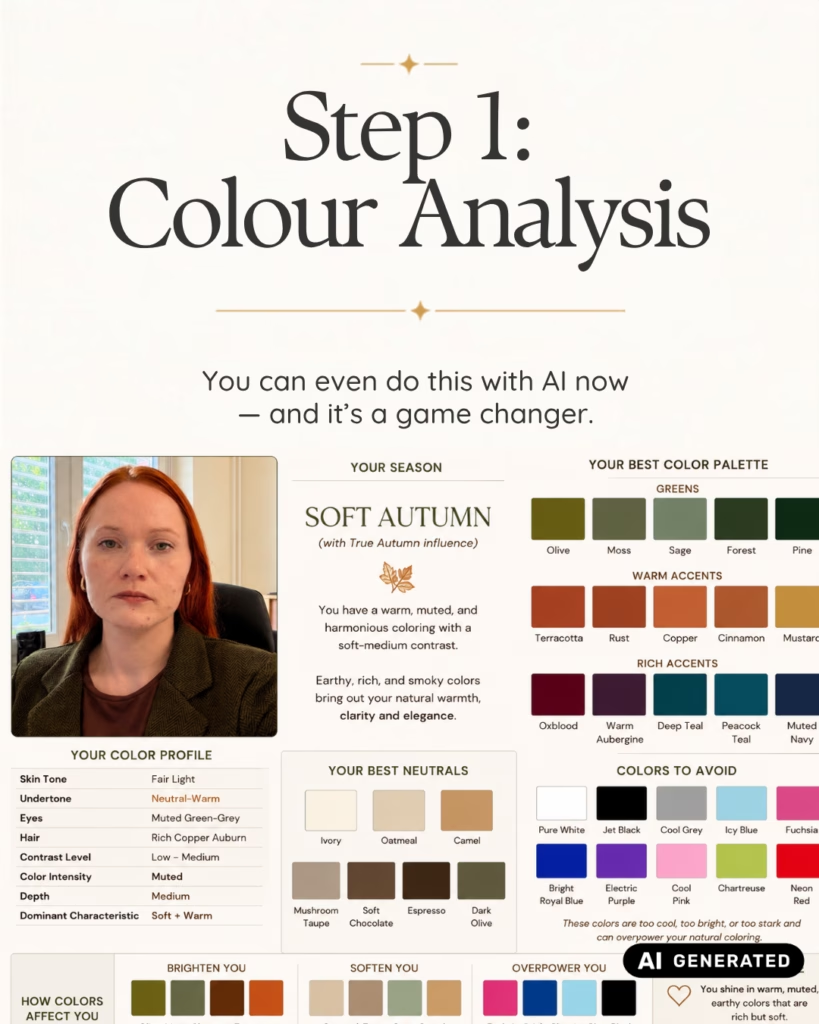
And then I fell into the rabbit whole of personal styling. I had AI do a colour analysis and read up on anything I could find to proof that. I read about kibbe bodytypes and essences and really looked at myself in the mirror to analyse it. And then I found style roots, that further cement the feel of your clothes. Let me try to describe it: I am a Kibbe Romantic, so basically very rounded and soft, but my essence is more classic. So basically more blouses with collars and less ruffles. My style root is mainly Mountain and mushroom, those underline the classic essence (Princess Katherine could be classified as Mountain and Mushroom would be Hedy Lamar). Usually you have a third, but in that I am a little stuck, I feel like earth is more my work place style because it’s a little toned down and fits my colour palette so well, sometimes it’s flower which supports my romantic body type and is more softer fabrics and when going oout it’s either fire (sexy like Marilyn Monroe) or Moon (edgy). If you want to visualise this, I have a whole pinterest board here.
All in all style became less about hiding my body and more about communicating who lives in it. There is no correct glow up aesthetic. Yours might be minimal, bright, dark, romantic, sporty, sharp, soft or quietly strange in the best way. The point is not to look expensive or effortless. The point is to stop postponing self respect until your body changes.
7. I let joy become part of the plan
Recovery is not only about cutting out bad habits. It is also about adding reasons to want your energy back. At some point, I realised that all my habits were about fixing myself. Very few were about enjoying my own life. So I started putting joy in the calendar on purpose. I travelled with friends even when it meant uncomfortable conversations about money and time. I went to concerts alone when no one else was free and gave myself permission to enjoy it anyway. I came back to yoga and meditation, not as another thing to optimise, but as a way to sit with myself. I made space for learning again, not just for qualifications, but for curiosity.
These things did not make me less serious about my career. They made my life too big to fit inside my job title. Travel, especially when it is planned around an honest schedule and budget, gave me proof that I could handle more than I thought. It broke up my old routines. It reminded me that I could be a beginner in a new place, navigate unfamiliar systems, get lost, find my way and return home with a wider sense of what was possible. Joy is not a prize you collect once you become the final, polished version of yourself. It is part of how you become well in the first place.
The habits I would start with if I had to begin again
If you feel overwhelmed reading all of this, please do not try to copy my entire life. Start much smaller. Choose one honest promise in each area.
Sleep: Pick a realistic bedtime for three nights this week, not an ideal one you will instantly break.
Food: Prepare one easy meal you can repeat on the nights when your energy is on the floor.
Movement: Take a ten minute walk or stretch in your living room without turning it into punishment.
Boundaries: Delay one automatic yes. Give yourself time to check your capacity and then answer.
Skin: Make sun protection the one step you almost never skip.
Style: Wear one thing you have been saving for a more deserving version of yourself.
Joy: Put one enjoyable plan in the calendar before the week fills up with obligations.
Quick reference: my inside out glow up
Area
What changed
What I notice now
Sleep
I protect rest before I hit crisis point
I wake up with more capacity and less dread
Food
I choose repeatable nourishment over extremes
My energy feels steadier across the day
Movement
I train for health and capability
I trust my body more in everyday life
Boundaries
I leave room for bad days
I feel less constantly braced and on alert
Skincare
I keep it simple and consistent
My skin feels cared for instead of criticised
Style
I dress the body and life I have now
I feel more like myself in my own clothes
Joy
I schedule life beyond work
I feel present, not just productive
Questions I still get about glowing up
Do I need to lose weight to have a glow up?
No. My body changed during my recovery, but weight loss is not the entry ticket to confidence, health, style or feeling alive. Your glow up can start with better sleep, more support, a kinder wardrobe, one honest conversation or finally making a medical appointment you keep postponing. Feeling more like yourself does not depend on a number.
How long did it take to see a difference?
Some changes were almost immediate. Having a plan for a difficult week helped me feel less chaotic right away. Saying no to one thing gave me one evening of peace. Other changes took months. Skin, strength, mood and trust in myself built slowly. The important shift was not a dramatic before and after photo. It was the quiet realisation that my ordinary days were easier to live.
What if I cannot do all of this consistently?
I cannot either. A sustainable system expects bad days. I keep a minimum version of each habit: a short walk to the corner and back, a very simple meal, a shower, an early night or sending a message to ask for help instead of disappearing. Consistency is not never falling off. It is knowing how to return without turning one hard week into a new identity.
Is this a beauty routine or a health routine?
It is both, because I do not experience my body in separate categories. How I sleep affects my face. How I eat affects my focus and my skin. How stressed I am affects my posture, my digestion and my patience with myself. How I dress affects how I move through rooms. The inside and outside are constantly talking to each other.
What should I do first?
Start with the thing that would make tomorrow less difficult. Not the most impressive habit to post about. The most supportive one. The one your body keeps quietly asking for. More often than not, I do believe that is sleep. But that does not have to be your story.
The glow up is yours, not a performance
I used to think a glow up meant becoming unrecognisable or Her. Now I think it means becoming easier to recognise, especially to yourself. The woman I am today is not perfect, fully healed or immune to exhaustion or bad decisions. She still struggles to eat a good dinner or sleep enough. The difference is that she is more honest about what she needs and less willing to abandon herself for approval. She has learned that self care is not selfish, that a life can be beautiful without being chaotic and that a body is not a project with a deadline. You do not have to wait until you are thinner, richer, calmer or more deserving. Start with the thing that would make tomorrow less difficult, and let the rest grow from there.
For more realistic routines, intentional living, travel systems and long term health habits, subscribe to my newsletter. I will meet you there with ideas that fit around a real job, real responsibilities and the occasional very unglamorous bad day.
Part of The One-Person Renaissance: A 12-Month Blueprint to Becoming the Most Educated, Empowered Woman: Read the full series overview here.
I grew up in a house where the word “stable” was sacred. Not stable like calm. Stable like this: Do not shake the system. Do not take risks. Do not dream too loudly, because loud dreams are for people with safety nets. My mum worked hard. She followed the rules she was given. And the quiet lesson I absorbed was clear. Get a good job. Keep it. Be grateful.
So I did. Law degree. HR career. Salary, pension, the full safety package. For a long time that felt like enough. It felt like I had done life correctly.
After my body had given out when I was still at university, it felt like winning the lottery. Somewhere between my burnout and the slow, boring, unglamorous rebuilding, I started to notice something. The people I found most interesting, the ones who seemed to have built something that was actually theirs, were not the ones who threw stability in the bin. They were the ones who held both. A job and a project. A salary and a side thing. Security and something small growing quietly in the background.
That awareness did not arrive as a dramatic epiphany. It arrived on a random Tuesday evening with a cup of tea and a book I had been avoiding. I remember thinking, almost annoyed with myself: why does entrepreneurship feel like it was designed for someone who is not me.
March felt like the right month to sit with that properly. The shift from February into March does something to my brain. The light changes. The air feels a tiny bit less heavy. Things start to grow whether you feel ready or not. Spring does not wait for your plan. It just starts.
So this month I studied entrepreneurship. Not to become an entrepreneur tomorrow. Not to quit my job, launch a product or post a smug day in the life of a CEO reel. I wanted to understand it. To read it like a lawyer and a tired autistic HR woman who grew up in financial scarcity. To ask what is actually useful for someone like me, and what is just noise in a nice font.
This is what I found:
Why Entrepreneurship Literacy Matters Even If You Never Start a Company
You Already Live Inside a Business. You Might as Well Understand How It Works.
Here is something I wish someone had told me at the start of my HR career. Every organisation you will ever work for is, at its core, a machine for creating and capturing value. That is it. Understanding how that machine works how pricing decisions get made, why some products get money and others quietly disappear, how a company decides what your role is worth is not optional knowledge if you care about your career. It is the difference between being managed and understanding the game you are inside.
When I started reading about entrepreneurship this month, I realised I was not just reading about starting a business. I was reading about how value gets created, how markets respond to problems, how systems either scale or fall apart. Very quickly I started seeing my own workplace through a different lens.
Why do we approach projects in this specific way?. What problem are we really solving and are we actually solving it? Where is the inefficiency that someone, someday, will build a better solution for? These are not abstract, MBA exam questions. They are the questions that make you sharper in a meeting, more grounded in a negotiation, and harder to ignore in a performance review.
Entrepreneurship literacy is career literacy. Full stop.
It Also Makes You Better at Spotting Opportunity
One thing I kept coming back to this month. A lot of entrepreneurship is just pattern recognition. Noticing what is missing. Noticing what is broken. Noticing where people are paying a lot of money for a very average solution because nothing better exists yet.
You do not have to be the one who builds the better solution to benefit from that skill. Sometimes the most powerful move is to put yourself inside the company that is about to be disrupted or the one quietly doing the disrupting. Sometimes it is knowing which industry to move toward and which one to leave before it shrinks around you.
Understanding entrepreneurship does not mean you have to become an entrepreneur. It means you stop moving through an economic system on autopilot.
What Entrepreneurship Actually Is (vs. What It’s Sold As)
Let us be honest about what most entrepreneurship content looks like.
Someone with a ring light and a Shopify store tells you to “bet on yourself.” Someone who raised a seed round at 24 tells you the only thing between you and success is mindset. Someone who sold their company for eight figures tells you the secret is waking up at 5am and drinking iced coffee they did not make.
Most entrepreneurship content is a highlight reel narrated by someone who had capital, connections or a co founder with both and who no longer remembers what it felt like to start without those things. That is not bitterness. That is just paying attention.
Underneath the noise, the actual definition of entrepreneurship is pretty plain. You notice a problem. You create something that solves it. Then you build a system around that solution so it can work without you manually pushing every button every single time.
That is it. No ring light required.
What helped me this month was pulling apart the concept of entrepreneurship from the culture of entrepreneurship. The concept is old, practical and available to anyone. The culture the mythology, the burn the boats slogans, the worship of exhaustion is recent. And it was not built with everyone in mind.
What I Actually Learned This Month
The Hormozi Concept That Reframed Everything
I picked up $100 Million Offers by Alex Hormozi fully expecting to feel like it was not for me. In some ways I was right. The scale he talks about, the rhetoric that does not feel like me, the examples that start from you already having an audience that is not my life. And I am not the glowing content creator who grows a community in a month.
But one idea stopped me.
Hormozi talks about a “value equation.” The basic idea. The perceived value of any offer comes down to four things:
The dream outcome someone wants
How likely they believe it is that they will get that outcome
How long it will take
How much effort or sacrifice it will cost them
High dream outcome + high perceived likelihood + low time and low effort = feels valuable.
The formula itself did not shock me. What sat with me was the implication.
I used to think about value as something fixed. A product is either good or it is not. A service is either worth it or it is not. His framework suggests that value is mostly perceived and that perception is something you can shape on purpose. The same service, described differently and structured in a way that feels easier and clearer, becomes worth more. Not because the service changed. Because the story and the experience around it changed.
For someone like me, who has spent years quietly building skills and systems that actually help people at work, that hit a nerve. I am not bad at creating value. I have been (and still feel like I am) bad at communicating it. Those are not the same problem. They do not need the same solution.
Women, Entrepreneurship and the Gap Nobody Talks About Enough
Women own approximately 42% of all US businesses ( I use US numbers here, because most of the podcasts and literature I found was american) but those businesses generate only 4.3% of total business revenue, reflecting deep structural disparities in scale and access to capital.¹
In 2023, female-founded startups received just 2.1% of all venture capital funding in the US, a figure that has barely moved in a decade.²
Millennial and Gen Z women are the fastest-growing demographic of new business owners, with self-employment among women aged 25 to 44 increasing by over 20% between 2019 and 2023.³
The average female-founded business is started with 50% less capital than the average male-founded business, meaning women are not less entrepreneurial, they are less funded.⁴
In the EU, women represent 34.4% of the self-employed, but are significantly underrepresented in high-growth sectors including technology and finance.⁵
The Critical Thinking Lens: Who Entrepreneurship Culture Was Built For
This is the part my brain kept circling back to all month. Entrepreneurship culture the books, the podcasts, the constant content around building a business was mostly created by people who started with things many of us do not have. Money. Or a network that acts like money. Or no dependants. Or the kind of confidence that comes from never being told that ambition is not for people like you.
I listened to Emma Grede on Aspire, talking about finding your why and starting your business and I found it genuinely inspiring. I also could not ignore that her starting point the connections she had, the industry she was already in is not something most listeners can copy. That does not make her story less true. It just makes the gap more visible.
Grace Beverly on Working Hard Hardly Working was more honest about this than most. In her episode on the four things she wished she had known before starting her business, she is pretty clear that what she built was possible partly because of timing, partly because of social media and partly because of things she did not fully control. That level of honesty is rare in this space and I appreciated it. But what is also clear to me, she solved a specific problem, she herself had and made that into a business. This is actually a story many female founders seem to share.
Leila Hormozi’s Build episode on goal setting mistakes was sharp and very practical. It was also written for someone who is deep in the building phase, not someone standing at the edge asking should I even try. Which is fine. It just means you need to know where you are on the path before you swallow the advice.
The Diary of a CEO episode “The Woman Who Makes Millionaires” was the one that made me most uncomfortable, in a way I needed. The whole “only 1% of people do this” framing is a classic scarcity hook. It works. It also quietly suggests that if you do not build wealth, it is because you personally failed, not because the system is skewed. Both things can be true at once. Mindset matters. The system is not neutral. Holding both without gaslighting yourself is part of thinking critically about this kind of content. And I don’t agree with Natalie Dawsons view on Burnout.
The Build-in-Public Question
There is a big trend right now around building in public. Sharing your process, your numbers, your failures, your wins, in real time. The idea is that it builds trust, audience and accountability all at once. I get why people like it. I also get why many women cannot safely do that. Especially if you are neurodivergent or you work in a conservative professional environment where a side project might look like disloyalty or you have people in your life who are not safe to share with. For some of us, visibility is not just vulnerable. It is risky. Yes, you can hit the block button any time and I urge everyone to use it liberally, I know I do. And you can be personal and still not share too personal things. But, seeing a woman fail in public if it doesn’t work out, feels to me, like just confirming gender biases.
Building in public is a real, valid strategy. It is also a strategy that quietly assumes a level of safety, professional, personal, social that is not evenly spread. For some of us, privacy is not fear. It is protection. You do not owe the internet your process for it to be legitimate.
I am building something. I am not ready to say what yet. That sentence stands on its own.
How I Actually Studied This Month
My original March plan looked great on paper. Classic autistic over engineering. Reading schedule, podcast queue, structured note taking system, colour coding. By the second week the schedule was gone and the system survived.
What actually worked. I read in the evenings before winding down for bed, listened to audio books and podcast while commuting and on the weekends doing chores. $100 Million Offers was read in a hospital waiting room while waiting for my mum. I did not force myself to read every book front to back. I jumped to the chapters that felt relevant to where I am, bookmarked the rest and let myself be a messy, non linear reader without shame. Small anecdotes were added to my notion pages at intervalls and I am still thinking of actually building myself a Zettelkasten on Obsidian.
I also went back to January’s economics reading. Herbert Edling’s Economics and Thomas Barthel’s Public Economy which I had worked through in January for the finance and economics month were more useful than I expected. Understanding how markets price things, how supply and demand actually behave, how public goods differ from private ones gave me a base layer. It helped me see why some business models work and others are slow motion disasters. The months in this series are meant to build on each other. This whole year is about amplifiying my general education and here it is again, becoming a top 1% educated woman. This was the first time I properly felt that stack in my brain instead of just knowing it in theory.
February’s technology and AI month kept showing up too. Almost every conversation about entrepreneurship ends up touching on what tech makes possible now that was impossible five years ago. Because I had already done the work in February, I did not feel lost when the conversation turned to that. I am not an entrepreneur yet. I might become one. I might build something small and keep it deliberately small. Or I might build something that surprises me. I honestly do not know.
What I do know is that this month shifted how I see myself in relation to building. I stopped seeing entrepreneurship as a personality I do not have and started seeing it as a cluster of skills I can learn. For someone who grew up being told stability and ambition cancel each other out, that is not a small shift.
Q&A: The Questions You Are Actually Asking
Q: I have a full-time job and no time. Is it even realistic to build something on the side?
Realistic, yes. Easy, no. Building something next to a full time job means you have to be ruthless about what you are not doing, not just what you are doing. Most people who build on the side do not secretly have extra hours you do not have. They have made different trade offs. That said, if you are in burnout recovery or your job is currently eating every spoon you have, this might not be your building season. That is not laziness. That is triage.
Q: I don’t have savings or capital to start anything. Does that mean entrepreneurship isn’t for me?
No. It means the kind of business you can start looks different from the ones that fill most books. Service businesses consulting, coaching, freelancing, writing need more time and skill than cash to begin. Digital products usually cost more in energy than in money. The capital heavy, high risk startups are the ones that get media coverage, which makes it easy to forget that most people who start something do not start there.
Q: I’m worried that if I start something and it fails, it will affect my professional reputation.
This is a real fear, especially in more traditional fields. Being seen as someone who tried something and it did not work can carry a stigma it should not. The loud build-in-public crowd rarely names that. You are allowed to build quietly. You can test ideas under the radar. You can move slowly and privately until you have something you feel safe attaching your name to. Your work is still real, even if no one sees the early versions.
Q: The entrepreneurship content I consume makes me feel like I’m already behind. How do I deal with that?
Start with this. A lot of people creating that content make money when you feel behind. Urgency sells programs. The “only 1% of people do this” line is a hook, not a diagnosis of your life. You are not late. You are at the beginning. That is the only place you can actually start from.
Keep Going With Me
If this hit something in you, subscribe to the newsletter. That is where I share the less polished version of all this. The messy notes. The things that did not work. The books I am reading before they get turned into essays.
This post is part of a 12 month self education series called The One-Person Renaissance. We have already covered Economics and Finance in January and Technology and AI in February. March is entrepreneurship. April is next.
I was scrolling on Social Media and everywhere I looked it was a new Claude feature here and a new AI Assistant there. And I sat there with my phone, my very human brain and that particular autistic mix of hyper focus and delayed emotional response. It felt like the floor shifted a few millimetres under my chair. Not enough to make anyone else look up. Enough that my nervous system noticed. It was not panic. It was not outrage. It was the quieter thought that scared me more. Things are changing and fast.
I work in HR. I have a law degree. I have spent years learning how to read people, how to write policy, how to live inside the gap between what organisations say they value and what they actually do. And here are people handing there most personal data and thinking to a machine.
And it made me realise: If I do not understand what this technology is, I will be making decisions about it with no real way to push back. That was the day I stopped treating AI as someone else’s specialist topic and started treating it as part of my actual life.
January in the One Person Renaissance series was about economics and finance and that month showed me that the systems shaping our money are not neutral at all. February took that same lens and turned it toward technology. Specifically artificial intelligence. What it is. What it costs. Who it serves. What it means for women like us who are trying to build careers and lives on purpose instead of on autopilot.
This is not a post from a tech person. I am not a tech person. I am an autistic, burnt out, rebuilding person who decided that staying ignorant was no longer an option.
Why This Is Not Optional Anymore, Especially If You Are a Woman in a Professional Career
Here is the part that does not get said in polite meetings. AI is already involved in your career. Not as a future scenario. As a present tense fact.
It screens your CV before a human ever scrolls. It scores your performance data. It flags patterns in how you communicate. It is used to predict who might leave, who is a high performer, who looks like a good bet. And the people building these systems are, statistically, not people who look like most of us or live lives that feel like ours.
We already know there is a pattern of AI systems absorbing the bias in their training data. Amazon scrapped an internal recruiting tool in 2018 after they discovered it was quietly pushing down CVs that included the word “women’s” — in things like women’s chess club or women’s leadership programme. The model learned from ten years of past hiring. Ten years of mostly hiring men. The machine copied the humans. The humans had a bias. The machine scaled it up and sped it up.¹ Understanding AI is not about becoming a programmer. I have zero interest in writing code. This is about basic fluency. Enough that when someone in a meeting says an algorithm made a decision, you know what to ask next. Enough to know when to say no.
For women in professional careers, that fluency is not an extra confidence skill. It is self protection.
What AI Actually Is, Translated Into Real Life
I spent a lot of February pulling jargon apart, because jargon is one of the neatest ways to make people feel stupid and shut them out of the conversation.
So here is how I now explain it when I am talking to friends who also do not feel like tech people.
The Short Version
When most people say AI right now, they are talking about systems trained on huge piles of data (often intelectual property of people who did not give liscences for it) that learn to spot patterns and then use those patterns to produce something. Text. Images. Recommendations. Scores. The tools you probably use already fit this description. Autocomplete in your email. The recommendations on your streaming service. The chatbot that appears when you are trying to get a refund. They all do their own version of the same move. They look at past data, find patterns and guess what should come next. The newer wave, the large language models like ChatGPT, are trained on staggering amounts of text from the internet. They learn the statistical relationships between words. When you ask a question, the model is not sitting there pondering like a tiny digital philosopher. It is predicting, in very fast detail, what a plausible response looks like given everything it has seen before.
That matters. It is not conscious. It does not understand your question the way a human does. It is extremely good at pattern recognition and at stringing words together. That is not the same thing as intelligence, no matter what the branding suggests.
The Longer Version
Ray Kurzweil’s The Singularity Is Nearer argues that we are moving toward a point where AI will surpass human intelligence in most areas of life and that this will happen faster than most people expect. Reading him felt like sitting with a brilliant, relentlessly optimistic uncle. He has big timelines. Big confidence. Some of his earlier predictions have been uncomfortably accurate, which makes it harder to roll your eyes and move on. Max Tegmark’s Life 3.0 felt different. Less like a prediction, more like someone saying, “Here are the questions we should probably ask before we press go on this thing.” Tegmark treats AI development as one of the most consequential things humans have ever done, and argues that what happens next depends heavily on choices we are making right now, not in some distant future we can leave to our grandchildren.
Neither book is light. I did not sit in the bath with a scented candle and casually absorb them. But both gave me ways to think about AI that went far beyond the usual “will it take my job” panic. Which, I learned fairly quickly, is the wrong question anyway.
The Critical Thinking Lens: AI Is Not Neutral
The most dangerous thing about AI is not that it might become smarter than us. It is that we might hand it authority before we have asked who built it, what it was trained on and whose interests it was designed to serve.
This is where most of my February energy went. Also the part that is almost totally missing from glossy AI conference talks and LinkedIn posts.
AI systems are built by humans, trained on data created by humans and rolled out to serve the interests of whoever is paying for them. None of that is neutral. All of that shapes what the system does and who it harms.
Nick Bostrom’s Superintelligence is dense and academic and at points I had to put the book down and go for a walk. Not because of science fiction scenarios, but because he is describing real structural risks that serious researchers are genuinely worried about. His central obsession is alignment. How do you make sure a powerful AI system pursues goals that are genuinely good for humans, rather than goals that look correct in a narrow technical way but clash badly with our actual values. It is the difference between “technically correct” and “this ruins lives.”
Nicholas Carr’s The Shallows looks at something smaller and closer. Not future superintelligence. Just the internet we already have and what it is doing to our brains. He writes about how the constant flood of information and the way digital media is structured changes how we read, think and focus. His argument is that we are trading depth for speed. We skim instead of sit. We snack instead of cook. The cost of that trade is slow. You do not notice it on a Tuesday afternoon, but over years it adds up. And I do believe we see the first results already, one only has to look at teenagers today.
Reading Carr alongside Kurzweil and Tegmark created this odd tension in my head. Some people are looking at civilisation level change. Carr is looking at what happens in your nervous system every time you grab your phone instead of letting your mind wander for five minutes.
Both levels matter.
The Environmental and Economic Costs Nobody Mentions at Conferences
When I put my critical thinking hat on here, I found something that really bothered me.
Training a large AI model eats a huge amount of computing power, which means a huge amount of electricity. A 2023 study estimated that training a single large language model can create as much carbon dioxide as five cars over their whole lifetimes.² The data centres that keep these systems running use billions of litres of water for cooling. The hardware depends on rare earth minerals that have to be mined, often in places where local communities carry the environmental and human cost. None of this means AI is automatically wrong. I do not think that. But it does mean the story of AI as a clean, neutral, purely progressive tool is incomplete. There are real costs. They do not land on everyone equally. And they almost never appear in the slide deck when someone is selling you efficiency. Maybe, and this is something I also read about this month, AI will advance to a point where it can create nanobots (yes, a la Iron Man) and these bots can become every atom or substance needed. A rare mineral or a body cell. At that point we will probably mine less and possibly be able to reduce energy costs. But in what state will our environment be by then?
What I Actually Learned This Month, Including the Thing That Unsettled Me
I spent part of February listening to two episodes of Diary of a CEO that I would recommend if you want to think more seriously about AI without needing a computer science degree. The Roman Yampolskiy episode is the one that lodged itself in my brain. He is an AI safety researcher and his position is not gentle. He does not think we can build a safe superintelligent AI. Not “it will be tricky.” Not “we need more regulation.” He thinks the problem might be impossible to solve and that most people pushing ahead with AI development are not acting as if that might be true. And I get him. A superintelligence is unprecedented and able to think of scenarios we cannot even phatom. So how do we protect ourselves if it doesn’t stay benign?
As someone who likes solutions and frameworks and neat systems, I found that hard to sit with. I did it anyway.
The Mo Gawdat episode felt emotionally different. Gawdat, who used to be Chief Business Officer at Google X, talks about AI with a kind of tired urgency. He is not trying to stop it. He treats its progress as inevitable. His focus is on the values we pour into these systems and whether the people building them are thinking carefully enough about what they are actually creating.
The BigDeal episode about building a business with AI employees was the most concrete and grounded. No sci fi. Just small business owners matter of factly talking about using AI tools to handle operational work. What struck me was not fear. It was how normal they made it sound. This is not a thought experiment for them. It is a Tuesday. That made my own career questions feel less hypothetical too. This is already happening. The question is not if it touches your field. The question is how soon and in what shape.
The Thing That Genuinely Unsettled Me
Here is the part that got under my skin. It was not the headlines about jobs being replaced. It was not Bostrom’s alignment problems. It was something smaller and closer.
I was reading about how some organisations now use AI in performance management. Tools that monitor productivity, track communication patterns and generate neat little assessments of individual performance. And I thought about me.
I am autistic. My brain works differently. I have spent years masking and adapting and performing a version of myself that looks “professional enough” in offices that were not built with people like me in mind. So imagine an AI system trained on data from neurotypical high performers assessing my email response times, my wording, how often I speak in meetings and turning that into a score. No context for sensory overload, for burnout, for the careful pacing that keeps me functional. No measure of the actual thought processes brought into every decision. That did not feel abstract. It felt personal. And it reminded me that the people already on the edge of existing systems are usually the ones most exposed when a new layer of automated judgement arrives.
The Tension: Tool That Frees You vs. Force That Replaces You
I refuse to be either a cheerleader or a catastrophist about AI. Both positions are lazy. The honest answer is that it depends, on who builds it, who governs it, who has access to it and whether the people most affected by it have any say in how it is deployed.
This is the question I kept circling all month, usually while making tea or staring out of train windows. On one hand, AI already makes my life easier in very practical ways. I use it to sketch first drafts of documents that would otherwise take me a whole evening. I use it to summarise long reports when my brain is already fried. I use it to generate options when I am stuck in black and white thinking. I use it to summarise and plan projects, I use it to fasten up research. It really has given me back some time. And as a burnout recoveree, time and energy are my most guarded resources.
On the other hand, I have watched AI being used to create deepfakes with malicious intentions, stolen intellectual property and accusations of using AI for writing anything in proper grammar.
So my conclusion was simple and not very glamorous. The technology is not the root problem. The governance is. And governance is a human problem, which means it is a space where people like us, educated, tired, paying attention, working in real organisations, are needed.
I am not anti AI. I am pro awkward questions about AI. Those are different positions and the way people talk about this topic often collapses them into a loud, useless binary. Let’s return to a topic many recognise in the AI debate: Is AI coming for our joby.
The short answer. Yes
The long one: one at a time. At first it will and is already hitting entry level jobs and lower income fields. Anything that is easily repeatable. Those have been the first jobs to go anywhere. We are not dictating our letters anymore ever since everyone at work uses a PC, we need less people working in archieves if they’re digital. But AI will go further and include more and more jobs.
This month I learned that humans will probably become like the nobility in history. Adminstrating themselves and living a cultural and social setting. No more 9-5, no more work. But what will be our way towars that? Who will we loose and leave behind? What will our society do, to ensure a stable life and income for everybody?
Those are the questions we already have to ask. But somehow we don’t.
How I Actually Studied This Month: My February Routine
I want to be specific about how I studied because “I read four books and listened to six podcasts” can sound either impressive or fake. Especially if you are already stretched thin.
I did not sit down and read four books from start to finish. I read what I needed and gave myself permission to be strategic. Weeks one and two: I started with Life 3.0. Tegmark is the most readable of the four authors on my list, so I began there. Thirty minutes in the morning before work with my coffee. No highlighters. Just a plain notebook where I wrote down questions that came up as I read. Week three: I moved to The Shallows in the evenings. Carr’s tone is more personal and the book is shorter. It felt like a good counterweight to the broad, sweeping thinking in Tegmark. That same week I listened to the Yampolskiy and Gawdat episodes of Diary of a CEO on my commute. Week four: I did not force every page of Superintelligence. I used the index and the chapter summaries and went straight to the sections that connected with the questions I had already written down. I listened to the audiobook of The Singularity Is Nearer on my commute. I also listened to the BigDeal AI CEO episode and blocked out an afternoon to actually experiment with several AI tools. No theory. Just testing. Where did they genuinely help. Where did they spit out confident nonsense.
The honest truth is that when you study something this complex and emotionally loaded, the goal is not to finish the reading list. The goal is to walk away with better questions than the ones you started with.
That is what February gave me.
Since then I have been experimenting with AI agents and prompts to make my life easier and it also rekindled my love of learning, because in these changing times the ability to grow and learn will become a key factor.
By the Numbers
Women hold only 26% of data and AI roles globally, according to the World Economic Forum’s Global Gender Gap Report 2023.³
The McKinsey Global Institute estimates that up to 14 million workers in the US alone could need to change occupations by 2030 due to AI-driven automation, with women in administrative and service roles disproportionately affected.⁴
A 2024 LinkedIn Workforce Report found that AI literacy is now among the top five skills employers are looking for across industries , including sectors traditionally dominated by women, such as healthcare, education and HR.⁵
Despite this, women are significantly underrepresented in AI ethics and governance roles, the exact spaces where decisions about how these systems are built and deployed are being made.
Q&A: The Questions You Are Actually Asking
Q: I am not a tech person. Is it too late for me to understand AI well enough to use it or protect myself from it?
No. And I say that as someone who spent most of her adult life assuming technology was for other people. The barrier to understanding AI is not technical skill. It is vocabulary and confidence. You do not need to know how to build a model. You need to know what questions to ask when someone tells you a decision was made by one. Start with one good book, I would recommend Life 3.0 and one good podcast episode, the Mo Gawdat Diary of a CEO episode is a strong entry point. That is enough to start.
Q: Should I be worried about AI replacing my job?
Honestly? Some roles will change significantly. Some tasks within almost every role will be automated. But the research consistently shows that the jobs most at risk are those built around repetitive, predictable tasks, not the jobs that require judgment, relationship management, ethical reasoning or contextual understanding. Though I do believe they will follow. The goal is not to avoid AI. It is to understand it well enough to position yourself as someone who works with it intelligently, rather than someone who is simply replaced by it.
Q: How do I know if an AI tool is actually good or just well-marketed?
Ask three questions. First: what was it trained on and by whom? Second: what are its known failure modes or limitations? Third: who bears the cost when it gets something wrong? If the company selling you the tool cannot answer those questions clearly, that tells you something important. I also look at where servers are located, e.g. if they’re in Europe and follow the GDPR. But that’s a personal decision.
Q: I feel overwhelmed every time I try to read about AI. Where do I even start?
Start with the feeling, not the information. The overwhelm is real and it is not a sign that you are not smart enough. It is a sign that the topic is genuinely complex and that most of the public discourse around it is either hype or panic, neither of which is useful. Give yourself permission to go slowly. One book. One podcast. One conversation with someone who thinks critically about it. You do not need to understand everything. You need to understand enough to participate in the conversation.
January was economics and finance, understanding the systems that shape our money and our choices. February was this. Each month builds a different layer of the same foundation: a woman who understands the world she is living in well enough to move through it with intention and to grow her skills.
If you want to follow along in real time, subscribe to the newsletter below. I share what I am reading, what I am questioning and what I am actually applying – without the performance of having it all figured out.
Strubell, E., Ganesh, A., and McCallum, A. (2019). Energy and Policy Considerations for Deep Learning in NLP. Proceedings of the 57th Annual Meeting of the Association for Computational Linguistics. https://arxiv.org/abs/1906.02629
I was twelve years old the first time I understood that we were poor. Not in the softened, tidy way adults sometimes say it. I mean the kind of poor where my mum would stand before the shelves in a supermarket, adding prices up and calculating what we wouldn’t be able to buy- The kind of poor where my grandma used to bulk cook food and bring it over for us. She had just lost her job. After 30 years in the company, the company was sold and shut down. She was not careless. I noticed her worries and tried to help. But nobody really explained things to me.
Money felt like weather. It happened around us. You earned it, you spent it, you ran out, you started again. No one talked about it. No one named it. That was the full lesson plan.
Fast forward twenty years. I have a law degree. I work in HR. I have been on holidays my eleven year old self would never have believed were possible. And still, most of my adult life, I felt the same low level panic at the checkout. The same feeling that money was something that happened to me, not something I could shape on purpose.
It was not an income problem. It was a language problem.
That shifted in 2021. Nothing really exciting happened. There was just me strolling and landing on the page of a financial coach for women. She was talking about financial literacy and how important it was and how no one taught us in school. Which really resonated with me. This started my journey. I started reading up on retirement insurance, about emergency accounts. I started slow. A budgeting hack here and there, a turnover on my insurances. Then I read my first books about investing. ETFs sounded like the safe and logical way. I opened up an investment account in 2023 and invested my first 100 € and then I did – nothing.
I was trying to get a feel on my emotions in investing. Because as I learned, you have to like the way you invest to be able to keep it up longterm and during recessions. I like investing, I really do. So after one whole year, I set up my automated payments. Into my emergency account, into my investment account and into my continued financial education.
I had changed a lot and rediscovered my love of learning. That had me set up a personal curriculum for me and of course finance had to play a part. So January was my financial education month. Not because January is special, I decided to make it special. As part of my One-Person Renaissance curriculum, I gave the whole month to economics and personal finance. I read and am still reading about financial literacy, the psychology behind money and investing. About different investment strategies, from ETFs, bonds and shares to real estate, private equity and angel investments.
No more avoiding it. No more hoping it would somehow make sense later.
January is dark and quiet and a bit nothing. I used that flat, grey energy as a place to sit with the thing I had been dodging for years.
This is what I learned, what I read, what I listened to and why I think learning how money works is one of the most quietly radical things a woman can do for herself right now. And it had me max out my emergency accounts, freeing up investment money and living month to month without worrying at the register.
Note: this is not investment advice but a record of my personal experiences. All investments offer risks. Always do your own research before investing money.
Why Financial Literacy Is Actually About Freedom (Not Just Money)
Here is what no one tells you when you grow up with not enough money. The lack is not only in your bank account. It moves into your body. It wires your nervous system. It decides how much risk feels safe, how much you dare to ask for, how big you let yourself want.
I spent years on a good salary and still felt breakable. Not because I was irresponsible. I knew how to stretch money. I knew how to survive. What I did not have was a clear way to think about money beyond getting through the month.
Financial literacy is what sits in that gap.
It is the difference between checking your balance and actually knowing what your money is doing when you are asleep. The difference between only working for money and, eventually, setting things up so money also works for you.
Robert Kiyosaki puts it bluntly in Rich Dad Poor Dad: the rich do not work for money. They acquire assets. The sentence looks almost silly when you first read it. It took me weeks to let it really land. Because to take that seriously, you have to completely change your idea of what it means to be doing well. Doing well is not just a high salary. It is money that still arrives when you are ill or burned out or taking a break. No one in my childhood ever talked about that. Not once. That is not a small missing piece. That is a whole other subject that never made it to the kitchen table.
The Two Things That Actually Changed How I Think About Money
I am not going to give you a reading list and wish you luck. I want to tell you about the two ideas that cracked something open for me and the books that delivered them.
Compound Interest: The Thing That Made Me Angry I Hadn’t Started Sooner
Albert Einstein allegedly called compound interest the eighth wonder of the world. I do not know if he really said it. The idea is still wild. Compound interest means you earn returns not only on your original money, but also on the returns that money already made. So it stacks. Slowly at first, then faster. Not in a straight line. In a curve. An exponential growth to success.
The catch is that it needs time. Which means the most powerful thing you can do in your twenties and thirties is not to find the perfect investment. It is to begin. With whatever you can. Even if it feels small and a bit pointless at first. Don’t believe me? In his book “The Psychology of Money” Morgan Housel explains just how much of his wealth Warren Buffet, the GOAT of investing, made past his 60th birthday. Spoiler alert: a lot!
If you invest £200 a month from age 25 at a 7% average yearly return, you end up with roughly £525,000 at 65. If you wait until 35 to start, that drops to around £243,000. Same money each month. One change. When you start. That gap is compound interest doing its thing. And you don’t need a continous 7 % either. A few good years at 20 % will compeed with recession months and you will still make money.
When I read that, I did not feel motivated. I felt briefly furious. Nobody told me this at eighteen. Nobody told my mum. We were both playing a game we did not know had rules.
Morgan Housel’s “The Psychology of Money” is where I also started making peace with that anger. He does not just explain the mechanics. He explains why clever people make messy decisions with money. Why we do things that make no sense on a spreadsheet but feel safe in our bodies. It felt less like a finance book and more like someone finally describing why I act the way I do around money, without making me feel stupid for it.
One idea in particular stopped me: that getting wealthy and staying wealthy are two completely different skills. Getting wealthy requires taking risks. Staying wealthy requires the opposite: caution, humility, not assuming the good times are permanent. I had never separated those two things before. I had been treating them as the same thing, which is part of why my relationship with money felt so confused.
The Difference Between Earning Money and Building Wealth
Your salary is not your wealth. It’s your starting material. The two are not the same thing, and confusing them is one of the most expensive mistakes a high-earning woman can make.
This one took me years. I thought a good income automatically meant I was good with money. That it meant I was safe. That if I just kept earning more, the rest would somehow sort itself out.
Earning money is you swapping your time, your brain or your body for pay. It is you showing up. It is tied to your energy and your health. You stop, it stops.
Building wealth is you slowly collecting things that do not need you in the same way. Assets that have their own life. Rent coming in while you are off work. Dividends landing while you are in bed with the flu. Royalties turning up months after you did the work.
The Diary of a CEO podcast has a run of money episodes that finally made this click for me. The conversations with Alex Hormozi, Codie Sanchez and Daniel Priestley all circle the same idea from different angles. The people who end up with real freedom are not always the ones with the biggest salaries. They are the ones who learn the difference between making money and placing money. Who ask, every time it hits their account: where does this go that helps my future self, not just my today self?
The BigDeal episode “I Asked 6 Billionaires How To Get Rich” sounds like a stunt. It is worth listening to with a notebook open. The actual advice is not shocking. What hit me was how early these people learned the rules. They were shown how assets work, how risk works, how ownership works, while the rest of us were just told to get a stable job and be grateful.
The gender wealth gap is not just about pay. It is about what we do with what we earn. Women are statistically more likely to keep money in cash savings rather than investments. That gap compounds over decades, quietly, invisibly, until retirement arrives and the numbers tell the whole story.
📊 Info Box: The Gender Wealth Gap
Women in the UK hold, on average, 35% less wealth than men. In the US, women hold approximately 55 cents for every dollar of wealth held by men. A significant driver of this gap is not just the pay gap, but the investment gap. Research by Fidelity found that women who invest actually outperform men by an average of 0.4% annually, yet women are 50% less likely to invest at all. The barrier is rarely capability. It is almost always access to information and confidence that the information applies to them.
Sources: World Economic Forum Gender Gap Report 2023; Fidelity Investments Women and Investing Study 2021
How I Actually Studied This in January
January has its own mood. The world shrinks a bit. Parties stop. Shops feel quiet. You get social permission to cancel plans and sit on your sofa in socks that do not match.
Instead of fighting that, I started using it.
My study plan was simple. One book a week. I went deep on Rich AF by Vivian Tu ( a great introduction to all things money) and The Psychology of Money by Morgan Housel rather than skimming five books and absorbing nothing. I listened to podcasts during my morning commute instead of music. I was driving, stuck in traffic and someone talked in my ear about interest rates or investment accounts.
I kept a messy notes document on my laptop. Every time I hit a word or concept I did not fully understand, it went in there. Later that day or at the weekend I would look it up, watch a short video or reread the chapter until it made basic sense in my own words.
I also listened to Emma Grede’s Aspire episode “How Not Talking About Money Is Stopping You From Making It.” If you grew up in a house where money meant shame, sighs or tight silences at the dinner table, please listen to it. She names the thing I had only ever felt as a knot in my chest. The way women are taught to be grateful for whatever shows up. The way we absorb the idea that talking about money is rude, greedy, unfeminine. That silence is not neutral. It protects the status quo. It keeps you from even knowing what questions to ask.
I did not finish every book I picked up this month. Some chapters lost me and I had to come back later. Which is okay, because from Day One I knew it was going to be a lifelong learning process, because money changes all the time. I argued with a few ideas out loud in my kitchen, specifically with Kiyosaki’s framing of the poor as people who simply do not understand assets, which I found a bit too clean given that some people are working three jobs and still cannot make rent. The ideas are useful. The framing occasionally ignores structural reality. I kept both thoughts. That is the work. This is not about ticking off a reading list. It is about letting new ways of thinking settle slowly into your decision making, until you catch yourself doing something different on a random Tuesday and realise the reading actually worked.
Growing up without money does not mean you are bad with money. It means you were never taught the rules of a game you were already playing. That is not a character flaw. It is a gap you can close.
Q&A: The Questions You’re Actually Asking
Q: I earn a decent salary but I have nothing saved. Where do I even start?
Start with clarity, not action. Before you open an investment account or set up a savings plan, spend two weeks tracking exactly where your money goes. Not to judge yourself. To get an honest picture. Most people are surprised by what they find. Once you can see the full picture, you can make intentional decisions about it. The first step is always visibility.
Q: I want to invest but I’m scared of losing money. Is it actually safe?
All investing carries risk. That is not a reason not to do it. The relevant question is: what is the risk of not investing? Keeping money in a standard savings account with inflation running at 3 to 4% means your money is losing real value every year. The stock market, historically, has returned an average of 7 to 10% annually over long periods. That does not mean every year is positive. It means over time, the trend is upward. Starting small, diversifying and thinking in decades rather than months is how you manage the risk.
Q: I feel like financial content is always aimed at men or at people who already have money. Where do I find information that actually speaks to me?
Vivian Tu’s Rich AF is the most accessible starting point I have found. She goes by @yourrichbff on social media and her short form content is just as good as the book. Emma Grede’s Aspire podcast covers the psychological and cultural side of women and money with real directness. And the Diary of a CEO money episodes are worth your time regardless of gender. Good financial thinking is good financial thinking.
Q: I grew up in a household with financial scarcity. Does that affect how I handle money as an adult?
Yes, and it is worth knowing that. Research in behavioural economics consistently shows that financial scarcity in childhood shapes adult decision making in specific ways: higher risk aversion, difficulty with long term planning, a tendency to prioritise immediate security over future growth. None of that is permanent. But it does mean that for some of us, financial education is not just about learning concepts. It is about unlearning emotional patterns that were adaptive once and are now getting in the way. Morgan Housel’s The Psychology of Money is the best starting point for understanding this.
The Invitation
Financial literacy is not a luxury subject. It is not for people who already have money. It is the foundation of every other kind of freedom you want to build, the travel, the career pivots, the ability to say no to things that do not fit your life.
January is the month I chose to build mine. You can start any month. You can start today.
And if you want to make sure you do not miss February’s deep-dive into AI, technology and digital fluency, subscribe to the newsletter below. No noise. Just the good stuff.
Footnotes & Sources
Kiyosaki, Robert T. Rich Dad Poor Dad. Warner Books, 1997. richdad.com
Tu, Vivian. Rich AF: The Winning Money Mindset That Will Change Your Life. Portfolio/Penguin, 2023. yourrichbff.com
Housel, Morgan. The Psychology of Money: Timeless Lessons on Wealth, Greed, and Happiness. Harriman House, 2020. morganhousel.com
Hazlitt, Henry. Economics in One Lesson. Harper & Brothers, 1946. Available via fee.org
Dalio, Ray. Principles: Life and Work. Simon & Schuster, 2017. principles.com
Fidelity Investments. “Women and Investing Study.” 2021. fidelity.com
World Economic Forum. Global Gender Gap Report 2023. weforum.org
Diary of a CEO Podcast. “Money Making Experts” series featuring Alex Hormozi, Codie Sanchez, Daniel Priestley. stevenbartlett.com/podcast
Aspire with Emma Grede. “How Not Talking About Money Is Stopping You From Making It.” Available on all major podcast platforms.
BigDeal Podcast. Episode #83: “I Asked 6 Billionaires How To Get Rich.” Available on all major podcast platforms.
I remember waking up on my 30th birthday with a strange mix of gratitude and restlessness. By all accounts, I had a “successful” life, a solid corporate job, a comfortable routine. And yet, a quiet voice in me wondered: Is this it? Hitting thirty felt like a crossroads where one path was staying the course and the other was an unknown adventure. I feared that pursuing change meant blowing up my whole life: quitting my job, moving to a new city, starting entirely from zero. But an emotional insight dawned on me: change doesn’t have to be a destructive fire; it can be a controlled burn, clearing space for new growth without turning everything to ash. In other words, you don’t need to run away to a monastery or resign on a whim to reinvent yourself. There’s a middle way, an evolution that builds on who you are. Turning thirty can actually be the beginning of becoming more of yourself, not throwing the past away.
A friend of mine , a high-performing marketing manager, shared how at 34 she felt utterly burnt out and bored at the same time. She dreaded Monday mornings, yet the thought of abandoning her hard-earned career was terrifying. Instead of making a rash decision, she started with a small change: taking a night class in UX design, something that had always intrigued her. That single step was a revelation. Within a year, she transitioned into a new hybrid role at her company, reinvigorated and reinvented without ever having to nuke her résumé. Her story taught me that turning the big 3-0 isn’t an alarm bell to upend everything, but an invitation to recalibrate. Change can be gentle. Reinvention can mean adding new layers to your life, not erasing the canvas.
The Mindset Shift: Evolve, Don’t Scrap Your Life
Before diving into strategies, let’s talk mindset. The biggest hurdle to reinventing yourself is often the belief that you must discard your past to create a new future. In reality, your past is your power source. Reinvention is about evolution, not deletion. As career expert Caren Merrick wisely writes, “Reinventing doesn’t mean devaluing or eliminating all that came before you.” All your decisions, struggles, and triumphs have made you the valuable person you are – they actually qualify you for the next step in your journey. In other words, a career or life reset is not a zero-sum game where a new path cancels out your old one. Think of it more like a relay race: you carry the baton of experience forward. Each phase of your life has been training for your next adventure. “Career change is not a gaping chasm ready to swallow you; it’s simply new space in an already thriving garden,” as one coach puts it. This shift in perspective is crucial: you’re not starting from scratch, you’re starting from experience. But in one thing everyone that tells you to discard your past self is right: you will leave that past self behind and evolve.
Equally important is embracing the idea that reinvention is a process, not an overnight flip of a switch. You don’t have to have everything figured out on day one. In fact, “reinventing doesn’t happen in a day. It happens one day at a time”. Give yourself permission to take small steps and experiment. We often pressure ourselves to make grand, dramatic moves for change (cue the urge to quit and move to Bali), but sustainable reinvention usually comes through incremental shifts. High-achieving women sometimes struggle here. We’re used to excelling quickly. But becoming a beginner again in some area of your life can be a profound act of growth. It requires humility and curiosity, traits that are part of emotional intelligence. Remind yourself that it’s okay to not have all the answers. Approach your reinvention with a learner’s mindset. The same openness that got you where you are can carry you into what’s next.
Another key mindset tweak is recognizing that it’s never “too late” to change. Society may subtly suggest that by 30 or 35 you’re supposed to stick to what you’ve been doing. That’s outdated thinking. We live in a time where switching careers or evolving your life at 30, 40, even 50 is not only common but often celebrated. According to Harvard Business Review, career pivots have become more common than ever, and there’s no perfect age or timeline for making a change. Many people actually find their stride in their thirties precisely because they bring a decade of experience and self-knowledge to the table. In your twenties your brain, more precisely the prefrontal cortex that is responsible for planning, impulse control and decisionmaking is finally developed. That’s what makes you’re thirties the first decade you can confidentially decide your life for yourself. Holding onto an old identity out of fear can stunt your growth. Your self-worth is not tied to one job title or one company. You are allowed to redefine what success looks like for you at 30+, and you can do it without self-destructing what you’ve built so far.
Finally, cultivate an emotionally intelligent approach to this journey. That means acknowledging your feelings (the fear, the excitement, the doubt) and approaching them with compassion rather than judgment. It’s normal to feel fear when stepping into the unknown. That fear has kept you safe in the past. But now it’s about discerning which fears are protecting you from real danger versus which are just protecting you from growth. High performers often wrestle with perfectionism and the fear of failure. Reinvention requires a bit of letting go of perfection. It’s okay to be a beginner at something new, to ask for help, or to take a step down in prestige while you pivot. Your long-term empowerment is worth it. Remember, we are happier when we’re making progress, learning, and growing. Give yourself permission to pursue progress over perfection. With this mindset: valuing your past, being patient with the process, believing it’s possible at any age, and practicing self-compassion. You’ve already won half the battle.
Subtle but Powerful Strategies to Reinvent Yourself
You might be thinking, “Alright, I’m working on my mindset. But what concrete steps can I take to reinvent myself without detonating my current life?” Here are several practical strategies for a life reinvention or career reset that won’t require you to hand in your resignation tomorrow. Each of these approaches lets you explore and grow while keeping the stability you’ve earned. Think of them as small pivots, mini experiments, to refresh your direction:
1. Pivot Your Skills (Not Just Your Job): Look for ways to evolve within or adjacent to your current career by leveraging the skills you already have. Sometimes the fresh start you crave is available in a different department, project, or role at your existing company or industry. Can you volunteer for cross-functional projects at work? Take on a slightly different role that uses your expertise in a new way? The goal is to double-down on your strengths in a new context. Career strategist Jenny Blake, in her book Pivot, emphasizes that a successful pivot starts from a “strong foundation” of what you already do well. You use your existing strengths and interests as a launchpad into a new direction. For example, if you’re a finance manager who craves creativity, you might pivot by joining a strategic planning task force (using your financial savvy in a more creative, big-picture way) or consulting for a non-profit on budgeting (applying your skills to a mission you care about). By doing this, you’re reinventing your career without abandoning your hard-won expertise. Each skill you’ve honed is a transferable asset. One woman’s mid-30s pivot from a hedge fund to journalism was successful partly because she leveraged the analytical and research skills from finance to excel in reporting. The takeaway: don’t throw out your toolkit. Use it to build something new. Identify your core skills (leadership, analysis, storytelling, whatever they may be) and seek new outlets for them. This might mean upskilling (taking a course to apply your skills in a different field) or simply reframing how and where you use them. You’ll find it much less intimidating to step into a new arena when you realize you’re not a newbie after all. You’re bringing a wealth of knowledge with you.
2. Start a Passion Project or “Side Hustle”: If your day job isn’t lighting you up, channel that energy into a side project. This could be anything: launching a small Etsy shop, starting a blog (like me), volunteering on weekends, freelancing in a skill you want to grow, or testing out a business idea in miniature. A side hustle is a powerful, low-risk way to explore a new identity or career path without quitting your primary income source. In fact, more than half of millennials (52%) report having at least one side hustle today. Not just for money, but to explore passions and diversify their skills. One inspiring example is Nicole Gibbons, who remained in her full-time PR job for years while growing a lifestyle blog and design business on the side. Her story shows that you can reinvent gradually: evenings and weekends can become the incubation period for your next chapter. Treat your passion project as a sandbox where you get to play, learn, and even fail safely. Whether it’s writing the first chapters of a novel, taking on one consulting client or selling your handmade crafts on Instagram, a side hustle can give you new purpose and excitement. It also creates an optional off-ramp: if one day your project gains momentum (or your soul just says “it’s time”), you can choose to turn it into your main gig. But even if it stays a side gig, it can provide the creative fulfillment or sense of ownership your main job lacks. Bonus: skills and confidence from your side hustle often spill over and boost your performance in your day job too. The key is to start small and stay consistent. Schedule a few hours each week for your project and treat that commitment like you would an important meeting, because it is. It’s a meeting with Future You. And even if you decide not to side hustle. There are many ways to channel your energy differently. You can pursue knowledge ( I know I am doing that. Here’s my blueprint.) or start a new hobby that fulfills you. The options are truly endless.
3. Take a Travel Sabbatical or Solo Retreat: Sometimes you need to step away from the noise of daily life to hear your own voice again. This doesn’t mean you must quit and backpack for a year (though if you can, more power to you!). It could be as accessible as taking a 2-week sabbatical or using a chunk of saved vacation time for a purposeful break. High-performing women often neglect vacations or fill them with obligations. Instead, consider planning a trip that’s just for you. Perhaps a solo travel adventure or a dedicated retreat focused on reflection and growth. Travel has a way of jolting us out of autopilot. Exploring a new environment, whether it’s a foreign country or a quiet cabin a few hours away, can bring fresh perspective and inspiration. Many companies offer unpaid sabbatical programs or career breaks after a certain tenure; it’s worth looking into yours. Even a brief hiatus can have profound effects. One corporate professional-turned-creator, Joy Ofodu, credits a short break for helping her pivot. In that time, she reclaimed her sense of wonder and hatched a concrete strategy for her new direction. If a month is too long, try a long weekend retreat. You might attend a guided retreat (for meditation, yoga, writing, etc.) or simply design your own DIY retreat. Perhaps renting an Airbnb by the coast to journal and brainstorm. Solo time is the key: being away from roles where you’re an employee, a boss, a partner or a mom, even briefly, lets you reconnect with you. Bring a journal (we’ll talk more about journaling later) and ask yourself big questions: What do I really want? What parts of myself have I left unexplored? Often, the answers become clearer when you’re outside your routine environment. Upon returning, you’ll likely find you haven’t blown up your life at all, but you have renewed clarity and energy to gently steer it in a new direction. Travel and retreats are like pressing the “reset” button on your mindset, helping you envision possibilities you couldn’t see when you were knee-deep in emails and meetings.
4. Stack New Habits for Personal Growth: Reinvention doesn’t only happen through big external changes; it can start right in your daily routine. Enter the concept of habit stacking. This is a strategy where you attach a small new habit to an existing one, so that change fits seamlessly into your life. It’s perfect for high-achievers who say, “I’m already so busy. How can I add anything else?” With habit stacking, you’re not carving out huge chunks of time; you’re piggybacking on things you already do. For example, if you want to start learning a new skill (say, coding or a new language), you could commit to doing a 15-minute lesson right after you brew your morning coffee or during your lunch break. “When I do [current habit], I will do [new habit].” This formula works wonders. Some examples: “When I get in my car for the commute, I will play a podcast about industry trends,” or “After I brush my teeth at night, I’ll spend 5 minutes planning tomorrow or journaling.” By tying the new habit to an established routine, you’re more likely to stick with it because it doesn’t feel like a huge additional burden. Over time, these micro-habits lead to macro changes. Want to pivot careers? Start habit-stacking learning into your day: read a few pages of a relevant book every night or complete one online course lesson after each workout. Want to improve your wellness and mindset? Add a short meditation when you first sit at your desk in the morning or end the day with a gratitude list. Habit stacking leverages our brain’s existing neural pathways and cues to make new behaviors almost automatic. This is how you build new muscles for your reinvention gradually. Each small habit is a vote for the person you want to become. Over months, you might be surprised at how much you’ve transformed, maybe you’ve written 50 blog posts, read 10 books, learned to code or built a meditation practice 10 minutes at a time. These incremental changes bolster your confidence and skills for bigger shifts. And crucially, they fit into your life without blowing up your schedule. Even with a packed calendar, you can always find tiny pockets of time to invest in Future You. Habit stacking is the epitome of evolving in place. Proof that you don’t need a dramatic overhaul to start seeing yourself in a new light. To learn more I recommend reading Atomic Habits*- the book about building habits.
5. Embrace a Minimalist Mindset Reset: When you’re feeling stuck or craving reinvention, one powerful (yet subtle) tactic is to simplify. Over the years, we accumulate not just possessions, but commitments, habits and mental clutter that weigh us down. Adopting a more minimalist mindset, essentially, consciously decluttering your life, can create the mental and emotional space you need for a fresh start. This can start in your physical environment: clean out that chaotic closet, simplify your living space, make your home office a place that inspires you. Clearing physical clutter often has a profound effect on mental clarity. Remember, “Clutter overwhelms because it constantly asks for attention…every piece of ‘stuff’ tells you there’s more to do. It pulls your focus, scattering your calm.” If you’ve been too busy to organize, tackling it is surprisingly therapeutic, a cleared desk or an orderly room can quiet anxious thoughts and give your mind room to think. But minimalist mindset goes beyond tossing old clothes. It’s also about streamlining your commitments and mental load. What can you let go of in your schedule that isn’t serving you? Maybe it’s a couple of social obligations that leave you drained, or saying “no” at work to extra projects that don’t align with your goals. Consider doing a “life audit” of all your current commitments and ask: which of these truly add value or joy and which am I doing out of habit or obligation? By trimming the excess, you free up time and energy that can now go into new pursuits or simply into resting (which high-achievers often need!). You might also try a digital declutter, unsubscribe from those emails that no longer interest you, reduce mindless social media use, and curate your information diet to what genuinely inspires you. Minimalism is fundamentally about being intentional: keeping only what matters and releasing the rest. This reset can be incredibly empowering. It reinforces that you are in control of designing your life. As you simplify, you’ll likely experience a mindset shift: you start focusing on what truly matters to you (your core values, passions, important relationships) instead of being buried under things and tasks that are just “there.” One outcome of this process is that you rediscover parts of yourself that were overshadowed. Maybe decluttering your old hobby supplies reminds you how much you used to love painting, prompting you to pick it up again. Or clearing your schedule a bit allows you to finally enroll in that course you’ve been meaning to. Think of minimalist living as hitting the reset button: it creates a calm, clear space in which you can imagine and build your next chapter. As the saying goes, “a clear space, a clear mind.” Sometimes, you don’t need to add more to your life to reinvent, you need to subtract the unimportant to make room for the essential new directions waiting for you.
Tools & Resources for a Fresh Start in Your 30s
Reinventing yourself is a courageous journey, but you don’t have to go it alone. There are some fantastic tools, books and communities that can inspire and support you along the way. Here are 5 recommended resources (think of them as friendly guides) to help with your life reinvention and career reset. These are also picks that many women have found useful in their thirties (journals, planners, books, and courses galore):
Book : Designing Your Life by Bill Burnett & Dave Evans*: An inspiring and practical book that applies design thinking to crafting your life and career. It’s perfect for when you’re unsure what exactly you want to do next. The authors (Stanford design professors) guide you through exercises to “prototype” different life paths, so you realize there are multiple exciting futures you could live. From creating Odyssey Plans (different 5-year life scenarios) to conducting small experiments (like trying a class or interviewing someone in a field), this book will help you get unstuck. The big lesson is that there’s no one “right” answer for your life. You can design and iterate until it fits. If you’re feeling lost or in need of a structured approach to reinvention, Designing Your Life is like having a career coach between two covers.
Book: Atomic Habits* by James Clear: Since we talked about habit stacking and small changes, this best-selling book is a must-read playbook on how tiny habits can lead to remarkable results. Clear breaks down the science of habit formation and offers a ton of practical tips for building good habits and breaking bad ones. Importantly, he shows how to make changes so small and easy that you can’t say no, which is exactly what a busy woman with a packed schedule needs. Atomic Habits will teach you how to redesign your environment for success (e.g. lay out your workout clothes to cue exercise), how to find an extra 1% improvement every day, and how these minuscule gains compound into a new you. If part of your reinvention involves being more productive, healthier, or learning new things, this book gives you the toolkit to actually follow through. It’s extremely actionable, you’ll likely start implementing tips before you even finish reading it. Plus, it’s motivating to see case studies of how others transformed their careers and lives through consistent tiny steps. This aligns perfectly with our theme: big change through small moves.
Journaling: The Five Minute Journal* (or Any Guided Journal): Never underestimate the power of journaling for self-discovery and mindset shifts. If you feel too busy (or intimidated) to journal, the Five Minute Journal is a beautifully simple entry point. As the name suggests, it literally takes just a few minutes each morning and night. It provides prompts for gratitude, prioritizing your day, and reflecting on what went well. This kind of guided journal is an excellent tool to cultivate positivity, self-awareness, and clarity. How does this help reinvention? By writing regularly, you start to notice patterns in what makes you happy or unhappy. Journaling can surface those nagging desires or ideas that get drowned out in everyday busyness. For example, you might notice you consistently feel energized on days you work on a certain type of task, that’s a clue to lean more into that area. Or perhaps writing out your frustrations reveals it’s not your job you hate, but a specific type of project or the lack of flexibility. Such insights are gold when planning a pivot. Other journals or exercises to consider: the classic “Morning Pages” (three pages of free-writing each morning, from The Artist’s Way by Julia Cameron) which many swear by for creative rejuvenation, or specific prompt journals (search for “career clarity journaling prompts”. You’ll find questions like “What did I love doing as a child?” or “What does my ideal day look like?”). The act of writing your thoughts is emotionally intelligent practice, it engages your reflective brain and helps regulate the swirl of emotions. Think of a journal as a safe space to dream, vent, plan and eventually recognize what you really want. Tip: To get started, you might write a prompt at the top of a page like “In five years, I want to be…” and let yourself answer without overthinking. You’ll be surprised what pours out when you give yourself permission. Want to know what I do? I write a Future me log. Basically I write in present tense about me in 2031. Writing as if I already accomplished my goals, helps my brain open itself to the suggestion – kind of like a manifestation – and it helps me determine if that is truly my goal. If I am bored of something by day 5, it’s not truly a goal of mine and I can stop trying to follow up on it.
Planner or Productivity System: The Passion Planner*(Weekly Planner & Goal-Setter): The Passion Planner is a popular planner designed to help you define and break down your goals while managing your daily schedule. It’s great for translating big aspirations (like “reinvent myself”) into actionable steps on your calendar. Each Passion Planner includes sections for creating a “Passion Roadmap”, you map out your wish list for 3 months, 1 year, 3 years and lifetime. Then it guides you to pick one and break it into smaller goals and tasks, which you can schedule monthly and weekly. For a high-performing woman juggling a lot, this planner can be a game-changer because it integrates your personal goals with your daily to-dos. It encourages reflection too: each month you’re prompted to review what you learned and how you’ll improve. If you prefer digital tools, consider Trello or Notion to do similar goal-setting and task tracking. The specific tool matters less than the practice: effectively, plan your reinvention like a project. Create milestones (e.g., “Complete XYZ certification by June” or “Attend 3 networking events this quarter”) and use a planner system to keep yourself accountable. The satisfaction of checking off these steps will build momentum. Plus, writing down goals makes you far more likely to achieve them. The Passion Planner’s community also shares inspiring stories on their site of people using the planner to pivot careers, start businesses, or overcome adversity, a nice reminder that you’re not alone and that structure + passion is a powerful combo. I personally use Notion, but I was a fan of manual planners for a long time. Choose what fits you best.
Courses & Communities: Coursera (Online Courses) and Lean In Circles (Peer Community): Reinvention often requires learning new things and meeting new people who get what you’re trying to do. For learning, platforms like Coursera, edX, and LinkedIn Learning put a world of courses at your fingertips. You can take a course in data analytics, digital marketing, graphic design, leadership or even happiness psychology. Many for free or a low cost, all on your own schedule. Gaining a new certification or skill not only boosts your confidence, it makes your pivot tangible (and resume-friendly) without quitting your job. For example, if you’re curious about coding, you could complete a Python or UX Design specialization on Coursera in a few months of evenings and suddenly you have a foothold to transition roles. It’s a practical way to test your interest in a field before making a bigger leap. On the community side, don’t underestimate the power of a support network. Look for groups of like-minded women or professionals. Lean In Circles, inspired by Sheryl Sandberg’s initiative, are small groups that meet regularly to support each other’s goals, many cities or companies have them or you can join a virtual one. There are also professional networks like Ellevate Network (a global network for women in business), Ladies Get Paid (for career support), or field-specific groups (Women in Tech, Women in Finance, etc.). If you’re pivoting into a new industry, join its professional association or find a Meetup group in that space. Surrounding yourself with people who are also driven to grow can make a huge difference. They’ll celebrate your small wins, share advice (like a great course or job lead), and keep you accountable. Some communities even have mentoring programs. Remember, reinvention is an ongoing journey, having educational resources and a tribe of supporters can sustain you when challenges arise. Plus, every new person you meet expands your perspective and opportunities. As the saying goes, your network is your net worth and it’s especially true when you’re venturing into something new. So enroll in that class, join that forum, say yes to that workshop , you never know which one could become the catalyst for your next chapter.
(These tools and resources are starting points. Pick one or two that resonate and give them a try. A book might spark an idea that changes your outlook, or a course might connect you to your next mentor. Equip yourself for success, you deserve all the support as you create your fresh start. Want to learn more? I have a whole blog post about getting things done without burning out. Here.)
Q&A: Reinventing Yourself – Common Questions Answered
You likely have some burning questions about what reinventing yourself in your thirties really entails. Here, we’ll tackle a few of the most common questions high-performing women ask when considering a career reset or fresh start for women in this stage of life. These answers are honest and actionable, with a dash of tough love and reassurance. Let’s dive in:
Q: Do I have to quit my job to start over? A: No, you don’t have to quit your job to kickstart a reinvention. In fact, many women find it wiser (and less stressful) to pivot gradually rather than make a sudden leap. Quitting can indeed free up time, but it also adds pressure (hello, bills!). Instead, think of ways to experiment on the side of your current role. Can you start a side hustle or take on freelance projects in the field you’re interested in? Can you negotiate a four-day workweek or a sabbatical to test something new? The goal is to validate your new direction before you sacrifice your steady income. We’ve seen examples in the real world. The principle stands: build a bridge to your new path. Also consider internal opportunities at your current company, perhaps a different department or a special project that aligns with your desired change. It’s possible your next chapter is one conversation with HR away. I know we can help you pivot or decide on company internal courses. Finally, check if your company offers any career development benefits, like tuition reimbursement for courses or the option to rotate roles. Use those! In short, treat quitting as a last resort or a well-timed move once you have momentum elsewhere. Reinvention doesn’t require dramatic martyrdom. You can start creating your fresh start now, under the safety net of your present job, until you’re truly ready to make a smooth transition.
Q: How do I find time for myself when I’m already overloaded with work and life? A: Finding “me time” in a packed schedule is challenging, but it’s also non-negotiable if you want to reinvent yourself (or simply stay sane). Start by reframing it as priority time, not a luxury. Even if you can only carve out 15-30 minutes a day, make that your sacred self-investment window. Here are a few tactics: Schedule it. Literally block time on your calendar for yourself like it’s an important meeting. Maybe it’s waking up 20 minutes earlier for a quiet coffee and journaling or a half-hour walk at lunch or 10 minutes of meditation in your car before driving home. These small pockets can recharge you more than you expect. Also, practice the art of boundary-setting. High-performers often feel they must be everything for everyone, but remember that saying yes to everyone else all the time means saying no to yourself. Look at your week and see if there’s anything you can delegate or let go. Maybe it’s hiring a babysitter for two hours on the weekend so you can go to a yoga class or politely declining a meeting that isn’t essential. When you do have free time, try to occasionally spend it alone or doing something purely for you, rather than always social or family obligations. Even micro-breaks during the day help: spend 5 minutes breathing deeply at your desk with eyes closed or take a short walk around the block to clear your head instead of scrolling your phone. It’s about quality, not quantity, a focused 15-minute personal break can be more restorative than an unfocused hour. Lastly, communicate with your partner or support system about needing some time for yourself. Often they’ll understand and help if you voice it. Remember, taking time for yourself isn’t selfish; it’s like refilling your cup so you can pour into everything else from a place of strength. As a mentor once told me, “You can’t pour from an empty cup.” Treat your personal time as the indispensable fuel for all your other roles. Start small, be consistent, and over time you’ll find you actually become more efficient and present in work and life because you’re not constantly running on empty.
Q: Is it too late to pivot my career at 35 (or 37, or 40)? A:Absolutely not. It is never too late to reinvent your career or life, and your mid-thirties are actually a fantastic time to do it. By 35, you likely have a much stronger sense of self than you did at 22, as well as a robust set of skills and experiences to leverage. Those are huge advantages. There’s a growing body of evidence and examples showing that success is not tied to youth. According to Harvard Business Review, career pivots are more common than ever now, and there’s no magical age when the window closes. Many women make significant career changes well into their 30s and 40s. For instance, Vera Wang famously entered the fashion industry at 40. Julia Child didn’t start cooking professionally until her late 30s. In the corporate world, I’ve met women who went from accountants to UX designers at 36 or marketers to nurses at 39. Was it easy? Not necessarily. But they did it, and so can you. One thing to prepare for: you might have to deal with some naysayers or internal doubts that whisper “you’re too old to start over.” Ignore them. As one reinventor in her 30s said, “We’re not a generation that goes to one job and stays there for 20 years… It’s okay to be a bit of a wanderer if you’re getting closer to who you truly are.” Your career is a long journey, and growth is not linear. A pivot at 35 isn’t a reset to zero; it’s more like a level-up using everything you’ve done before. Sure, you may need to refresh some skills or even accept being a novice in a new domain (humbling, yes, but doable). But your maturity and professional savvy will help you learn faster and avoid the mistakes you might have made in your 20s. Also, organizations today value diversity of experience, coming from a different background can actually make you more interesting to employers or clients, not less. If you’re worried about starting at the bottom, remember you’re bringing a wealth of transferable skills. You may have to take a step back in title or pay initially, but chances are you’ll catch up quickly once you get your footing. And your happiness and fulfillment are worth it. Life is too short to grind away in a career that you’ve outgrown just because of a birthdate. So whether you’re 35 or 55, if you feel the call to pivot, that’s your green light. The best time to plant a tree was 20 years ago; the second best time is now. The same goes for your career change.
Q: How do I know if this feeling I have is burnout or just boredom? A: This is a fantastic question, because burnout and boredom can feel oddly similar on the surface (disengagement, lack of motivation), but they stem from opposite problems and thus require different solutions. Here’s how to tell: Burnout is generally the result of overload: too much work, stress, pressure, and not enough recovery. It often comes with exhaustion (mental, physical, emotional), cynicism or irritability, and a sense of inefficacy. You might care about your work but feel absolutely drained by it. Burnout can make you dread going to work because you’re over-stimulated and overextended. Boredom, on the other hand, comes from underload: not feeling challenged or engaged. If you’re bored (some call this “rust-out” or boreout), you might feel restless, lethargic or stuck in a rut because your work lacks meaning or excitement. Time may drag, and you’re left feeling unfulfilled and underutilized. A key difference noted by psychologists: “Boredom is a lack of stimulation, purpose, or engagement… Burnout, in contrast, is the result of chronic stress and overwork.” Another way to frame it: Burnout means something’s broken and needs repair; boredom means something’s missing and needs to be added. So ask yourself: Am I tired and overwhelmed (more likely burnout) or restless and feeling unchallenged (more likely boredom)? Of course, it’s possible to have a bit of both at once (the joy of modern work life!). If you determine you’re experiencing burnout, the remedy is to step back and heal. That might mean taking time off, reducing your workload, speaking to your manager about redistributing tasks or ramping up self-care and boundaries. Focus on recovery: sleep, exercise, perhaps talking to a therapist or coach. Burnout often comes from giving too much of yourself for too long, so it’s time to refill your cup and perhaps reassess whether parts of your job (or the job itself) are unsustainably demanding. On the other hand, if it’s boredom, the cure is to introduce new challenges. Seek growth: ask for more responsibility or a different kind of project, learn a new skill or carve out a niche in your role where you can innovate. If your job can’t provide that, then it’s a sign you might need to look elsewhere or create side projects that excite you. Sometimes boredom is a big clue that you’ve outgrown your position. I know that this is happening to me, so I am currently transitioning to a new role. Also, communicate with your boss, a good manager would rather help redesign your role than lose you. In both cases, burnout or boredom, reinvention can be a solution, but the approach differs. A burned-out person might reinvent by finding a healthier work environment or a role that offers better balance, whereas a bored person might reinvent by finding a more stimulating field or injecting variety into their routine. Listen to your mind and body’s signals. If you’re chronically exhausted and every day is a slog, address burnout urgently. If you’re mentally checked out because things are too easy or monotonous, stir the pot and stretch yourself. And if you’re still not sure, try talking it out with someone (a colleague, mentor, or counselor). Sometimes articulating how you feel makes the answer crystal clear.
Q: What if I don’t know what I want? A: Ah, the million-dollar question. “I know I need a change, but I have no clue what I actually want to do next.” First, let me reassure you that not knowing is okay and more common than you think. High achievers often have spent so long climbing one ladder or meeting others’ expectations that when it’s time to ask “What do I want?” the answer isn’t obvious. Think of this not as a dead end, but as a starting point for exploration. Here’s how to navigate the uncertainty:
Stop telling yourself you have no idea. This might sound counterintuitive, but the more you repeat “I don’t know what I want,” the more you trap yourself in inaction. Career coach Caroline Adams reminds us that this thought “keeps you trapped in the very career you know you don’t want”. And importantly, she adds, “it’s not even true.” Deep down, you likely have hunches and clues about what you enjoy or value. They may not translate neatly into a job title yet, that’s fine. Start by gathering the puzzle pieces: What activities make you lose track of time? When do you feel most energized at work or in life? What are topics you naturally read or talk about even when no one asks you to? These are clues to what you want.
Make an “ingredients list” for your happy life/career. Maybe you can’t say “I want to be a UX researcher at X company” yet, but you can probably list elements that matter to you. For example: I want to work on a team I respect; I want a flexible schedule; I need to be creative in my work; I enjoy mentoring others; I’d love to be connected to a cause; I want financial stability around $X income; I want growth opportunities, etc. Write down as many “wants” big or small as you can. Don’t worry about how they all fit together yet. This exercise is basically defining what “fulfilling” looks like to you. Often, the issue is you do know what you want in pieces, you just haven’t figured out the label or form it takes. That’s okay, patterns will emerge. For instance, if you wrote “creative, help people, love wellness, flexible schedule, avoids corporate bureaucracy,” you might realize a career in health coaching or at a wellness startup could hit those notes. Or if you wrote “leadership, big picture strategy, social impact, travel, team collaboration,” maybe you’re aiming towards management in a mission-driven organization, or starting your own venture. The point is, identify the core ingredients first; the recipe (job title or life path) comes later.
Dare to dream (without immediately dismissing). Often we do get flickers of a dream, but we snuff them out with practicality or doubt. That inner voice says, “Oh I’d love to open a bakery… but that’s unrealistic,” or “I wish I could be a writer… but I’m too old/ I have kids/ I make too much now.” For now, hush the “how” and “but” voices and let yourself envision possibilities freely. One technique is to imagine you’re financially secure and no one will judge you, what would you try? Or, if you had a second life to live, what different career or lifestyle would you pursue? Sometimes removing the perceived barriers, even hypothetically, reveals desires you’ve buried. You might uncover that you really want a more artistic career, or that you want to live in a different country or simply that you want a job with less stress so you can enjoy family time. None of these realizations are silly. They are yours.
Experiment and explore. Once you have some hints (even if they are vague like “something with kids” or “work outdoors” or “more analytical work”), it’s time to test the waters. You don’t find clarity by only thinking; you find it by doing. So try low-commitment experiments: take a weekend workshop in something that intrigues you, shadow a friend in their job for a day, volunteer or start a small project related to an interest. If you’re drawn to interior design, offer to help a friend redo a room. If coding piques your interest, do a 30-day online coding challenge. Pay attention to what lights you up versus what leaves you cold. Each experiment is a data point. It’s fine if some experiments confirm “Nope, not for me”. That’s valuable knowledge too, because it narrows your direction. On the flip side, if something makes you feel alive (you finish the day energised or you can’t stop thinking about it), lean in further. Talk to people in that field, informational interviews can be golden. Join online forums or LinkedIn groups related to your budding interest. Essentially, follow your curiosity like breadcrumbs. Curiosity is often a compass pointing toward what you subconsciously want.
Get a guide if needed. Sometimes an outside perspective accelerates the process. This could be a career coach (yes, they can be pricey, but even a few sessions could bring huge clarity), a mentor figure or even a good friend who knows you deeply. They might see patterns in you that you overlook. There are also free or low-cost resources: books (like the ones listed above), worksheets, even podcasts about career change that include exercises. If you have access to a professional counselor or coach through an employee assistance program, take advantage. Another idea: consider working with a therapist if you suspect deeper fears or beliefs are keeping you from knowing or pursuing what you want. Therapy isn’t just for healing traumas; it can be great for self-exploration and removing mental roadblocks.
Above all, trust that somewhere inside, you do know. It might not be a crystal-clear vision yet, but through reflection and exploration, you will refine it. And also, your vision can evolve. You don’t have to pick one perfect future and stick to it forever. You just need a direction to start moving in and you can course-correct as you learn more. Give yourself grace during this discovery phase. It’s like dating your future self: you might have to meet a few versions of “what could be” before you fall in love with one. And that’s perfectly okay. Keep taking action, however small, and bit by bit, the outline of what you want will come into focus. Clarity is a process, not a lightning bolt.
Conclusion: You Don’t Need a New Life. Just a New Direction
Reinventing yourself in your thirties as a high-achieving woman is a journey of self-renewal, not self-destruction. It’s standing at the canvas of your life and deciding to add new colors and shapes, using the rich hues you’ve already got as the foundation. By now, I hope you see that you can make a change without having to burn down everything you’ve built. You can honor your past accomplishments and experiences while still boldly stepping into new terrain. The key is the blend of mindset and action: believe that you are allowed to change (because you are allowed and capable and deserving) and then take practical steps one by one to make it happen. In your career, in your life, in your mindset.
Imagine looking back at this moment years from now. You won’t regret that you tried something, only if you never tried at all. Give that inner voice the respect it deserves. If something inside is whispering for more, listen. Start with a small pivot, a single class, a conversation, a cleared shelf, a morning ritual, whatever resonates and let that be the pebble that starts the ripple effect of change through your life. Embrace the adventure element of this; approach your reinvention with a sense of curiosity and even play. Not everything will work out as planned, and that’s fine. You’ll adjust and keep moving. Every step is teaching you, shaping you.
Remember those inspiring women we mentioned, and countless others who’ve rewritten their story at 30, 35, 45… They did not have superpowers or an extra hours in the day. They simply decided that their long-term happiness was worth the short-term discomfort of change. And they likely leaned on friends, mentors and tools along the way, so can you. As you stand on the brink of your own reinvention, take to heart the best advice of all: You don’t need a new life, you just need a new direction. Every big journey begins with that single step in a new direction. So ask yourself, what small step can I take today? Then take it and the next. Your thirties (and beyond) are yours to reinvent, one intentional day at a time. Go ahead and embrace your fresh start. Your best chapter might be the one you write next.
Welcome to The One-Person Renaissance, a year-long curriculum designed to transform you into one of the most educated, empowered and well-rounded women in your field.
This blog series is my experiment for 2026 and I will take you along and guide you month by month, covering essential topics from economics and technology to entrepreneurship, philosophy, and beyond. Each month, we’ll dive deep into a new subject, complete with book recommendations, actionable insights, and practical exercises.
This is not just about reading, it’s about becoming. By the end of the year, we’ll have the knowledge, skills and confidence to excel as a professional, innovator, and leader.
This post contains affiliate links, meaning by clicking on them you support me through a small commission to no extra cost to you. Links are marked as “*”. I only recommend what I use and read myself and am convinced of.
Monthly Curriculum
Prequel to the curriculum: Critical Thinking and Logic
Shortly before the new year and my curriculum could arrive, I prepared by changing my thinking patterns and the way I am reading and progressing the information I am and will be consuming during the following 12 months.
Why it matters: Every book, every episode, every media post contains a pattern of thinking, logic and biased-opinions by the author. Recommendations and conclusions are based on them and are thus not entirely neutral, even if the author is trying to accomplish that. Using logic and critical thinking enables us to sort through the information, discover biases and form our own opinions.
Book recommendations:
Critical Thinking, Logic and Problem Solving by Andrew Reese
Within Reason: #118 Joe Folley – Everything You Need To Know About Logic
January: Economics & Finance
Why it matters: Understanding economics and finance is the foundation of personal and professional freedom. This month, the goal is to learn how money works, how to build wealth and how to make informed financial decisions.
Financial literacy is to me one of the most important topics and that is why I am starting with it in January. While everyone else is trying to follow their new years resolutions, the dark month of January is perfect to cosy up at home and learn finance. It will be an ongoing progress, because my plan to wealth is to continue learning finance throughout the whole year through podcasts, books, magazine articles and courses.
Why it matters: Technology is reshaping every industry. This month, we’ll explore the future of AI, digital transformation and how to leverage technology to stay ahead. At the same time we’re applying critical thinking to AI, super AI and the costs for economy and environment.
Diary of a CEO: Roman Yampolskiy: These are the only 5 Jobs that will remain in 2030 & Proof we’re living in a simulation!
Diary of a CEO: Ex-Google Exec (Mo Gawdat) on AI: The Next 15 Years Will Be Hell Before We Get To Heaven… And Only These 5 Jobs Remain
BigDeal: #85 AI CEO: How to Make A $10 M Business with AI Employees
Bots & Bosses (An AI Podcast) /German
Want a deep dive into my opinion? I wrote it down here.
March: Entrepreneurship & Innovation
Why it matters: Entrepreneurship is about turning ideas into impact. This month, we’ll learn how to start, scale, and innovate in any field. I also revised some general lessons in economics I had at university.
Aspire with Emma Grede: Aspire with Jay Shetty:How to Succeed in Business without losing your Soul
Aspire with Emma Grede: Find your Why. Start your Business
Working Hard with Grace Beverly: The Four things I Wish I Knew Before I Started My Business
Diary of a CEO: The Woman Who Makes Millionaires: Only 1% of People Do This
Build with Leila Hormozi: Throwback: 5 Goal-Setting Mistakes that Will Tank Your Business
Millions were Made by Jessica Marx (It also fits this category well)
Want the deep dive into this? I wrote a whole article about it here.
April: Marketing & Consumer Psychology
Why it matters: Being able to understand marketing helps to think critically about ads and influencer posts, while at the same time helping us negotiate and promote ourselves as well as any sidehustles.
Personal Brand: How to Grow a Following by James David Rockefeller
Podcasts:
Creator Unplugged by Jun Yuh
OMR Education (German)
Be Your Brand by Verena Bender (German)
Nudge by Phill Agnew
That Storytelling Podcast with Ashley Renders
May: Health, Energy, Longevity and Fashion
Why it matters: Your body is your most valuable asset. This month, we’ll learn how to optimize health, energy and longevity for a longterm healthy life, high energy levels for succeeding in life and how to look good. And look into the Beauty Industry.
Book recommendations:
TCM diet* by Dr Ildris Halen (so many alusions to trending diets)
Why we sleep* by Matthew Walker PhD (the most important one on this list, because wow)
ROAR* by Stacy Sims (Matching Food and Fitness to Female Physique)
The Beauty Myth* by Naomi Wolf (How Fashion and Beauty is used against women)
Podcast recommendations:
FoundMyFitness by Rhonda Patrick, PhD (so many studies)
The Biohacker Blondie Podcast
Huberman Lab hosted by Andrew Huberman
June: Psychology, Neuroscience & Human Behavior
Why it matters: Understanding psychology helps master communication, leadership and self-improvement. We’ll learn how the brain works and become able to discover patterns that advance us in life
Why it matters: We’ll learn how to set up for longterm and generational success, employ strategies in career and private life and learn how the world operates.
Why it matters: Leadership is about inspiring others to act. This month, we’ll learn how to lead with impact by employing rhetorical and communication skills, as well as learning how to show respect and resolve conflicts diplomatically.
October: History & Geopolitics
Why it matters: The future belongs to those who understand the past and how the world’s links tie together.
November: Biology & Physics
Why it matters: Want to understand the world? Then we’ll have to understand science.
December: Mathematics & Systems Thinking
Why it matters: Mathematics and systems is something the universe employs too often to ignore. Learn how to apply logical thinking and mathematics to everything learned in the past year and how to use it to advance on a systematic level.
Conclusion
This is our year. Each month, we’ll build on the last, transforming into a woman who is not just educated, but empowered, ready to lead, innovate and inspire. Stay tuned for deep dives into each topic, actionable insights and a community of like-minded learners.
I’ll start with a confession: there was a time I was bouncing between Zoom meetings in my home office, daydreaming about Bali beaches and ramen dinners in Tokyo. Late one night, fueled by chai and existential dread, I actually wrote a description of my future self. I ended it with a hope of achieving it. Fast-forward a few months, and that goofy exercise turned into a mini-epiphany. Somewhere between scraping flight prices on Google Flights and binge-watching reels on vision boards, I stumbled on this crazy cool concept of treating your future self like a real person, someone worth investing in.
It sounds a bit woo-woo at first, I know. But hear me out: if we never plan for that future stranger in the mirror, we’re basically sending them bad news. You wouldn’t ignore a good friend’s big vacation plans, right? So why ghost future-me when it comes to planning career growth, health habits or life goals? That’s the core of future self literacy, learning to “speak” future-you’s language. Turns out, on Pinterest and Instagram, everyone from productivity gurus to journal addicts is buzzing about this. What is it, why’s it blowing up, and how do we actually use it to live more and worry less? Let’s dive in.
What is Future Self Literacy and Why It Matters
“Future self literacy” basically means developing the ability to imagine, plan for and connect with the person you’ll be down the road. (Hint: it’s you, just a few eons of Netflix binging and coffee-fueled workdays older.) This has become a big deal on productivity blogs and social media lately. Seriously, scroll on Pinterest under “future self journaling” and you’ll see prompts like “Letter to my future self” and dreamy vision boards. TikTok is full of folks setting intentions for “Future Me” and sharing #careerreset vibes. It’s everywhere because, well, it works when you do it right.
Research even backs this up. Psychologists say we’re hardwired to treat future us like strangers. In a Psychology Today article, Hal Hershfield (author of Your Future Self: How to Make Tomorrow Better Today) jokes that most of us act like “tomorrow’s me” is someone else’s problem. We splurge on desserts now while knowing future-me will pay for it with extra gym sessions later. We put off savings or skill-building until “someday” and then pretend that time magically stretches. Hershfield’s insight: making the future vivid bridges this gap. In his words, doing something now “for my future self is like giving a gift to my future self”. Suddenly that deadline or daily workout isn’t punishment, it’s a present-wrapping session for future-you.
Why does it matter? Think of it this way: your 5-year-later self has goals too, maybe free travel, a higher salary or less stress. Future-self literacy is about aligning today’s choices so your future self wakes up and says, “Wow, thank you!” instead of “Ah man, I missed my chance.” It’s booming because everyone wants a life upgrade these days. Busy professionals in their 30s and 40s (sound familiar?) want practical shortcuts to boss-level careers and passport stamps. Learning to coach your own future self delivers exactly that. Also, do you remember that good old interview question: Where do you see yourself in 5 years?” Imagine having an immediate and well-thought through answer.
Book Recommendations: Habits and Mindset
Sometimes the best advice comes from experts who have boiled this stuff down into bite-size wisdom. Here are two amazing books I keep raving about, each with an affiliate link sprinkled in (I do get a tiny commission if you buy through these, at zero extra cost to you, and it helps fuel my next adventure! Marked as “*”).
Look, by now you’ve probably heard of Atomic Habits. It’s everywhere: Twitter quotes, productivity newsletters, you name it. And with good reason: it’s the #1 New York Times bestseller, basically the Bible of behavior change. In Clear’s words, it’s “the most comprehensive and practical guide on how to create good habits, break bad ones, and get 1 percent better every day.” (That last part – 1% – is literally his tagline. Super catchy, right?)
The core idea is that tiny changes compound. Instead of aiming for some grand, distant goal, you focus on improving your system, your daily routine. Clear famously says, “You do not rise to the level of your goals. You fall to the level of your systems.” In other words, if you set a goal to “run a marathon by next year,” that’s cool, but unless you build a system of daily 5-minute jogs and better sleep, odds are it won’t happen.
For our future-self fanatics, Atomic Habits is gold. Need a future-you who’s fitter? Clear will show you how to string together baby-step habits (cue -> craving -> response -> reward) so that eventually working out or meditating becomes as automatic as checking email. Want future-you to be a world traveler instead of a workaholic? Start tracking your daily savings, or read travel guides for just 15 minutes each night. Clear even created a nifty habit tracker (you literally put an X on your calendar each day you do the habit) because seeing that streak visually motivates you to not break it. It’s science: people who log their habits are way more likely to stick with them.
Atomic Habits also covers habit stacking, environment design, and the Two-Minute Rule (“if it takes less than 2 minutes, do it now”). All practical stuff that future-you will LOVE you for. I’ve personally used his 2-minute rule to tackle chores and mini-projects (future me thanks me every single time I stack a tiny win in the morning).
Quick take-away: Building systems now means your future self glides smoothly. Grab a copy of Atomic Habits here and start thinking 1% better!
For a slightly different vibe, The Mountain Is You is like the emotional-altitude version of habit-building. Brianna Wiest uses the metaphor of a mountain to represent the big challenges and self-sabotaging patterns we face. The premise? We often stand in our own way, and climbing that mountain means digging into our baggage (trauma, fear, negative habits) so we can step out of our own way.
This one’s for the feels and the “aha” moments. Wiest dives into why we self-sabotage, because our lower impulses and higher aspirations are at odds. She guides you in “excavating trauma, building resilience and adjusting how we show up for the climb.” In true future-self terms, she talks about learning to “act as our highest potential future selves,” because ultimately the mountain we master is ourselves.
If Atomic Habits teaches you practical how-tos, The Mountain Is You helps you reframe your mindset so those habits actually stick. It’s about identifying that inner voice that says “nah, too hard” and gently restructuring it to “okay, I can try this differently.” Very often, feeling blocked isn’t a time-management problem; it’s an emotional block. This book has lovely exercises and reflections (think journal prompts and tough questions) that nudge you to connect present-you with future-you on a deeper level.
Pragmatic example: Wiest might get you to imagine what your future self would thank you for during a tough week. Maybe future-you thanks you for dropping an unhealthy habit or finally speaking up for a raise. The book literally reframes the mountain in front of you as a route to self-mastery.
Quick take-away: If you feel stuck or keep repeating patterns, The Mountain Is You will help you break that cycle. It’s like a pep talk from Future You: “C’mon, I know you’ve got this.”
Thinking, Fast and Slow by Daniel Kahneman
This is the book that explains what your brain is actually doing when you make the choices that shape your future.
Daniel Kahneman’s central idea is that we tend to move between two ways of thinking. One is quick, automatic and intuitive. It helps us react, recognise patterns and make everyday decisions without analysing everything. The other is slower and more deliberate. It helps us question our assumptions, weigh our options and think through decisions that matter.
Your future self is shaped by both.
The problem is that quick thinking often makes a decision before you have had time to ask whether it serves you. It reaches for the extra hour of work because the deadline feels urgent. It says yes before you notice that your calendar is already full. It decides a trip is too expensive or complicated before you have properly researched it. It spends today’s energy as if tomorrow’s energy is guaranteed. That is why this book belongs in a conversation about future self literacy. Your future self is not only shaped by big, carefully considered decisions. She is also shaped by the hundreds of smaller choices you make when you are tired, rushed, distracted or emotionally overwhelmed.
My hot take is that a lot of what looks like a discipline problem is really a decision making problem.
When I am exhausted, I do not need another motivational speech. I need fewer decisions between me and the choice I already know will help. For me, that might mean putting my workout clothes where I can see them, deciding my travel budget before I open a flight search or blocking recovery time in my calendar before the week fills up.
I am not trying to outsmart my brain every minute of the day. I am creating conditions in which my quick decisions are more likely to support the person I am becoming.
Kahneman also explores the mental shortcuts that can distort our judgement. We often give too much weight to information that is easy to remember, feel losses more strongly than similar gains, and become overly confident in our predictions about the future. You can see this in ordinary life. One expensive holiday can convince you that travel is always unaffordable. One missed opportunity at work can make you believe you are not ready for a promotion. One difficult week can turn into the story that you are incapable of consistency.
The practical lesson is simple: do not treat every thought as a fact. Slow down when a decision has real consequences and ask yourself:
What do I know and what am I assuming?
Am I reacting to what feels urgent or choosing what matters?
Would I make the same decision if I were rested and had more information?
What would make the better choice easier for me tomorrow?
I use questions like these as a small pause between impulse and action. They give me enough space to notice whether a choice belongs to present me, tired me or future me.
Quick takeaway: Read Thinking, Fast and Slow when you want to understand the mental shortcuts behind your habits, spending, career decisions and travel planning. You will not become perfectly rational, because nobody does. But you may start noticing the moments when your brain is making a lasting decision based on a temporary feeling. That awareness is a powerful form of future self literacy.
Skill Development Platforms
I’m all about efficient learning. Why spend $1500 on an in-person seminar when there are online classes you can take while sipping coconut water on a beach? That’s where platforms like Skillshare come in. Think of Skillshare as Netflix for learning: it’s an online learning community with thousands of classes (illustration, design, business, even travel vlogging). The site brags about offering “thousands of classes” and gives new members a free trial for unlimited access. Why Skillshare for future-self-lovers? First, it’s super cheap relative to workshops (often just a monthly subscription). Second, you can learn all kinds of practical skills on your schedule. Want to be more productive? There are classes on time management, setting goals or even using apps like Notion and Trello. Trying to level up your remote-work game? They have courses on remote work best practices, freelancing, or even digital nomad skills. And yep, there are even classes about travel photography, writing your first e-book or building a passive income stream (because why not make money while you sleep?).
I also recommend checking out sites like Udemy, edX or Harvard Online. So many universities offer free courses on a bunch of topics and you only pay for a certificate. Topics like business, financial or legal basics, computering or social studies make this my true go to in learning new skills.
Productivity Tools and “Reset” Habits
Along with courses and books, the little tools and habits you use daily are like micro-investments in your future self. Here’s a quick toolkit:
Journaling: Yep, adults do it and it’s more powerful than you think. Just jotting thoughts for 5-10 minutes can clear mental clutter and spark ideas. Science backs it: writing things down literally boosts the brain’s focus and memory. There are tons of ways to journal: a bullet journal, a gratitude log or even a “Future Self” letter page. Apps like Day One or even good old Moleskine notebooks work, pick your vibe. Start by reviewing last week’s notes every Sunday; it’s amazing how patterns and insights pop up when you give your brain a quick weekly reset.
Time Blocking: Cal Newport made this famous as “calendar time blocking.” Basically, you assign every chunk of your day a specific task (not just vague “work” but “9-10am: write report”, “10-10:30am: email clearing”). It stops you from doomscrolling or letting meetings run wild. For travel lovers, it also means you guard your personal time. Put Friday 3-5pm as “Plan Italy trip!” or whatever. Seeing it in your calendar means it’s real. Pro tip: include buffer “break” blocks so you don’t freak out if things run long.
Habit Tracking: Atomic Habits swears by this, and I do too. Use a simple habit tracker app, a planning app like notion or a paper chart. Each time you work out, save $5 or meditate, mark it done. There’s something ridiculously satisfying about filling in those boxes. It’s immediate feedback, you see progress and suddenly skipping a day feels wrong because you’d break the streak. Clear himself notes that even a basic X-on-calendar habit tracker “provides immediate evidence that you completed your habit” and therefore motivates you to continue.
Weekly Reviews: In productivity circles (hi, Todoist blog fans), a weekly review is the ritual. Spend 10-15 minutes every weekend (I love Sunday night) looking back: what went well? What got stuck? Then tweak your plan for next week. It’s like checkpointing your career/game life. It sounds cheesy, but it’s how you catch creeping clutter (chores piling up, unread emails or “I really should update my LinkedIn”). This little practice helped me carve out an extra travel weekend last month because I realized on Sunday that a task I could automate was eating an hour a day. Boom, fixed it, freed up time.
Digital Tools: We live in an app world, might as well use it. Task managers (Notion, Trello, Todoist) can replace mental load. If you plan to pick up new skills, use a learning tracker (even a Notion page where you log “Skill to learn” and “Progress”). For journaling/brain-dumping, apps like Evernote or Google Docs are perfect because you can access them from anywhere (hotel Wi-Fi or cafe). Email is also a big-time drain; try batching it twice a day or use filters to let less important stuff simmer.
“Reset” Habits: These are rituals that let your brain recharge so future-you isn’t running on fumes. They could be morning routines (coffee + 5 minutes of deep breathing), evening unplug sessions (no screens after 8pm) or even one weekend a quarter that’s tech-free. I schedule at least one “Do Nothing” block weekly, where I literally just stare at clouds (or plan a trip!). It’s anti-productive, sure, but ironically it resets my focus. Scientific studies even show short vacations or breaks boost long-term productivity and guess what? Travel is the ultimate reset.
The overarching idea: build a toolkit of small habits (bullet journaling, time-blocking calendar, a weekly brain dump) so your future self doesn’t face chaos. Right now, you’re setting up a support network for yourself. It’s kind of like having an assistant who checks in with Future You, except the assistant is you.
How This Translates to Career Growth and More Freedom to Travel
Alright, I know what you’re thinking: “Cool story, but I have deadlines and bills to pay. How does this let me actually travel without torpedoing my career?” Great question.
First, here’s the encouraging part: working+travelling isn’t just pie-in-the-sky anymore. The digital nomad lifestyle is legit mainstream. As one 2025 career guide points out, there are now about 50 million digital nomads worldwide (up from 35 million just two years ago). People across Gen X and even Boomers are ditching the office to swap commute times for sunrise yoga on a beach. Basically, remote roles are exploding. But even if you can’t or don’t want to work remote, there are so many ways to use your weekend and PTO effectively if you plan your time right. I have posts about maximising my PTO and midbudgeting my travel right here, here and here. Go check them out.
Skill Growth: The skills that future-self literacy teaches are the skills digital nomads need. CareerAddict spells it out: time management and self-discipline are #1 for nomads. If you can juggle deadlines across time zones, that’s exactly future-self stuff. By building those habits and mindsets now (even if you never leave your cubicle), you’re priming yourself to work from anywhere in the world. You’ll be more efficient and more valuable at work, think promotions or raises, because you’re not wasting 9-to-5 staring at your phone. In fact, skill-building (like taking Udemy courses on your own time) is a career booster. It shows initiative and often teaches concrete skills you can use right away (like negotiating remote work policies or learning a high-demand digital skill).
Burnout Prevention (Career Reset): Here’s a factoid for you: in early 2025, Glassdoor reported burnout hit a 32% year-over-year surge, the highest ever. Enter future-self literacy as our anti-burnout kit. By habitually giving yourself breaks, sabbaticals (yes, companies are starting to normalize those), and personal days, you actually protect your long-term momentum. The weird truth: sometimes taking a break accelerates your career. It doesn’t mean derailment; it means catching a new wind.
Freedom to Travel: When your time and tasks are optimized, you literally gain space in your calendar. Maybe you finish work an hour early one day or you wrangle a “work from Barcelona” week because your boss sees you handling everything like a champ. So savvy companies will accommodate it if you prove you can be reliable. Future-self savvy folks can create vacation buffers or side-income streams (ever thought about teaching an online class on Skillshare for passive income? 😏).
Also, building these habits often saves money. Atomic Habits includes stories of people incrementally saving or investing small amounts; The Mountain Is You frames spending wisely as treating future you kindly. The result: more travel funds. By the time that dream trip rolls around, future-you isn’t empty-pocketed, they’re thriving.
Bottom line: you’re not choosing between career or travel; you’re weaving them together. Future-self literacy gives you the toolkit to do both. Your organized, disciplined present self means you can climb that career ladder or roll out to the beach without it collapsing.
Q&A Section
How do I stay consistent with new habits? Ahh, consistency is the holy grail, right? First, start tiny. Don’t announce you’ll run 5k every morning; start with just 5 minutes or one block per day. Atomic Habits teaches the Two-Minute Rule: make any habit take 2 minutes or less at first. Then celebrate each small win (even if it’s just checking the box). Use triggers: tie the new habit to an existing one (“after I brew coffee, I will journal for 2 minutes”). Track it! Like we said, crossing off your habit tracker or using an app gives instant gratification. And be forgiving: some days slip-ups happen. Don’t beat yourself up; just mark a new X the next day. Real talk, I’ve binged Netflix and skipped my goal too, but habit trackers and self-compassion keep me going. (Psychologists say even seeing those little marks reminds you to act and motivates you not to break the chain.)
What if I don’t know what I want my future self to be? That’s 100% normal. Few of us have a crystal-clear vision immediately. Start by asking yourself values and small experiments. For example, what if future you could have one superpower? More freedom, creativity or health? Pick one and run with it. Journaling prompts are great here (there are like 76 prompts on Pinterest, crazy, right?. You could try, say, writing to yourself 5 years from now about what you did this week. Or just start a new hobby and see how it feels. Often, clarity comes through action, not before it. So explore fields or skills that intrigue you (hello, Udemy again). Think, “Future Me, would I regret not learning this?” If the answer is yes, dive in. It’s like dating yourself, try different things and eventually the right future-self match sticks.
How do I make time for learning when I work 9–5? I feel you, after a long day, who has brain juice left for studying? The trick is micro-learning and smart scheduling. Sneak learning into daily routines: listen to audiobooks on your commute, follow a 10-minute Skillshare tutorial during lunch or read on a (short) evening break. Block just 20 minutes a day in your calendar labeled “learn something new.” It might not sound like much, but it adds up to 2+ hours a week. Also, note that some Skillshare classes are literally 10–20 minutes and give a huge insight boost. Remember: quality beats quantity. Even one concept per week can transform your skills over months. And one more hack: combine learning with leisure: read that career-reboot book on a cozy weekend morning. Your future self will be grateful that your “me-time” was also productive.
How will these habits help me travel more? Great question. It’s not immediate, but trust me, it snowballs. If you manage your time insanely well at work, you’ll get more “free” time. If you automate certain tasks (hello, productivity hacks), you might actually get out of the office earlier or open to remote-work pitches. Good habits often build savings (even just round-up-to-dollar saving apps count!), so you’ll have travel cash. Plus, companies love efficient, reliable employees, so you might earn promotions or remote opportunities (all while many of your peers are burning out). In short: you’re creating bandwidth, both timewise and financially, to slip in adventures. Think of it like saving up XP points in a game so that you can unlock the “travel world” level.
I want to live in the moment. Isn’t this future focus just stressful? Ah, I’m right there with you. It can feel odd to daydream about future-me when life is already hectic. The key is balance. Future-self planning doesn’t mean living rigidly for tomorrow; it means making little changes that also improve today. For instance, time blocking means you’re actually finishing work on time (more evening fun), not living by strict distraction. Journaling 5 minutes a day can clear your mind so you enjoy the present even more. Remember Hershfield’s insight: focusing on future self can make the journey more joyful not less. So don’t doom-scroll Pinterest into stress. Instead, use these tools as mini self-care rituals that fuel today and set up tomorrow.
Conclusion
Stepping into your future self isn’t about losing the now, it’s about amplifying it. By adopting a future-self mindset, you can build habits, learn skills and create systems that make life smoother today and downright lovely for tomorrow. Imagine sipping coconut water on some tropical beach, knowing you built your work life so efficiently that this adventure didn’t set you back. Imagine impressing your boss with those habit-tracking spreadsheets and then surprising your future self with that dream job abroad.
In short, future-self literacy equals life upgrade: more productivity at work, less stress and yes, more passport stamps. You end up living intentionally in the present because you know your actions matter for tomorrow. So go ahead, pick one book or tool from above and get started. Start tiny, think ahead, and give that gift to future-you. Want more? I am building a curriculum of life, with all the skills and knowledge one needs to belong to the 1% most educated people. A true future-focused roadmap with monthly topics to advance in life and in career. Check it out here.
If you liked this deep dive (and maybe laughed at my chaos along the way), consider joining my newsletter. I share more tips on productivity, travel hacks, and how to mix career growth with wanderlust. See you on the adventure trail! 🌟
Disclaimer: Some links above (like books and Skillshare) are affiliate links. I only recommend stuff I genuinely use or believe in. If you make a purchase or sign up through them, I might earn a small commission at no extra cost to you. Thanks for supporting my travel-fueled content!