Welcome to The One-Person Renaissance, a year-long curriculum designed to transform you into one of the most educated, empowered and well-rounded women in your field.
This blog series is my experiment for 2026 and I will take you along and guide you month by month, covering essential topics from economics and technology to entrepreneurship, philosophy, and beyond. Each month, we’ll dive deep into a new subject, complete with book recommendations, actionable insights, and practical exercises.
This is not just about reading, it’s about becoming. By the end of the year, we’ll have the knowledge, skills and confidence to excel as a professional, innovator, and leader.
This post contains affiliate links, meaning by clicking on them you support me through a small commission to no extra cost to you. Links are marked as “*”. I only recommend what I use and read myself and am convinced of.
Monthly Curriculum
Prequel to the curriculum: Critical Thinking and Logic
Shortly before the new year and my curriculum could arrive, I prepared by changing my thinking patterns and the way I am reading and progressing the information I am and will be consuming during the following 12 months.
Why it matters: Every book, every episode, every media post contains a pattern of thinking, logic and biased-opinions by the author. Recommendations and conclusions are based on them and are thus not entirely neutral, even if the author is trying to accomplish that. Using logic and critical thinking enables us to sort through the information, discover biases and form our own opinions.
Book recommendations:
Critical Thinking, Logic and Problem Solving by Andrew Reese
Within Reason: #118 Joe Folley – Everything You Need To Know About Logic
January: Economics & Finance
Why it matters: Understanding economics and finance is the foundation of personal and professional freedom. This month, the goal is to learn how money works, how to build wealth and how to make informed financial decisions.
Financial literacy is to me one of the most important topics and that is why I am starting with it in January. While everyone else is trying to follow their new years resolutions, the dark month of January is perfect to cosy up at home and learn finance. It will be an ongoing progress, because my plan to wealth is to continue learning finance throughout the whole year through podcasts, books, magazine articles and courses.
Why it matters: Technology is reshaping every industry. This month, we’ll explore the future of AI, digital transformation and how to leverage technology to stay ahead. At the same time we’re applying critical thinking to AI, super AI and the costs for economy and environment.
Diary of a CEO: Roman Yampolskiy: These are the only 5 Jobs that will remain in 2030 & Proof we’re living in a simulation!
Diary of a CEO: Ex-Google Exec (Mo Gawdat) on AI: The Next 15 Years Will Be Hell Before We Get To Heaven… And Only These 5 Jobs Remain
BigDeal: #85 AI CEO: How to Make A $10 M Business with AI Employees
Bots & Bosses (An AI Podcast) /German
Want a deep dive into my opinion? I wrote it down here.
March: Entrepreneurship & Innovation
Why it matters: Entrepreneurship is about turning ideas into impact. This month, we’ll learn how to start, scale, and innovate in any field. I also revised some general lessons in economics I had at university.
Aspire with Emma Grede: Aspire with Jay Shetty:How to Succeed in Business without losing your Soul
Aspire with Emma Grede: Find your Why. Start your Business
Working Hard with Grace Beverly: The Four things I Wish I Knew Before I Started My Business
Diary of a CEO: The Woman Who Makes Millionaires: Only 1% of People Do This
Build with Leila Hormozi: Throwback: 5 Goal-Setting Mistakes that Will Tank Your Business
Millions were Made by Jessica Marx (It also fits this category well)
Want the deep dive into this? I wrote a whole article about it here.
April: Marketing & Consumer Psychology
Why it matters: Being able to understand marketing helps to think critically about ads and influencer posts, while at the same time helping us negotiate and promote ourselves as well as any sidehustles.
Personal Brand: How to Grow a Following by James David Rockefeller
Podcasts:
Creator Unplugged by Jun Yuh
OMR Education (German)
Be Your Brand by Verena Bender (German)
Nudge by Phill Agnew
That Storytelling Podcast with Ashley Renders
May: Health, Energy, Longevity and Fashion
Why it matters: Your body is your most valuable asset. This month, we’ll learn how to optimize health, energy and longevity for a longterm healthy life, high energy levels for succeeding in life and how to look good. And look into the Beauty Industry.
Book recommendations:
TCM diet* by Dr Ildris Halen (so many alusions to trending diets)
Why we sleep* by Matthew Walker PhD (the most important one on this list, because wow)
ROAR* by Stacy Sims (Matching Food and Fitness to Female Physique)
The Beauty Myth* by Naomi Wolf (How Fashion and Beauty is used against women)
Podcast recommendations:
FoundMyFitness by Rhonda Patrick, PhD (so many studies)
The Biohacker Blondie Podcast
Huberman Lab hosted by Andrew Huberman
June: Psychology, Neuroscience & Human Behavior
Why it matters: Understanding psychology helps master communication, leadership and self-improvement. We’ll learn how the brain works and become able to discover patterns that advance us in life
Why it matters: We’ll learn how to set up for longterm and generational success, employ strategies in career and private life and learn how the world operates.
Why it matters: Leadership is about inspiring others to act. This month, we’ll learn how to lead with impact by employing rhetorical and communication skills, as well as learning how to show respect and resolve conflicts diplomatically.
October: History & Geopolitics
Why it matters: The future belongs to those who understand the past and how the world’s links tie together.
November: Biology & Physics
Why it matters: Want to understand the world? Then we’ll have to understand science.
December: Mathematics & Systems Thinking
Why it matters: Mathematics and systems is something the universe employs too often to ignore. Learn how to apply logical thinking and mathematics to everything learned in the past year and how to use it to advance on a systematic level.
Conclusion
This is our year. Each month, we’ll build on the last, transforming into a woman who is not just educated, but empowered, ready to lead, innovate and inspire. Stay tuned for deep dives into each topic, actionable insights and a community of like-minded learners.
I’ll start with a confession: there was a time I was bouncing between Zoom meetings in my home office, daydreaming about Bali beaches and ramen dinners in Tokyo. Late one night, fueled by chai and existential dread, I actually wrote a description of my future self. I ended it with a hope of achieving it. Fast-forward a few months, and that goofy exercise turned into a mini-epiphany. Somewhere between scraping flight prices on Google Flights and binge-watching reels on vision boards, I stumbled on this crazy cool concept of treating your future self like a real person, someone worth investing in.
It sounds a bit woo-woo at first, I know. But hear me out: if we never plan for that future stranger in the mirror, we’re basically sending them bad news. You wouldn’t ignore a good friend’s big vacation plans, right? So why ghost future-me when it comes to planning career growth, health habits or life goals? That’s the core of future self literacy, learning to “speak” future-you’s language. Turns out, on Pinterest and Instagram, everyone from productivity gurus to journal addicts is buzzing about this. What is it, why’s it blowing up, and how do we actually use it to live more and worry less? Let’s dive in.
What is Future Self Literacy and Why It Matters
“Future self literacy” basically means developing the ability to imagine, plan for and connect with the person you’ll be down the road. (Hint: it’s you, just a few eons of Netflix binging and coffee-fueled workdays older.) This has become a big deal on productivity blogs and social media lately. Seriously, scroll on Pinterest under “future self journaling” and you’ll see prompts like “Letter to my future self” and dreamy vision boards. TikTok is full of folks setting intentions for “Future Me” and sharing #careerreset vibes. It’s everywhere because, well, it works when you do it right.
Research even backs this up. Psychologists say we’re hardwired to treat future us like strangers. In a Psychology Today article, Hal Hershfield (author of Your Future Self: How to Make Tomorrow Better Today) jokes that most of us act like “tomorrow’s me” is someone else’s problem. We splurge on desserts now while knowing future-me will pay for it with extra gym sessions later. We put off savings or skill-building until “someday” and then pretend that time magically stretches. Hershfield’s insight: making the future vivid bridges this gap. In his words, doing something now “for my future self is like giving a gift to my future self”. Suddenly that deadline or daily workout isn’t punishment, it’s a present-wrapping session for future-you.
Why does it matter? Think of it this way: your 5-year-later self has goals too, maybe free travel, a higher salary or less stress. Future-self literacy is about aligning today’s choices so your future self wakes up and says, “Wow, thank you!” instead of “Ah man, I missed my chance.” It’s booming because everyone wants a life upgrade these days. Busy professionals in their 30s and 40s (sound familiar?) want practical shortcuts to boss-level careers and passport stamps. Learning to coach your own future self delivers exactly that. Also, do you remember that good old interview question: Where do you see yourself in 5 years?” Imagine having an immediate and well-thought through answer.
Book Recommendations: Habits and Mindset
Sometimes the best advice comes from experts who have boiled this stuff down into bite-size wisdom. Here are two amazing books I keep raving about, each with an affiliate link sprinkled in (I do get a tiny commission if you buy through these, at zero extra cost to you, and it helps fuel my next adventure! Marked as “*”).
Look, by now you’ve probably heard of Atomic Habits. It’s everywhere: Twitter quotes, productivity newsletters, you name it. And with good reason: it’s the #1 New York Times bestseller, basically the Bible of behavior change. In Clear’s words, it’s “the most comprehensive and practical guide on how to create good habits, break bad ones, and get 1 percent better every day.” (That last part – 1% – is literally his tagline. Super catchy, right?)
The core idea is that tiny changes compound. Instead of aiming for some grand, distant goal, you focus on improving your system, your daily routine. Clear famously says, “You do not rise to the level of your goals. You fall to the level of your systems.” In other words, if you set a goal to “run a marathon by next year,” that’s cool, but unless you build a system of daily 5-minute jogs and better sleep, odds are it won’t happen.
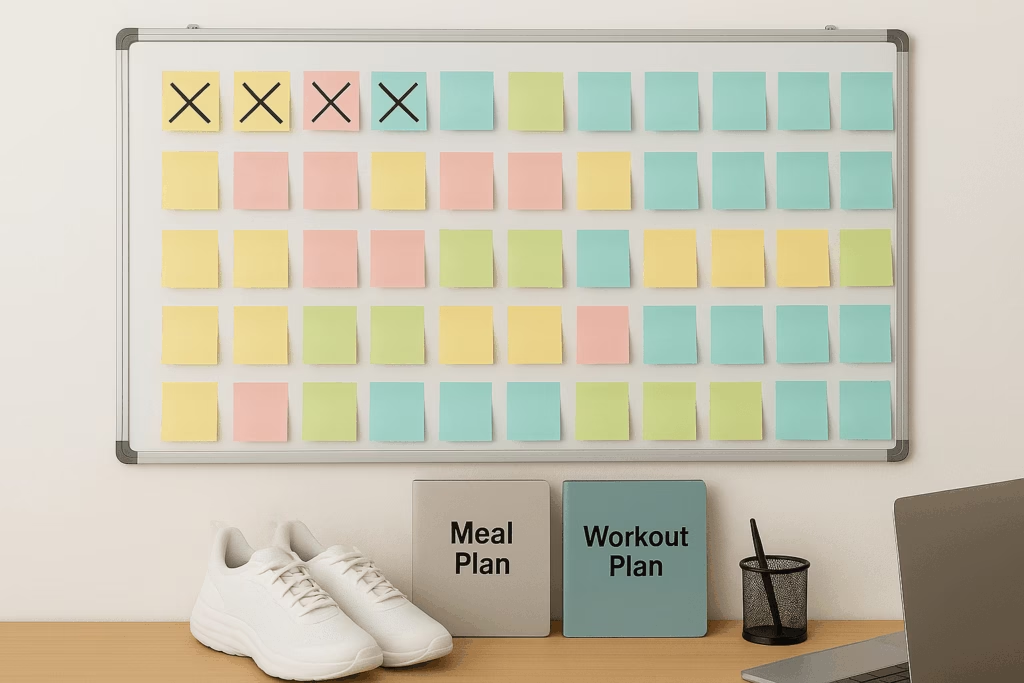
For our future-self fanatics, Atomic Habits is gold. Need a future-you who’s fitter? Clear will show you how to string together baby-step habits (cue -> craving -> response -> reward) so that eventually working out or meditating becomes as automatic as checking email. Want future-you to be a world traveler instead of a workaholic? Start tracking your daily savings, or read travel guides for just 15 minutes each night. Clear even created a nifty habit tracker (you literally put an X on your calendar each day you do the habit) because seeing that streak visually motivates you to not break it. It’s science: people who log their habits are way more likely to stick with them.
Atomic Habits also covers habit stacking, environment design, and the Two-Minute Rule (“if it takes less than 2 minutes, do it now”). All practical stuff that future-you will LOVE you for. I’ve personally used his 2-minute rule to tackle chores and mini-projects (future me thanks me every single time I stack a tiny win in the morning).
Quick take-away: Building systems now means your future self glides smoothly. Grab a copy of Atomic Habits here and start thinking 1% better!
For a slightly different vibe, The Mountain Is You is like the emotional-altitude version of habit-building. Brianna Wiest uses the metaphor of a mountain to represent the big challenges and self-sabotaging patterns we face. The premise? We often stand in our own way, and climbing that mountain means digging into our baggage (trauma, fear, negative habits) so we can step out of our own way.
This one’s for the feels and the “aha” moments. Wiest dives into why we self-sabotage, because our lower impulses and higher aspirations are at odds. She guides you in “excavating trauma, building resilience and adjusting how we show up for the climb.” In true future-self terms, she talks about learning to “act as our highest potential future selves,” because ultimately the mountain we master is ourselves.
If Atomic Habits teaches you practical how-tos, The Mountain Is You helps you reframe your mindset so those habits actually stick. It’s about identifying that inner voice that says “nah, too hard” and gently restructuring it to “okay, I can try this differently.” Very often, feeling blocked isn’t a time-management problem; it’s an emotional block. This book has lovely exercises and reflections (think journal prompts and tough questions) that nudge you to connect present-you with future-you on a deeper level.
Pragmatic example: Wiest might get you to imagine what your future self would thank you for during a tough week. Maybe future-you thanks you for dropping an unhealthy habit or finally speaking up for a raise. The book literally reframes the mountain in front of you as a route to self-mastery.
Quick take-away: If you feel stuck or keep repeating patterns, The Mountain Is You will help you break that cycle. It’s like a pep talk from Future You: “C’mon, I know you’ve got this.”
Thinking, Fast and Slow by Daniel Kahneman
This is the book that explains what your brain is actually doing when you make the choices that shape your future.
Daniel Kahneman’s central idea is that we tend to move between two ways of thinking. One is quick, automatic and intuitive. It helps us react, recognise patterns and make everyday decisions without analysing everything. The other is slower and more deliberate. It helps us question our assumptions, weigh our options and think through decisions that matter.
Your future self is shaped by both.
The problem is that quick thinking often makes a decision before you have had time to ask whether it serves you. It reaches for the extra hour of work because the deadline feels urgent. It says yes before you notice that your calendar is already full. It decides a trip is too expensive or complicated before you have properly researched it. It spends today’s energy as if tomorrow’s energy is guaranteed. That is why this book belongs in a conversation about future self literacy. Your future self is not only shaped by big, carefully considered decisions. She is also shaped by the hundreds of smaller choices you make when you are tired, rushed, distracted or emotionally overwhelmed.
My hot take is that a lot of what looks like a discipline problem is really a decision making problem.
When I am exhausted, I do not need another motivational speech. I need fewer decisions between me and the choice I already know will help. For me, that might mean putting my workout clothes where I can see them, deciding my travel budget before I open a flight search or blocking recovery time in my calendar before the week fills up.
I am not trying to outsmart my brain every minute of the day. I am creating conditions in which my quick decisions are more likely to support the person I am becoming.
Kahneman also explores the mental shortcuts that can distort our judgement. We often give too much weight to information that is easy to remember, feel losses more strongly than similar gains, and become overly confident in our predictions about the future. You can see this in ordinary life. One expensive holiday can convince you that travel is always unaffordable. One missed opportunity at work can make you believe you are not ready for a promotion. One difficult week can turn into the story that you are incapable of consistency.
The practical lesson is simple: do not treat every thought as a fact. Slow down when a decision has real consequences and ask yourself:
What do I know and what am I assuming?
Am I reacting to what feels urgent or choosing what matters?
Would I make the same decision if I were rested and had more information?
What would make the better choice easier for me tomorrow?
I use questions like these as a small pause between impulse and action. They give me enough space to notice whether a choice belongs to present me, tired me or future me.
Quick takeaway: Read Thinking, Fast and Slow when you want to understand the mental shortcuts behind your habits, spending, career decisions and travel planning. You will not become perfectly rational, because nobody does. But you may start noticing the moments when your brain is making a lasting decision based on a temporary feeling. That awareness is a powerful form of future self literacy.
Skill Development Platforms
I’m all about efficient learning. Why spend $1500 on an in-person seminar when there are online classes you can take while sipping coconut water on a beach? That’s where platforms like Skillshare come in. Think of Skillshare as Netflix for learning: it’s an online learning community with thousands of classes (illustration, design, business, even travel vlogging). The site brags about offering “thousands of classes” and gives new members a free trial for unlimited access. Why Skillshare for future-self-lovers? First, it’s super cheap relative to workshops (often just a monthly subscription). Second, you can learn all kinds of practical skills on your schedule. Want to be more productive? There are classes on time management, setting goals or even using apps like Notion and Trello. Trying to level up your remote-work game? They have courses on remote work best practices, freelancing, or even digital nomad skills. And yep, there are even classes about travel photography, writing your first e-book or building a passive income stream (because why not make money while you sleep?).
I also recommend checking out sites like Udemy, edX or Harvard Online. So many universities offer free courses on a bunch of topics and you only pay for a certificate. Topics like business, financial or legal basics, computering or social studies make this my true go to in learning new skills.
Productivity Tools and “Reset” Habits
Along with courses and books, the little tools and habits you use daily are like micro-investments in your future self. Here’s a quick toolkit:
Journaling: Yep, adults do it and it’s more powerful than you think. Just jotting thoughts for 5-10 minutes can clear mental clutter and spark ideas. Science backs it: writing things down literally boosts the brain’s focus and memory. There are tons of ways to journal: a bullet journal, a gratitude log or even a “Future Self” letter page. Apps like Day One or even good old Moleskine notebooks work, pick your vibe. Start by reviewing last week’s notes every Sunday; it’s amazing how patterns and insights pop up when you give your brain a quick weekly reset.
Time Blocking: Cal Newport made this famous as “calendar time blocking.” Basically, you assign every chunk of your day a specific task (not just vague “work” but “9-10am: write report”, “10-10:30am: email clearing”). It stops you from doomscrolling or letting meetings run wild. For travel lovers, it also means you guard your personal time. Put Friday 3-5pm as “Plan Italy trip!” or whatever. Seeing it in your calendar means it’s real. Pro tip: include buffer “break” blocks so you don’t freak out if things run long.
Habit Tracking: Atomic Habits swears by this, and I do too. Use a simple habit tracker app, a planning app like notion or a paper chart. Each time you work out, save $5 or meditate, mark it done. There’s something ridiculously satisfying about filling in those boxes. It’s immediate feedback, you see progress and suddenly skipping a day feels wrong because you’d break the streak. Clear himself notes that even a basic X-on-calendar habit tracker “provides immediate evidence that you completed your habit” and therefore motivates you to continue.
Weekly Reviews: In productivity circles (hi, Todoist blog fans), a weekly review is the ritual. Spend 10-15 minutes every weekend (I love Sunday night) looking back: what went well? What got stuck? Then tweak your plan for next week. It’s like checkpointing your career/game life. It sounds cheesy, but it’s how you catch creeping clutter (chores piling up, unread emails or “I really should update my LinkedIn”). This little practice helped me carve out an extra travel weekend last month because I realized on Sunday that a task I could automate was eating an hour a day. Boom, fixed it, freed up time.
Digital Tools: We live in an app world, might as well use it. Task managers (Notion, Trello, Todoist) can replace mental load. If you plan to pick up new skills, use a learning tracker (even a Notion page where you log “Skill to learn” and “Progress”). For journaling/brain-dumping, apps like Evernote or Google Docs are perfect because you can access them from anywhere (hotel Wi-Fi or cafe). Email is also a big-time drain; try batching it twice a day or use filters to let less important stuff simmer.
“Reset” Habits: These are rituals that let your brain recharge so future-you isn’t running on fumes. They could be morning routines (coffee + 5 minutes of deep breathing), evening unplug sessions (no screens after 8pm) or even one weekend a quarter that’s tech-free. I schedule at least one “Do Nothing” block weekly, where I literally just stare at clouds (or plan a trip!). It’s anti-productive, sure, but ironically it resets my focus. Scientific studies even show short vacations or breaks boost long-term productivity and guess what? Travel is the ultimate reset.
The overarching idea: build a toolkit of small habits (bullet journaling, time-blocking calendar, a weekly brain dump) so your future self doesn’t face chaos. Right now, you’re setting up a support network for yourself. It’s kind of like having an assistant who checks in with Future You, except the assistant is you.
How This Translates to Career Growth and More Freedom to Travel
Alright, I know what you’re thinking: “Cool story, but I have deadlines and bills to pay. How does this let me actually travel without torpedoing my career?” Great question.
First, here’s the encouraging part: working+travelling isn’t just pie-in-the-sky anymore. The digital nomad lifestyle is legit mainstream. As one 2025 career guide points out, there are now about 50 million digital nomads worldwide (up from 35 million just two years ago). People across Gen X and even Boomers are ditching the office to swap commute times for sunrise yoga on a beach. Basically, remote roles are exploding. But even if you can’t or don’t want to work remote, there are so many ways to use your weekend and PTO effectively if you plan your time right. I have posts about maximising my PTO and midbudgeting my travel right here, here and here. Go check them out.
Skill Growth: The skills that future-self literacy teaches are the skills digital nomads need. CareerAddict spells it out: time management and self-discipline are #1 for nomads. If you can juggle deadlines across time zones, that’s exactly future-self stuff. By building those habits and mindsets now (even if you never leave your cubicle), you’re priming yourself to work from anywhere in the world. You’ll be more efficient and more valuable at work, think promotions or raises, because you’re not wasting 9-to-5 staring at your phone. In fact, skill-building (like taking Udemy courses on your own time) is a career booster. It shows initiative and often teaches concrete skills you can use right away (like negotiating remote work policies or learning a high-demand digital skill).
Burnout Prevention (Career Reset): Here’s a factoid for you: in early 2025, Glassdoor reported burnout hit a 32% year-over-year surge, the highest ever. Enter future-self literacy as our anti-burnout kit. By habitually giving yourself breaks, sabbaticals (yes, companies are starting to normalize those), and personal days, you actually protect your long-term momentum. The weird truth: sometimes taking a break accelerates your career. It doesn’t mean derailment; it means catching a new wind.
Freedom to Travel: When your time and tasks are optimized, you literally gain space in your calendar. Maybe you finish work an hour early one day or you wrangle a “work from Barcelona” week because your boss sees you handling everything like a champ. So savvy companies will accommodate it if you prove you can be reliable. Future-self savvy folks can create vacation buffers or side-income streams (ever thought about teaching an online class on Skillshare for passive income? 😏).
Also, building these habits often saves money. Atomic Habits includes stories of people incrementally saving or investing small amounts; The Mountain Is You frames spending wisely as treating future you kindly. The result: more travel funds. By the time that dream trip rolls around, future-you isn’t empty-pocketed, they’re thriving.
Bottom line: you’re not choosing between career or travel; you’re weaving them together. Future-self literacy gives you the toolkit to do both. Your organized, disciplined present self means you can climb that career ladder or roll out to the beach without it collapsing.
Q&A Section
How do I stay consistent with new habits? Ahh, consistency is the holy grail, right? First, start tiny. Don’t announce you’ll run 5k every morning; start with just 5 minutes or one block per day. Atomic Habits teaches the Two-Minute Rule: make any habit take 2 minutes or less at first. Then celebrate each small win (even if it’s just checking the box). Use triggers: tie the new habit to an existing one (“after I brew coffee, I will journal for 2 minutes”). Track it! Like we said, crossing off your habit tracker or using an app gives instant gratification. And be forgiving: some days slip-ups happen. Don’t beat yourself up; just mark a new X the next day. Real talk, I’ve binged Netflix and skipped my goal too, but habit trackers and self-compassion keep me going. (Psychologists say even seeing those little marks reminds you to act and motivates you not to break the chain.)
What if I don’t know what I want my future self to be? That’s 100% normal. Few of us have a crystal-clear vision immediately. Start by asking yourself values and small experiments. For example, what if future you could have one superpower? More freedom, creativity or health? Pick one and run with it. Journaling prompts are great here (there are like 76 prompts on Pinterest, crazy, right?. You could try, say, writing to yourself 5 years from now about what you did this week. Or just start a new hobby and see how it feels. Often, clarity comes through action, not before it. So explore fields or skills that intrigue you (hello, Udemy again). Think, “Future Me, would I regret not learning this?” If the answer is yes, dive in. It’s like dating yourself, try different things and eventually the right future-self match sticks.
How do I make time for learning when I work 9–5? I feel you, after a long day, who has brain juice left for studying? The trick is micro-learning and smart scheduling. Sneak learning into daily routines: listen to audiobooks on your commute, follow a 10-minute Skillshare tutorial during lunch or read on a (short) evening break. Block just 20 minutes a day in your calendar labeled “learn something new.” It might not sound like much, but it adds up to 2+ hours a week. Also, note that some Skillshare classes are literally 10–20 minutes and give a huge insight boost. Remember: quality beats quantity. Even one concept per week can transform your skills over months. And one more hack: combine learning with leisure: read that career-reboot book on a cozy weekend morning. Your future self will be grateful that your “me-time” was also productive.
How will these habits help me travel more? Great question. It’s not immediate, but trust me, it snowballs. If you manage your time insanely well at work, you’ll get more “free” time. If you automate certain tasks (hello, productivity hacks), you might actually get out of the office earlier or open to remote-work pitches. Good habits often build savings (even just round-up-to-dollar saving apps count!), so you’ll have travel cash. Plus, companies love efficient, reliable employees, so you might earn promotions or remote opportunities (all while many of your peers are burning out). In short: you’re creating bandwidth, both timewise and financially, to slip in adventures. Think of it like saving up XP points in a game so that you can unlock the “travel world” level.
I want to live in the moment. Isn’t this future focus just stressful? Ah, I’m right there with you. It can feel odd to daydream about future-me when life is already hectic. The key is balance. Future-self planning doesn’t mean living rigidly for tomorrow; it means making little changes that also improve today. For instance, time blocking means you’re actually finishing work on time (more evening fun), not living by strict distraction. Journaling 5 minutes a day can clear your mind so you enjoy the present even more. Remember Hershfield’s insight: focusing on future self can make the journey more joyful not less. So don’t doom-scroll Pinterest into stress. Instead, use these tools as mini self-care rituals that fuel today and set up tomorrow.
Conclusion
Stepping into your future self isn’t about losing the now, it’s about amplifying it. By adopting a future-self mindset, you can build habits, learn skills and create systems that make life smoother today and downright lovely for tomorrow. Imagine sipping coconut water on some tropical beach, knowing you built your work life so efficiently that this adventure didn’t set you back. Imagine impressing your boss with those habit-tracking spreadsheets and then surprising your future self with that dream job abroad.
In short, future-self literacy equals life upgrade: more productivity at work, less stress and yes, more passport stamps. You end up living intentionally in the present because you know your actions matter for tomorrow. So go ahead, pick one book or tool from above and get started. Start tiny, think ahead, and give that gift to future-you. Want more? I am building a curriculum of life, with all the skills and knowledge one needs to belong to the 1% most educated people. A true future-focused roadmap with monthly topics to advance in life and in career. Check it out here.
If you liked this deep dive (and maybe laughed at my chaos along the way), consider joining my newsletter. I share more tips on productivity, travel hacks, and how to mix career growth with wanderlust. See you on the adventure trail! 🌟
Disclaimer: Some links above (like books and Skillshare) are affiliate links. I only recommend stuff I genuinely use or believe in. If you make a purchase or sign up through them, I might earn a small commission at no extra cost to you. Thanks for supporting my travel-fueled content!
Intro: The Day My Brain Exploded (Literally, Almost)
Picture this: It’s a Tuesday. I’m sitting at my desk, staring at my third cup of coffee, my to-do list looks like a CVS receipt, and my brain feels like a browser with 97 tabs open, all playing ads. I had just promised my boss I’d create that perfect presentation, my mom was at the hospital and my grandma had called the police the previous night because her granddaughter had been at a party at 2 am at 24 years old. Then, it happened. I opened my notes app to add “buy more coffee” and saw it: 147 unfinished tasks, 37 chapters to go in my study books and a still my head was killing me. My brain short-circuited. I actually said out loud, “WTF is wrong with me?” That’s when I realized: I needed a mental declutter. Not just a little tidy-up, but a full-on, Marie Kondo-style purge of the mental junk drawing my energy, focus and joy. If you’ve ever felt like your brain is a hoarder’s basement, full of “shoulds,” “what-ifs,” and “I’ll-get-to-thats”: this is your sign. It’s time for a mental spring cleaning.
This post contains affiliate links, by clicking on the link I may earn a small commission to no extra cost to you. Affiliate links are marked as “*”. This post is purely for entertainment purposes.
Why Mental Decluttering is the Ultimate Productivity Hack (And Why You’re Probably Avoiding It)
Here’s a fun fact: The average person has about 6,000 thoughts per day. And if you’re anything like me, at least 5,999 of those are some version of “Why didn’t I say that in the meeting?”, “I should meal prep,” or “Is it too late to become a Youtube star?” Our brains weren’t designed to handle the constant barrage of information, commitments and digital noise we throw at them. Mental clutter is like a computer running too many programs; it slows you down, drains your battery and eventually crashes. But here’s the kicker: Most of us spend more time organizing our sock drawers than our minds. We’ll deep-clean our kitchens, but we won’t delete the 3,000 unread emails in our inbox. We’ll KonMari our closets, but we won’t question why we’re still holding onto a grudge from 2017.
Mental decluttering isn’t just about feeling better, it’s about performing better. Studies show that reducing mental clutter can:
Boost productivity by up to 40% (yes, really)
Lower stress and anxiety
Improve sleep and decision-making
Make you feel like you’ve got your life together (even if you don’t)
So, if you’re ready to stop feeling like a hamster on a wheel and start feeling like the CEO of your own life, let’s dive into the mental decluttering rituals that actually work.
Step 1: The Brain Dump
What it is: A no-holds-barred, stream-of-consciousness dump of every single thought, task, worry and idea swirling in your head.
Why it works: Your brain is like RAM, it can only hold so much at once. When you offload everything onto paper (or a doc), you free up mental space for what actually matters.
How to do it:
Grab a notebook, a blank doc or a voice memo app.
Set a timer for 10 minutes.
Write down everything, from “call mom” to “why do I still have that weird dream about high school?” No filters, no judgment.
When the timer goes off, take a deep breath. Congrats, you just emptied your mental trash can.
Pro tip: Do this first thing in the morning or right before bed. It’s like giving your brain a spa day.
You can also just talk to yourself, that’s what I do often because I want to spare myself the work of actually journaling. At times I dictate it into my AI assistant to sort through and create actual usable summaries of my thoughts.
Did you try this? Seriously, pause and do a 5-minute brain dump right now. I’ll wait.
Step 2: The Commitment Audit (AKA The “Why Am I Even Doing This?” Test)
What it is: A ruthless review of every commitment, goal, and obligation in your life to see if it’s still serving you.
Why it works: We say “yes” to things out of guilt, FOMO or habit, then wonder why we’re exhausted. This is about reclaiming your time and energy for what truly matters.
How to do it:
Make a list of everything you’re currently committed to, work projects, side hustles, social obligations, even that book club you never attend.
For each item, ask:
Does this align with my current goals or values?
Does this bring me joy, fulfillment or growth?
If I dropped this tomorrow, would I feel relief or regret?
Quit, delegate or renegotiate anything that doesn’t pass the test.
WTF Fact: The average person spends 41% of their time on tasks that don’t align with their goals. That’s like working two days a week for free. And then we’re wondering why we’re not advancing in life and our goals. Stop volunteering for your own burnout.
Step 3: The Digital Detox (AKA The “Why Is My Phone a Black Hole?” Challenge)
What it is: A strategic cleanse of your digital life, emails, apps, notifications and social media.
Why it works: Our devices are designed to hijack our attention. The average person checks their phone 96 times a day. That’s not productivity, that’s dependency.
How to do it:
Unsubscribe from emails you never read.
Delete apps you haven’t used in 30 days. (Yes, that includes the one you downloaded to “learn Spanish” in 2020.)
Turn off non-essential notifications. Your brain doesn’t need a ping every time someone likes your post.
Schedule “no-screen” blocks, especially first thing in the morning and before bed.
Pro tip: Try a “digital sunset”, no screens 1 hour before bed. Your sleep (and sanity) will thank you. But honestly, that is so much harder to do than in the mornings, especially if you’re like me: blogger and content creator and only have two hours in the evenings to work on that.
Step 4: The Memory Palace
What it is: A system for organizing and storing information so you’re not constantly searching for it.
Why it works: Mental clutter often comes from not having a reliable system for the stuff you need to remember. When you know where everything “lives,” your brain can relax.
How to do it:
Use the “Two-Minute Rule”: If a task takes less than two minutes, do it immediately. (Putting your keys in the same spot every time? Two minutes. Replying to that text? Two minutes.)
Create a “Home” for Everything: Designate specific places for your wallet, charger, workout clothes, etc. No more frantic searches before work.
Use a “Second Brain”: Tools like Notion or Evernote can store ideas, lists, and resources so you don’t have to remember them.
If you’re a visual person, try the “Bullet Journal Method” by Ryder Carroll*. It’s like a planner, diary, and to-do list all in one. I’m a list person and love having everything separate but in one place, so notion is my way to go.
Step 5: The Future Self Letter
What it is: Writing a letter from your future self to your present self, giving advice and perspective.
Why it works: It helps you see what’s truly important and let go of the stuff that isn’t.
How to do it:
Imagine it’s one year from now. You’re happier, healthier and more successful.
Write a letter to your current self. Include:
What you’re proud of accomplishing
What you wish you’d stopped worrying about
Advice for the next 12 months
Seal it and open it in a year or read it whenever you feel stuck.
Don’t feel comfortable with writing a letter format? Write a description of your future self in the first person. Having a list of strong “I will”‘s is gonna be a gamechanger, trust me.
Q & A: Your Burning Questions About Mental Decluttering
Q: “I don’t have time for this! How do I start small?” A: Start with a 5-minute brain dump or a 10-minute commitment audit. Even small steps create momentum.
Q: “What if I feel guilty about quitting things?” A: Guilt is just fear in disguise. Ask yourself: “Is this serving me or am I serving it?” Your time is precious, spend it on what matters. Prepare for talks about projects work or social and I recommend a yes-no-yes format. Start with something positive about the project, kindly form the no and then offer the person something positive, like “another time” or “let’s get back to that”. Everyone will leave that room feeling good about themselves.
Q: “How do I stop overthinking at night?” A: Try a “worry dump” before bed. Write down everything on your mind, then tell yourself, “I’ll deal with this tomorrow.” Works like magic.
Q: “What’s the one thing I can do today for instant relief?” A: Delete one toxic app, unsubscribe from 10 emails, and say no to one thing you don’t want to do. Boom, mental space created.
Conclusion: Your Brain Deserves a Spa Day
Here’s the truth: Mental clutter isn’t just annoying, it’s expensive. It costs you time, energy and opportunities. But the good news? You’re not stuck with a messy mind. You can declutter, reset, and reclaim your focus, one small step at a time. So, grab your notebook, your delete button, and your courage. Your future self is waiting for you to show up, clear, focused and ready to live your best life. Now, go declutter something. Your brain will thank you.
Want to learn more about becoming productive without burning out? Here’s my post on soft productivity so you get more done without risking a burnout.
Welcome to the very first post on The Asthetic of Jess!
It is so exciting to be here and to be able to take you with me on my travels and celebrate all things travel! Here we enjoy everything, from epic adventures to cozy getaways and local gems.
I‘m Jess, your new virtual travel buddy, here to share stories, destinations, tips, insider secrets and full on itineraries that will make your journeys smoother, cheaper and overall more exciting. Whether you want to explore Europe, take cheeky getaways, discover new destinations or just want the best travel gadgets – I‘ve got you covered.
Expect a mix of carefully crafted itineraries, hacks for travelling on a budget without sacrificing comfort and tales from the road (Yes, I may have gotten completely lost in my home town while maintaining amazing map reading skills on the road – true story).
So buckle up, pack your favourite carry-on luggage and let‘s make your travel dreams a beautiful reality. The world is waiting- and now, so are your new adventures right here on this blog.