This post contains affiliate links, meaning that by you clicking on them, I may earn a small commission. No extra cost to you and you help me keep this blog up and running. Links are marked as “*”.
There was a season when my life looked fine on paper and felt like a slow collapse from the inside.
I was studying law, taking on family responsibilities that were too heavy for one person (especially one without a fully developed prefrontal cortex), worrying about money, getting sick again and again, and pretending I could keep pushing. On the outside, I looked functional, if a bit lazy. On the inside, I felt brittle.
I was tired in a way that a weekend could not touch. My head was spinning as if I was on a rollercoaster permanently. My body felt dense, like everything was happening in slow motion. I negotiated with myself to get out of bed. Sometimes I lost that negotiation and stayed there, scrolling and feeling worse.
It would have been easy to buy a new lipstick and call it self improvement. I did not need another product. I needed a life that was not quietly making me ill.
That sounds obvious from here. It did not feel obvious while I was in it. I thought the fix was to become more disciplined, more productive, more impressive. I kept trying to optimise myself. New planners. New routines. New rules. I believed that if I could just organise everything perfectly, I would finally turn into the version of me I kept imagining.
Instead, I burned out.
Eventually, I hit the point where I could not pretend anymore. My systems did not support me. They consumed me. I asked for help. I made uncomfortable changes in my family life. I gave myself permission to build a plan B for my studies. I started putting my health back on the list of actual priorities, not just a word I used while ignoring my body.
The visible changes came later. I lost 12 kilograms after a period of changing how I ate and cared for myself. My skin calmed down. I started dressing in a way that matched my taste instead of my fear. But the real glow up was quieter and less Instagram ready. I stopped waking up already behind. I had more energy. I could make plans and trust that I might enjoy them. I recognised myself again.
The weight loss was one outcome of a wider recovery. It was not the goal everyone needs to copy, and it was not proof that I had finally become worthy of care.
This is what changed how I look and how I feel, in real life and not just in photos.
The most convincing glow up is not looking like a different woman. It is deciding you will not abandon yourself to keep up with your life.
1. I made sleep a health habit, not a reward
For years, I treated sleep like a prize I could earn after I finished everything else.
You can guess how that went. Everything else never ended. There was always another task, another favour, another story that felt urgent. I took pride in functioning on almost nothing. I called it dedication. My body called it a problem.
When I started recovering from burnout, I had to drop the performance. I stopped using exhaustion as a personality trait. I created a realistic bedtime window instead of a fantasy one. I stopped sleeping with my laptop next to me. I paid attention to what made the next morning feel softer instead of like an emergency.
I did not aim for a perfect eight hour sleep score. I just aimed for fewer mornings where I opened my eyes and felt panic as the first emotion.
The American Academy of Sleep Medicine recommends that adults regularly sleep at least seven hours for optimal health, while recognising that individual needs vary.[1] I did not turn that into a new standard to fail at. I used it as a reminder that my body was not being dramatic. It was asking for something normal. Really, if you want to learn more, I recommend reading “Why we Sleep” by Matthew Walker*. That book taught me so much!
My practical version
I start with the morning instead of obsessing over the exact bedtime. I ask myself what time I need to be functional tomorrow and what calculate backwards. When would I need to sleep by, meaning that I have to be in bed about an hour earlier to fall asleep, meaning my night routine has to start earlier…
Usually it means making breakfast the night before, so I do not start the day with decision fatigue. Sometimes it means accepting that the laundry will live in the basket for another day and the world will not end.
Sleep is not laziness. It is maintenance. You do not have to earn it by suffering first.
2. I stopped making food a moral issue
Disclaimer: this is my personal story with food and I am aware that at one point it was not a healthy relationship. Please do not take my story as personal recommendation. If you notice you or someone close to you has a eating disorder, please seek help. I am not a nutritionist and am only speaking about my experience and research.
For a long time, food was either a test I passed or a crime I committed.
At one point, I did a strict sugar detox and lost 12 kilograms. People praised my discipline. They did not see me white knuckling my way through social events, feeling guilty for wanting dessert, or obsessively thinking about the next time I would be allowed to eat something I actually liked. And I told myself I was just on a 12-week diet and I had to push through. And as someone who was overweight at that point, I do believe that decision was right.
That experience taught me something useful, but not the lesson diet culture wanted it to teach. The lasting change did not come from finding the most intense plan. It came from noticing how food affects my actual life. My energy. My mood. My digestion. My ability to think clearly in the afternoon. My ability to be present with people I love. And honestly, it also taught me how much sugar is in anything processed and now a lot of things just taste too sweet for me.
But more important: I became more interested in meals I could repeat than in rules I could break.
Now I try to make the easiest option a nourishing one. I keep simple ingredients at home that I know I will use. I add something filling to most meals so I am not hungry again in an hour. I eat more regularly instead of waiting until I am ravenous, inhaling whatever is closest and then feeling ashamed. When before I was either eating junk food or kept on grazing throughout the day.
I also stopped pretending that wellness requires elaborate cooking every night. Some days, a beautiful meal is a proper recipe and a table you actually sit at. Other days, it is eggs, vegetables, bread and fruit thrown together in ten minutes while you answer a message with your other hand. Both count.
A habit that only works when you are well rested, wealthy and highly motivated is not a health habit. It is a special occasion.
My body did not need another punishment. It needed consistency and enough food to live the life I kept demanding from it. And before you ask: Yes, I kept those 12 kg off.
3. I started moving for strength, mood and the future version of my body
For years, exercise felt like a punishment for being in a body at all.
I moved to make myself smaller. I chose workouts I hated and then despised myself for not sticking with them. I saw my body as a stubborn problem to beat into a different shape.
I remember basically rolling out of bed to do my first tabata workout. That relationship could not survive if I wanted to feel well. I slowly began to think about movement as a way to feel more capable instead of more acceptable.
The image that changed my relationship with exercise was not a mirror. It was the aforementioned story. Watching my family struggle through health issues and not being able to walk through a train station with luggage and be able to carry it up the stairs and up to a hotel room and still have energy for dinner. And I want to be able to enjoy that at 50, 60, even 80. So it’s not how my body looks, but how it feels that is more important to me.
Yoga helped me slow down enough to notice what my body felt like, which was confronting at first and keeps me mobile. Walking became my moving meditation. Strength training surprised me. Feeling my muscles work made me feel connected to myself in a way I had not experienced before. Not cute. Not pretty. Just present and powerful in very ordinary ways. Ballroom dancing is my way to lay down the amour I wear everyday and shut off my brain.
And then I have excercises that I do from time to time, because I enjoy them: flagfootball, playing tennis with collegues and I am thinking of trying out paddle.
The World Health Organization recommends that adults get 150 to 300 minutes of moderate physical activity per week or an equivalent amount of vigorous activity, plus muscle strengthening on at least two days per week.[2] That is a helpful reference, not a character judgment. Studies suggest that working on muscle mass through resistance training and on your VO2max is lowering your overall risk factors as you age. You can start getting your own info on that here.
If you are starting from almost nothing, a ten minute walk is a beginning, not a failure. If your health, disability or energy levels change what is realistic, you adapt. The goal is a body that feels supported, not punished. And as I keep reminding myself, have a bad day plan and then add up on good days.
The movement rule I actually follow
Make it easy to start and satisfying to finish.
Put your shoes by the door instead of buried in a cupboard. Choose music you actually like. Pick a route that feels safe and gives you something to look at. Choose a class where the teacher sees you as a person, not a project.
Build the habit around the life you genuinely want, not around a fantasy version of yourself who wakes up at five, never gets sick and loves burpees (Spoiler alert: No one does).
4. I built boundaries before I built a beauty routine
This is the habit that changed my face the most. I stopped saying yes to everything that drained me.
For years, I lived in a constant state of low level panic. I said yes to obligations I did not have capacity for. I answered messages the moment they arrived. I dropped my own needs to respond to everyone else’s urgency. If someone else needed something, I treated it as more valid than what my body was quietly trying to tell me.
That chronic stress showed up in my skin, my posture, my voice and the way I walked into a room. I did not need a jade roller. I needed fewer emergencies.
Boundaries lowered that background noise. I started scheduling absolute free days where nothing was planned and I did not apologise for it. I practised saying no and then stopping, without adding a five paragraph explanation to make my refusal more palatable. I stopped letting other people’s urgency become a permanent alarm inside my nervous system.
Life did not magically become easy. Hard things still happened. I still had responsibilities. But I had more capacity to meet them.
Stress does not only live in your calendar. It shows up in your jaw, behind your eyes, in your digestion, in your sleep and in the way even fun plans can feel like too much. My outside began to soften when my inside was not bracing all day. And my face and body now look so much less puffy.
Sometimes the most expensive beauty treatment is continuing to live in a way your nervous system cannot afford.
My boundary practice is simple. Before I agree, I ask whether I honestly have the time, the energy and the genuine desire. If the answer is no, I try not to automatically turn that no into a yes just because I feel guilty.
5. I made skincare boring and consistent
My skincare glow up did not come from a bathroom full of products. It came from doing a few basic things on repeat and giving them time to work.
I became more consistent with cleansing my face gently, moisturising even when I was tired, and protecting my skin from the sun instead of acting surprised by new sunspots every summer. I am not buying every new, trendy skincare product. I am not trying new things every week. I stick to a boring, non-viral micellar water to remove make-up and sunscreen, gentle foam cleanser for my skintype, matching toner, exfoliator for my sensitive, acne-prone skin, a prescribed cream by my dermatologist and a moisturiser in the evening. And water, that same toner, a calming serum and a good sunscreen in the morning.
I am not interested in promising that one product will transform your life or make you look ten years younger. Skin is personal. Hormones, medication, stress, genetics, allergies, skin tone and medical conditions all matter. If something on your skin is persistent, painful, changing or simply worrying you, a qualified dermatologist will always beat another viral product.
The deeper lesson for me was learning to care for my future self without demanding instant proof that it was working. That applies to skincare, fitness, savings, education, friendships and almost everything else I value. The glow often shows up months after you start the habit.
6. I changed the way I dressed before I changed my body
For a long time, I treated style as a reward. I thought I could earn it once I became more confident, thinner, healthier or more successful. Until then, I lived in clothes that were almost right but not quite, because they matched the story I told myself. Temporary. In between. Not there yet.
That belief kept my confidence permanently in the future.
I remember standing in front of my wardrobe before work, already running late, rejecting one outfit after another. Nothing felt like me. Some clothes were too uncomfortable for a full day. Others belonged to an imaginary version of my life. I did not need more clothes. I needed fewer decisions and a clearer sense of what made me feel composed.
I started paying attention to what I actually reached for. The dark trousers that made me feel grounded. The jacket that helped me feel more authoritative in a male dominated room. The shoes I could walk in without thinking about my feet all day. I slowly curated my wardrobe around my real life, not a fantasy lifestyle where I floated from meeting to rooftop drink in high heels.
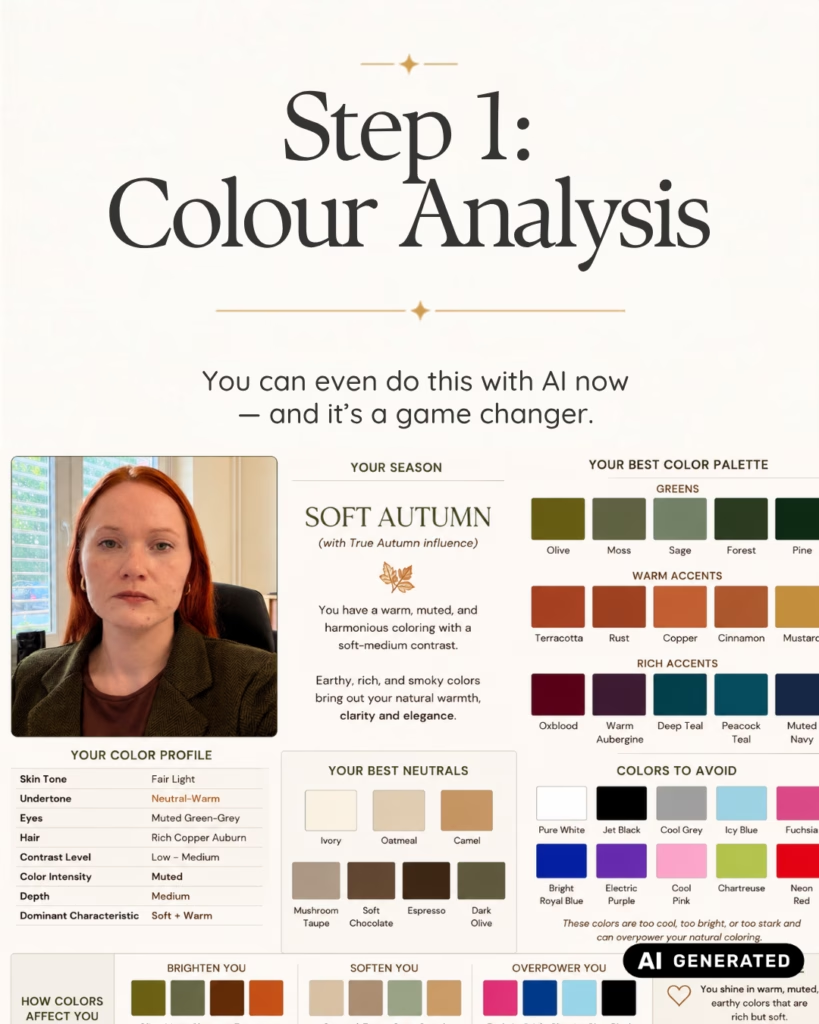
And then I fell into the rabbit whole of personal styling. I had AI do a colour analysis and read up on anything I could find to proof that. I read about kibbe bodytypes and essences and really looked at myself in the mirror to analyse it. And then I found style roots, that further cement the feel of your clothes. Let me try to describe it: I am a Kibbe Romantic, so basically very rounded and soft, but my essence is more classic. So basically more blouses with collars and less ruffles. My style root is mainly Mountain and mushroom, those underline the classic essence (Princess Katherine could be classified as Mountain and Mushroom would be Hedy Lamar). Usually you have a third, but in that I am a little stuck, I feel like earth is more my work place style because it’s a little toned down and fits my colour palette so well, sometimes it’s flower which supports my romantic body type and is more softer fabrics and when going oout it’s either fire (sexy like Marilyn Monroe) or Moon (edgy). If you want to visualise this, I have a whole pinterest board here.
All in all style became less about hiding my body and more about communicating who lives in it.
There is no correct glow up aesthetic. Yours might be minimal, bright, dark, romantic, sporty, sharp, soft or quietly strange in the best way. The point is not to look expensive or effortless. The point is to stop postponing self respect until your body changes.
7. I let joy become part of the plan
Recovery is not only about cutting out bad habits. It is also about adding reasons to want your energy back.
At some point, I realised that all my habits were about fixing myself. Very few were about enjoying my own life. So I started putting joy in the calendar on purpose.
I travelled with friends even when it meant uncomfortable conversations about money and time. I went to concerts alone when no one else was free and gave myself permission to enjoy it anyway. I came back to yoga and meditation, not as another thing to optimise, but as a way to sit with myself. I made space for learning again, not just for qualifications, but for curiosity.
These things did not make me less serious about my career. They made my life too big to fit inside my job title.
Travel, especially when it is planned around an honest schedule and budget, gave me proof that I could handle more than I thought. It broke up my old routines. It reminded me that I could be a beginner in a new place, navigate unfamiliar systems, get lost, find my way and return home with a wider sense of what was possible.
Joy is not a prize you collect once you become the final, polished version of yourself. It is part of how you become well in the first place.
The habits I would start with if I had to begin again
If you feel overwhelmed reading all of this, please do not try to copy my entire life. Start much smaller. Choose one honest promise in each area.
- Sleep: Pick a realistic bedtime for three nights this week, not an ideal one you will instantly break.
- Food: Prepare one easy meal you can repeat on the nights when your energy is on the floor.
- Movement: Take a ten minute walk or stretch in your living room without turning it into punishment.
- Boundaries: Delay one automatic yes. Give yourself time to check your capacity and then answer.
- Skin: Make sun protection the one step you almost never skip.
- Style: Wear one thing you have been saving for a more deserving version of yourself.
- Joy: Put one enjoyable plan in the calendar before the week fills up with obligations.
Quick reference: my inside out glow up
| Area | What changed | What I notice now |
|---|---|---|
| Sleep | I protect rest before I hit crisis point | I wake up with more capacity and less dread |
| Food | I choose repeatable nourishment over extremes | My energy feels steadier across the day |
| Movement | I train for health and capability | I trust my body more in everyday life |
| Boundaries | I leave room for bad days | I feel less constantly braced and on alert |
| Skincare | I keep it simple and consistent | My skin feels cared for instead of criticised |
| Style | I dress the body and life I have now | I feel more like myself in my own clothes |
| Joy | I schedule life beyond work | I feel present, not just productive |
Questions I still get about glowing up
Do I need to lose weight to have a glow up?
No. My body changed during my recovery, but weight loss is not the entry ticket to confidence, health, style or feeling alive.
Your glow up can start with better sleep, more support, a kinder wardrobe, one honest conversation or finally making a medical appointment you keep postponing. Feeling more like yourself does not depend on a number.
How long did it take to see a difference?
Some changes were almost immediate. Having a plan for a difficult week helped me feel less chaotic right away. Saying no to one thing gave me one evening of peace.
Other changes took months. Skin, strength, mood and trust in myself built slowly. The important shift was not a dramatic before and after photo. It was the quiet realisation that my ordinary days were easier to live.
What if I cannot do all of this consistently?
I cannot either.
A sustainable system expects bad days. I keep a minimum version of each habit: a short walk to the corner and back, a very simple meal, a shower, an early night or sending a message to ask for help instead of disappearing.
Consistency is not never falling off. It is knowing how to return without turning one hard week into a new identity.
Is this a beauty routine or a health routine?
It is both, because I do not experience my body in separate categories.
How I sleep affects my face. How I eat affects my focus and my skin. How stressed I am affects my posture, my digestion and my patience with myself. How I dress affects how I move through rooms. The inside and outside are constantly talking to each other.
What should I do first?
Start with the thing that would make tomorrow less difficult.
Not the most impressive habit to post about. The most supportive one. The one your body keeps quietly asking for.
More often than not, I do believe that is sleep. But that does not have to be your story.
The glow up is yours, not a performance
I used to think a glow up meant becoming unrecognisable or Her. Now I think it means becoming easier to recognise, especially to yourself.
The woman I am today is not perfect, fully healed or immune to exhaustion or bad decisions.
She still struggles to eat a good dinner or sleep enough.
The difference is that she is more honest about what she needs and less willing to abandon herself for approval. She has learned that self care is not selfish, that a life can be beautiful without being chaotic and that a body is not a project with a deadline.
You do not have to wait until you are thinner, richer, calmer or more deserving. Start with the thing that would make tomorrow less difficult, and let the rest grow from there.
For more realistic routines, intentional living, travel systems and long term health habits, subscribe to my newsletter. I will meet you there with ideas that fit around a real job, real responsibilities and the occasional very unglamorous bad day.
Footnotes
[1] American Academy of Sleep Medicine, “Sleep FAQs,” https://sleepeducation.org/sleep-faqs/
[2] World Health Organization, “Physical activity,” https://www.who.int/initiatives/behealthy/physical-activity